10 Best Andrew Huberman Episodes for Focus and Productivity

Jul 20, 2026
10 min read
48 views
Last updated: July 2026
This is a curated path through Andrew Huberman's work on focus and productivity, built for founders who need to concentrate for long stretches and protect their attention. It moves from daily foundations like light and sleep to the neuroscience of focus, motivation, and willpower.
The ten episodes run about eighteen hours in total, mixing full deep-dives with short, high-signal clips. Together they form a canonical set because they cover the mechanisms behind attention, not just tips, and feature strong voices like David Goggins and Dr. Adam Grant alongside Huberman's own protocols.
The videos on this list, in the order to watch them, are:
How Should You Start Your Morning? (Andrew Huberman)
How Do You Sleep for Sharp Focus? (Andrew Huberman)
How Does Focus Rewire Your Brain? (Andrew Huberman)
How Do You Manage Dopamine for Focus? (Andrew Huberman)
How Can Anyone Improve Their Focus? (Andrew Huberman)
Can Meditation Sharpen Your Attention? (Andrew Huberman)
What Is the Best Way to Learn Fast? (Andrew Huberman)
How Do You Beat Procrastination? (Dr. Adam Grant)
How Do You Build Real Willpower? (David Goggins & Andrew Huberman)
How Do You Refocus Under Stress? (Andrew Huberman)
Total: 10 videos, 1072 minutes of watch time (about 18 hours), and 59M combined views.
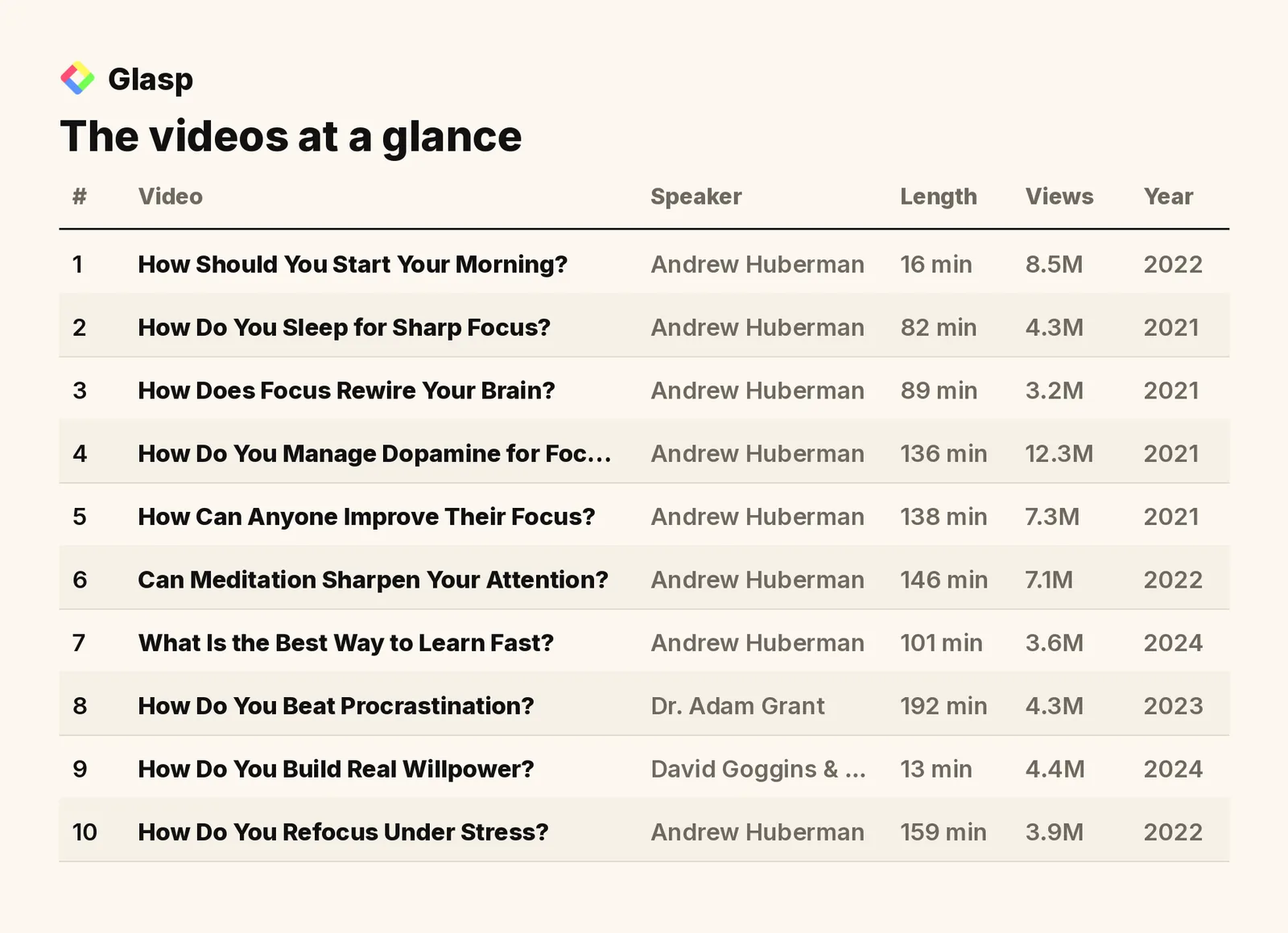
1. How Should You Start Your Morning?

Andrew Huberman · 16 min · 8.5M views · 2022
In short: Expose yourself to natural light within an hour of waking, delay caffeine, and add exercise to align your circadian rhythm and boost alertness.
This short talk lays the foundation: what to do in the first hour after waking. It answers how morning light, timed caffeine, and early movement set your alertness for the entire day. Start here before layering on anything more advanced.
Key takeaways
Consistent, good-quality sleep underlies performance and health, making it the base condition for a productive and focused morning routine.
Natural light within an hour of waking aligns the circadian rhythm and improves alertness, focus, and mood through the day.
Sunlight on the skin triggers dopamine release, which raises motivation and overall wellbeing during the waking hours.
Delaying caffeine after waking and exercising early can improve alertness and help prevent afternoon energy crashes.
Watch on YouTube · Read the summary and Q&A
2. How Do You Sleep for Sharp Focus?

Andrew Huberman · 82 min · 4.3M views · 2021
In short: Prioritize early morning sunlight and avoid bright light at night to set your circadian rhythm and stay alert during waking hours.
Focus during the day is built the night before. This episode explains how to time light exposure so your circadian rhythm supports deep sleep and daytime alertness. It answers why so many productivity problems trace back to sleep.
Key takeaways
Early morning sunlight exposure is the main lever for setting a healthy circadian rhythm and a reliable sleep-wake cycle.
Late-night light exposure disrupts sleep by inhibiting the release of sleep-inducing hormones and delaying the sleep-wake cycle.
Lower, dimmer lights in the evening are preferable because lighting location and intensity influence the circadian rhythm.
Evening light exposure delays the sleep-wake cycle, which makes waking early the next morning noticeably harder.
Watch on YouTube · Read the summary and Q&A
3. How Does Focus Rewire Your Brain?

Andrew Huberman · 89 min · 3.2M views · 2021
In short: Adults change their brain circuits through focused attention and alertness followed by deep rest, using neurochemicals like epinephrine and acetylcholine.
Once your foundations are set, this is the mechanism episode. It answers what actually has to happen in an adult brain for focus to create lasting change. Attention plus rest, driven by specific neurochemicals, is the core lesson.
Key takeaways
Neuroplasticity, the brain's ability to change with experience, is most prominent in early development and slows into adulthood.
For adults, focused attention and alertness are required to trigger neuroplasticity and learn new skills rather than passive exposure.
Epinephrine drives alertness and acetylcholine drives attention, and both neurochemicals facilitate brain change during focused learning.
Deep sleep and non-sleep deep rest consolidate learning and promote the neuroplasticity that focused attention initiates.
Watch on YouTube · Read the summary and Q&A
4. How Do You Manage Dopamine for Focus?

Andrew Huberman · 136 min · 12.3M views · 2021
In short: Understand dopamine's motivation and movement pathways and manage the balance between baseline and peaks to sustain long-term motivation and focus.
Motivation is chemistry, and this episode is the definitive Huberman explainer on dopamine. It answers how to manage your baseline and peaks so motivation lasts beyond the first burst. Essential for anyone chasing long projects.
Key takeaways
Dopamine drives motivation, desire, and pleasure, playing a central role in the pursuit of rewards and goals.
There are two main dopamine pathways, one governing movement and one governing motivation and craving.
Dopamine dynamics involve a balance between baseline levels and peaks, with drops below baseline driving the desire for more.
Various substances and activities raise dopamine levels, but the size of the increase depends on individual factors.
Watch on YouTube · Read the summary and Q&A
5. How Can Anyone Improve Their Focus?
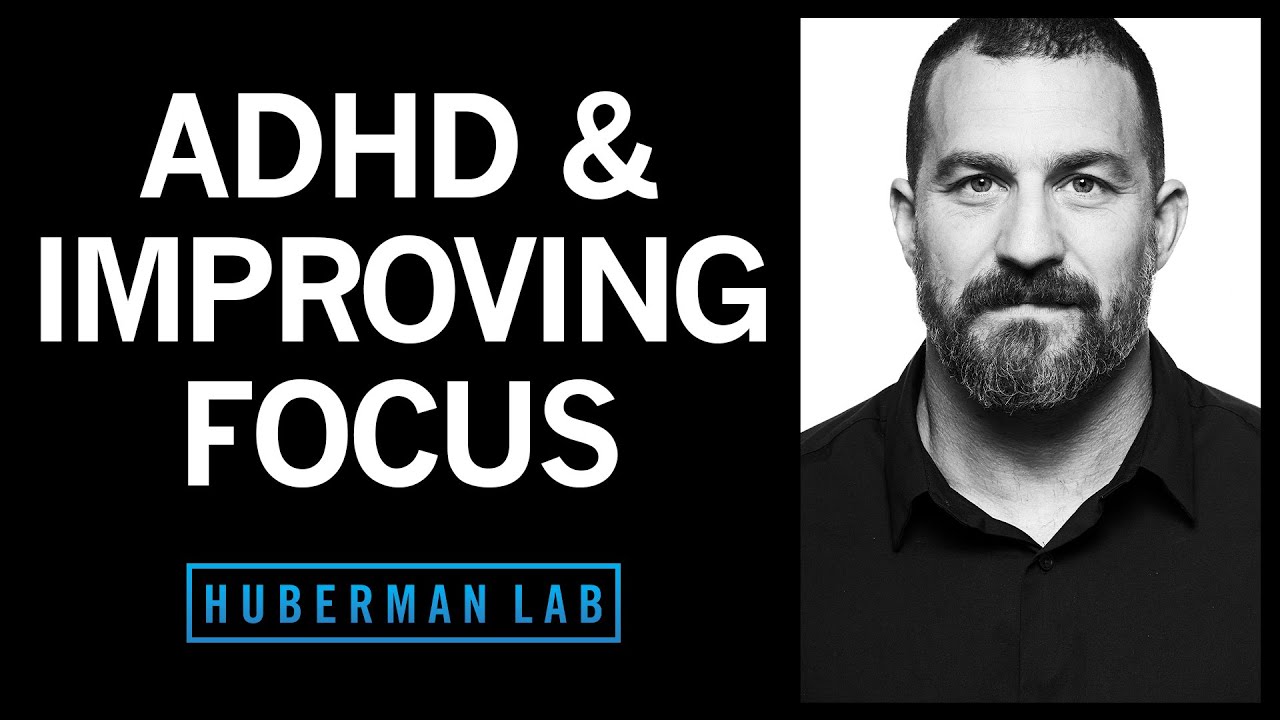
Andrew Huberman · 138 min · 7.3M views · 2021
In short: Raise dopamine through behavior, diet, or stimulant medication and reduce distractions, so attention and impulse control improve for almost anyone.
Whether or not you have ADHD, attention can be trained. This episode answers how dopamine, behavior, diet, and, when appropriate, medication shape focus. It is the most direct treatment of the attention problem itself.
Key takeaways
ADHD is characterized by challenges with attention, focus, impulse control, and the perception of passing time.
Dopamine regulates attention and focus, and low dopamine levels can impair both functions in many people.
Medications like Ritalin and Adderall increase dopamine levels to improve focus in individuals diagnosed with ADHD.
Early treatment of ADHD in childhood can help children develop and maintain good attentional abilities over time.
Watch on YouTube · Read the summary and Q&A
6. Can Meditation Sharpen Your Attention?

Andrew Huberman · 146 min · 7.1M views · 2022
In short: Meditation activates the prefrontal cortex and insula and shifts attention inward, which improves focus, sleep, and symptoms of depression.
Meditation is often recommended but rarely explained mechanistically. This episode answers whether and how meditation sharpens attention, and which styles produce which effects. A practical addition once your basics are in place.
Key takeaways
Meditation activates the prefrontal cortex, anterior cingulate cortex, and insula, areas that interpret bodily sensations and emotions.
Closing the eyes during meditation shifts perception from external stimuli to internal sensations, promoting interoceptive awareness.
Different meditation types produce specific effects, including sharper focus, reduced depression symptoms, improved sleep, and better performance.
Meditation can produce measurable changes in the brain and body over time through consistent, repeated practice.
Watch on YouTube · Read the summary and Q&A
7. What Is the Best Way to Learn Fast?
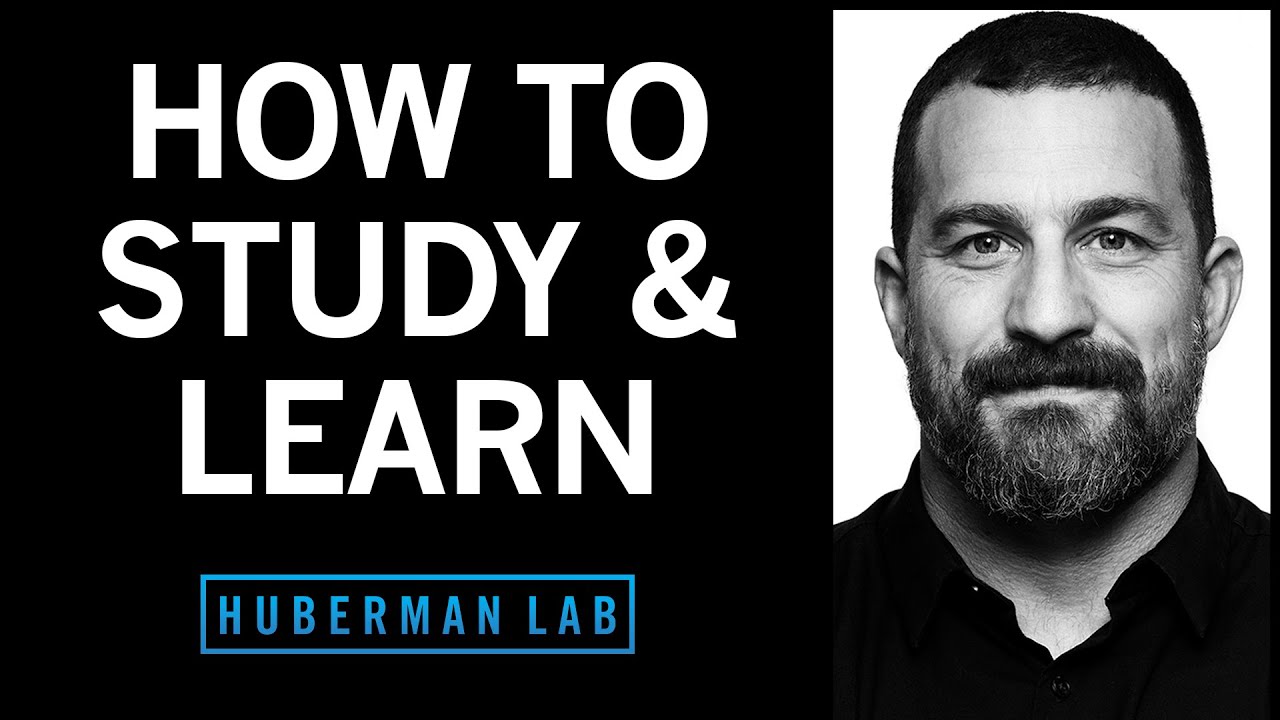
Andrew Huberman · 101 min · 3.6M views · 2024
In short: Test yourself soon after learning, study alone without distraction, and sleep well, because self-testing can cut forgetting by half.
For founders constantly learning new domains, this is the study-skills episode. It answers what actually moves information into long-term memory, with self-testing as the headline tool. Direct, protocol-driven, and immediately usable.
Key takeaways
Testing yourself immediately after learning new material can reduce forgetting by fifty percent, making it a powerful learning tool.
The most successful students schedule regular, distraction-free study sessions and often study alone to sharpen their focus.
Sleep supports neuroplasticity, and REM sleep plays a key role in consolidating new information into long-term memory.
Gap effects, short breaks during study, enhance memory by letting the hippocampus replay the learned information.
Watch on YouTube · Read the summary and Q&A
8. How Do You Beat Procrastination?
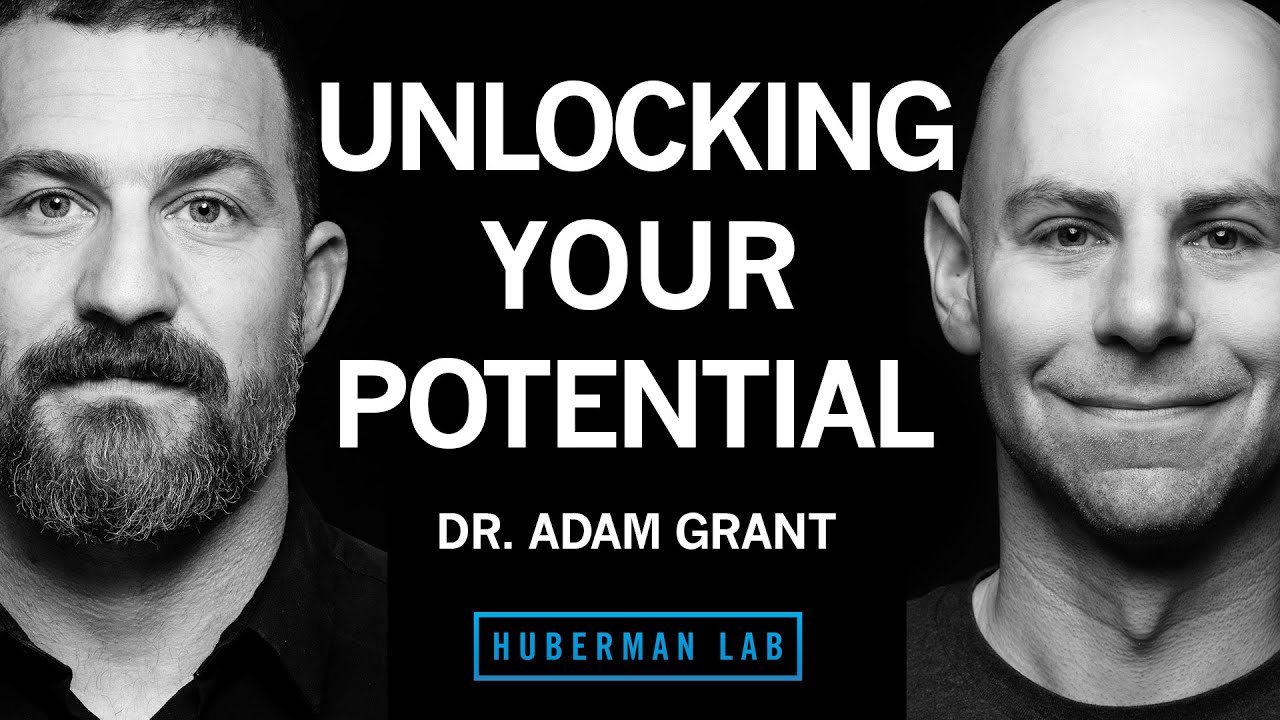
Dr. Adam Grant · 192 min · 4.3M views · 2023
In short: Recognize procrastination as avoiding negative emotions, then use curiosity and purpose to build the intrinsic motivation that sustains focus.
Adam Grant reframes procrastination as an emotional problem, not a character flaw. This episode answers how to rebuild intrinsic motivation through curiosity and purpose. Useful when discipline alone has stopped working.
Key takeaways
Procrastination often results from avoiding negative emotions like fear or boredom rather than from simple laziness alone.
Moderate procrastination can enhance creativity by allowing new ideas to incubate and percolate in the mind.
Intrinsic motivation, fueled by curiosity and a sense of purpose, improves performance, focus, and persistence over time.
Extrinsic rewards work best as symbols of appreciation rather than tools of control, preserving autonomy and choice.
Watch on YouTube · Read the summary and Q&A
9. How Do You Build Real Willpower?

David Goggins & Andrew Huberman · 13 min · 4.4M views · 2024
In short: Repeatedly doing hard things you dislike grows the anterior midcingulate cortex, the brain region that acts as the seat of willpower.
Goggins and Huberman locate willpower in a specific brain region that grows through discomfort. This clip answers where willpower comes from and how to build more of it. Short, concrete, and motivating without hype.
Key takeaways
The anterior midcingulate cortex grows when people do things they do not want to do.
Obese individuals have a smaller anterior midcingulate cortex, but it grows when they adopt healthier behaviors.
Athletes, people who overcome challenges, and those who live long tend to have a larger anterior midcingulate cortex.
Building willpower involves consistently doing difficult, unenjoyable tasks, since the region is not influenced by activities you enjoy.
Watch on YouTube · Read the summary and Q&A
10. How Do You Refocus Under Stress?
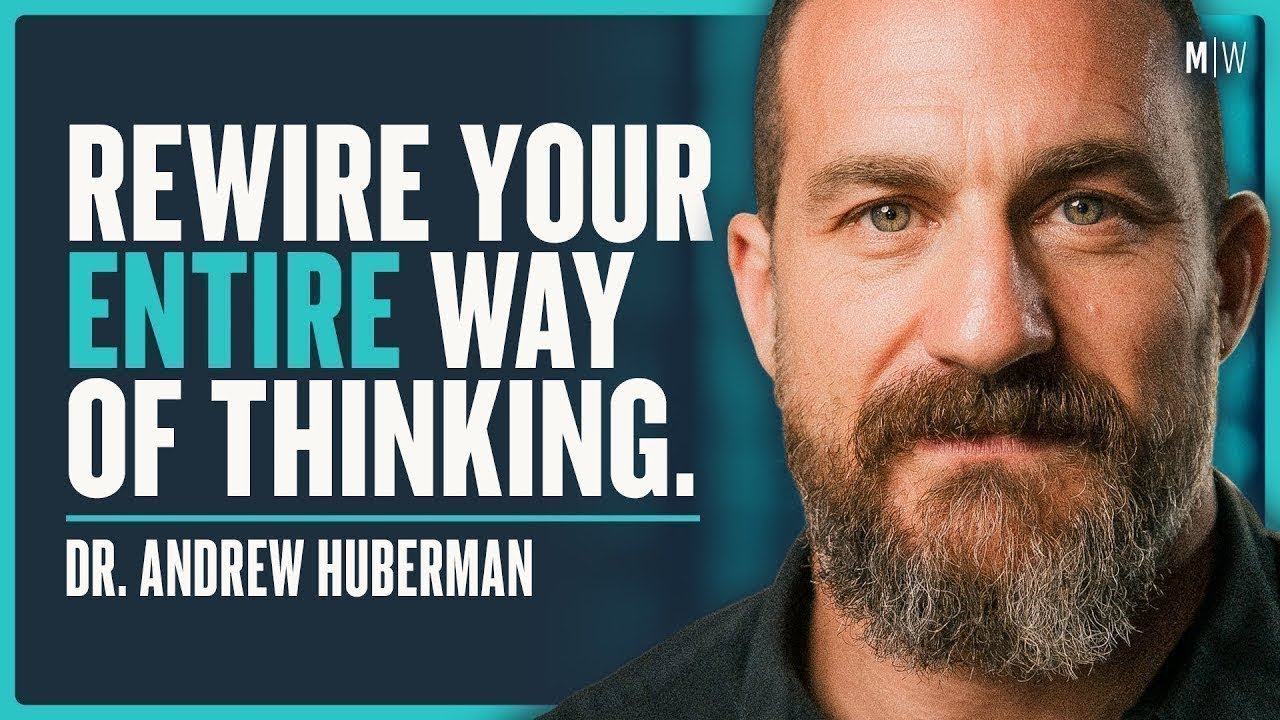
Andrew Huberman · 159 min · 3.9M views · 2022
In short: Shift your autonomic nervous system with breathing and physical activity, because the mind cannot talk itself out of extreme states.
When stress hijacks focus, thinking harder does not help. This episode answers how to use the body, through breathing and movement, to shift your mental state. The closing lesson: manage your physiology to regain your attention.
Key takeaways
The autonomic nervous system regulates mental states, and thoughts alone cannot easily override extreme arousal or relaxation.
Stress fixates thoughts and makes them hard to change, so talking yourself out of anxiety rarely works.
Shifting your autonomic state through breathing or physical activity can change your thoughts, actions, and perception of time.
Grief from breakups and loss share similar neural processes, and fully feeling sadness helps the healing process.
Watch on YouTube · Read the summary and Q&A
Frequently asked questions
Which Andrew Huberman episode is best for focus?
Start with How to Focus to Change Your Brain, which explains the attention and rest cycle adults need to rewire their brains, then add the dopamine episode for motivation.
Does Huberman have an episode on ADHD and focus?
Yes. ADHD & How Anyone Can Improve Their Focus covers how dopamine, behavior, diet, and stimulant medication shape attention and impulse control.
What is Andrew Huberman's morning routine for productivity?
Get natural light within an hour of waking, delay caffeine, and add early exercise to align your circadian rhythm and boost alertness.
How does Huberman say to build willpower?
Consistently do difficult things you do not want to do, which grows the anterior midcingulate cortex, described as the seat of willpower.
How long would it take to watch these Huberman focus episodes?
The full set runs about eighteen hours, though several picks are short clips of ten to thirty minutes you can watch in one sitting.
Who is this Andrew Huberman video list for?
This collection is for anyone who wants to improve focus and productivity, covering morning routines, sleep, dopamine management, learning speed, procrastination, willpower, and refocusing under stress.
Where should I start with Huberman's focus episodes?
Start with the morning routine and sleep episodes, since how you begin your day and how well you sleep set the foundation for sharp focus before any other technique matters.
Do I need a science background to follow Huberman's focus advice?
No background is needed. The episodes cover practical topics like starting your morning, sleeping for sharp focus, managing dopamine, and beating procrastination, all framed around what anyone can do to improve their focus.
Is focus something you are born with or can you train it?
Focus can be trained rather than fixed at birth: attention rewires the brain, meditation can sharpen attention, and there are specific approaches for building willpower and refocusing under stress.
How to use this list
Watch these in order to build focus from the ground up: fix your mornings and sleep first, then learn how attention rewires the brain, then layer on dopamine, learning, and willpower. If you are short on time, start with How to Focus to Change Your Brain, since it explains the core mechanism every other episode builds on, then jump to the dopamine episode for motivation. Treat the short clips as fast wins you can apply the same day.
Related lists
💡 Want summaries and transcripts for any YouTube video? Try YouTube Summary with ChatGPT & Claude.