What Are the Best Strategies for Effective Learning?
TL;DR
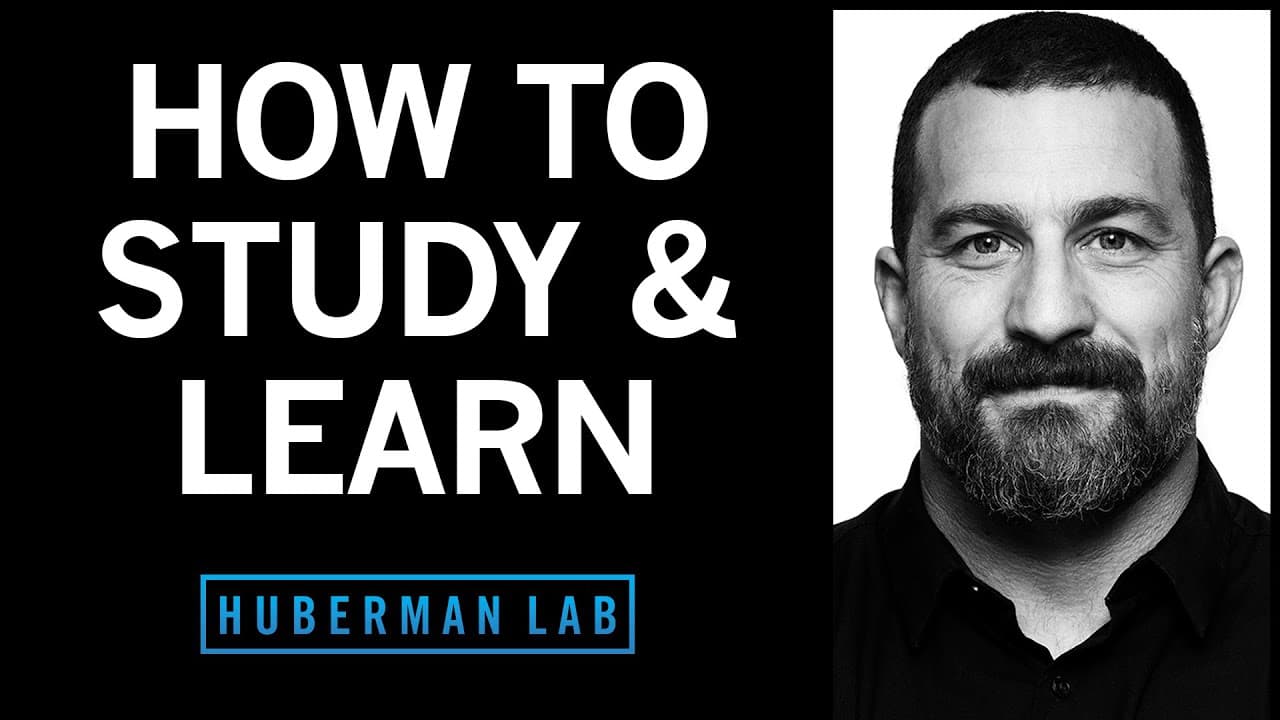
Testing yourself shortly after learning information can dramatically boost memory retention and reduce forgetting. Establishing a consistent study routine, minimizing distractions, and prioritizing sleep, especially REM sleep, are essential strategies for optimal learning and memory consolidation.
Transcript
welcome to the huberman Lab podcast where we discuss science and science-based tools for everyday life I'm Andrew huberman and I'm a professor of neurobiology and Opthalmology at Stanford school of medicine today we are discussing how to study and learn that is what the scientific data say is the best way to study in order to rememb... Read More
Key Insights
- Testing oneself immediately after learning new material can reduce forgetting by 50%, making it a powerful learning tool.
- The most successful students schedule regular, distraction-free study sessions and often study alone to enhance focus.
- Emotionally charged learning experiences, whether positive or negative, enhance memory retention due to increased neuromodulator activity.
- Sleep is crucial for neuroplasticity, with REM sleep playing a key role in consolidating new information into long-term memory.
- Mindfulness meditation can improve focus and attention, aiding in better learning and retention of new information.
- Interleaving unrelated information during study sessions can enhance learning by providing cognitive breaks and increasing engagement.
- Gap effects, or taking short breaks during study sessions, can enhance memory by allowing the hippocampus to replay information.
- Testing is not just for evaluation but is a critical tool for learning, helping to identify knowledge gaps and reinforce memory.
Install to Summarize YouTube Videos and Get Transcripts
Explore YouTube Video Summarizer or Get YouTube Transcript Extractor
Questions & Answers
Q: What is the best way to offset forgetting after learning new material?
The best way to offset forgetting after learning new material is to test yourself on the material soon after being exposed to it. This practice has been shown to reduce forgetting by about 50%, making it a highly effective tool for consolidating information into long-term memory.
Q: Why is sleep important for learning and memory?
Sleep is crucial for learning and memory because it is during sleep, particularly REM sleep, that the brain undergoes neuroplastic changes. These changes involve the strengthening and weakening of neural connections, which are essential for consolidating new information into long-term memory. A good night's sleep after learning can significantly enhance retention.
Q: How does mindfulness meditation aid in learning?
Mindfulness meditation aids in learning by improving focus and attention. Regular practice of mindfulness meditation, even for just 10 minutes a day, has been shown to enhance one's ability to concentrate, which is critical for effective learning and memory retention. It helps in reducing distractions and increasing engagement with the study material.
Q: What is the role of emotion in learning and memory?
Emotion plays a significant role in learning and memory because emotionally charged experiences are more likely to be remembered. This is due to the increased release of neuromodulators like epinephrine during emotional events, which enhances the encoding of these experiences into long-term memory. Both positive and negative emotions can enhance memory retention.
Q: What are gap effects and how do they enhance learning?
Gap effects refer to the practice of taking short breaks during study sessions. These breaks allow the hippocampus to replay the information at a faster rate, similar to what occurs during REM sleep, thereby enhancing memory consolidation. Gap effects help in reinforcing the learning process by providing the brain with additional repetitions of the material.
Q: How can interleaving information improve study sessions?
Interleaving information involves mixing different topics or subjects during study sessions. This practice can improve learning by providing cognitive breaks and increasing engagement with the material. It prevents monotony and enhances problem-solving skills by requiring the brain to constantly adjust and apply different strategies to different types of information.
Q: What study habits are common among the most successful students?
The most successful students often schedule regular, distraction-free study sessions, study alone to enhance focus, and engage in self-testing to reinforce learning. They also set long-term aspirational goals and use tools like mindfulness meditation to improve concentration. These habits help in maximizing their learning efficiency and retention of information.
Q: Why is testing considered a better learning tool than repeated exposure to material?
Testing is considered a better learning tool than repeated exposure because it actively engages the brain in recalling and applying information, which strengthens neural connections. Self-testing soon after learning material has been shown to significantly improve memory retention and understanding, as it helps identify knowledge gaps and reinforces learning more effectively than passive review.
Summary & Key Takeaways
-
The episode emphasizes the importance of testing as a learning tool, highlighting that testing oneself soon after learning material can significantly enhance memory retention by reducing forgetting. Testing helps in identifying knowledge gaps and reinforces the learning process.
-
Successful study habits include scheduling regular, distraction-free study sessions, often studying alone, and engaging in mindfulness meditation to improve focus. Sleep, especially REM sleep, is vital for consolidating new information into long-term memory.
-
Emotionally charged learning experiences enhance memory retention due to increased neuromodulator activity. Interleaving unrelated information during study sessions and utilizing gap effects can further enhance learning by providing cognitive breaks and increasing engagement.
Read in Other Languages (beta)
Share This Summary 📚
Summarize YouTube Videos and Get Video Transcripts with 1-Click
Try YouTube Summary with ChatGPT & Claude or YouTube Transcript Generator
Explore More Summaries from Andrew Huberman 📚

Summarize YouTube Videos and Get Video Transcripts with 1-Click
Try YouTube Summary with ChatGPT & Claude or YouTube Transcript Generator