10 Best YouTube Videos About Space and the Universe

Sep 15, 2026
16 min read
18 views
Last updated: September 2026
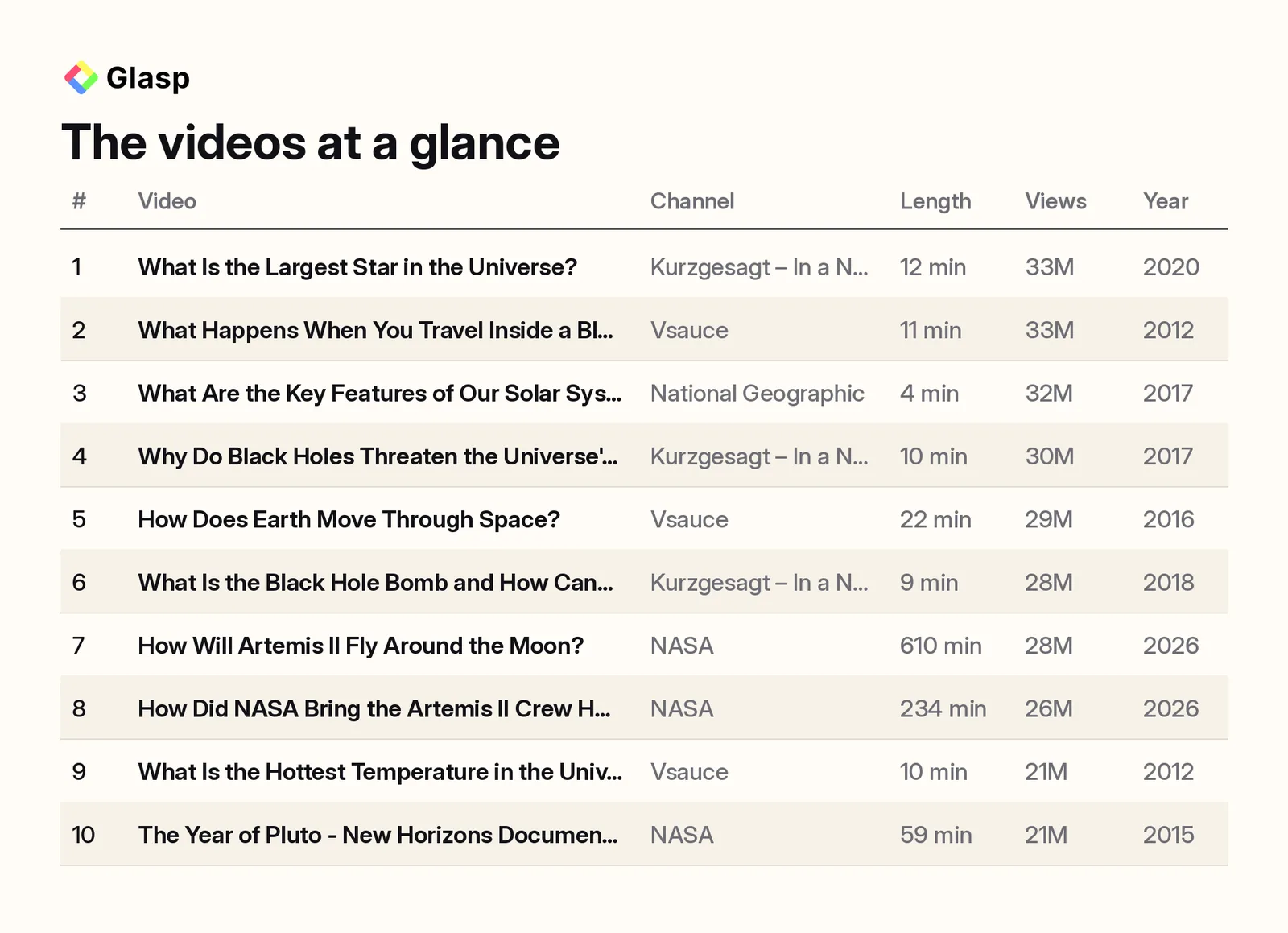
This is a ten-video sequence about space and the universe, ordered as a path rather than a ranking. It is for viewers who want to move from familiar cosmic landmarks and scale into black-hole physics, spacecraft operations, and exploration.
The full set runs a little over sixteen hours. Among its most enduring videos are Kurzgesagt on the largest known star, Vsauce on traveling inside a black hole, and NASA on the New Horizons journey to Pluto.
The videos on this list, in the order to watch them, are:
What Is the Largest Star in the Universe? (Kurzgesagt – In a Nutshell)
What Are the Key Features of Our Solar System? (National Geographic)
Why Do Black Holes Threaten the Universe's Information? (Kurzgesagt – In a Nutshell)
How Does Earth Move Through Space? (Vsauce)
What Is the Black Hole Bomb and How Can It Be Used? (Kurzgesagt – In a Nutshell)
The Year of Pluto - New Horizons Documentary Brings Humanity Closer to the Edge of the Solar System (NASA)
Total: 10 videos, 981 minutes of watch time (16 hours 21 minutes), and 281.4M combined views.
1. What Is the Largest Star in the Universe?

"The Largest Star in the Universe – Size Comparison" · Kurzgesagt – In a Nutshell · 12 min · 33M views · 2020
In short: Stephenson 2-18 is the largest known star, with an estimated radius 2,150 times the Sun's and nearly half a million times its power.
Start here because a tour of the universe needs a working sense of scale. Kurzgesagt moves from gas giants and sub-brown dwarfs, which have some star-like properties without being true stars, into main-sequence stars, giants, and hypergiants. The video explains that stars occupy different stages with different properties and lifespans, then ends with a named extreme that makes the rest of the sequence easier to picture.
The comparison separates size from mass. Red dwarfs are the most abundant stars, while rare blue and yellow hypergiants include Pistol Star and Rho Cassiopeiae. R136a1 is the most massive known star at 315 solar masses, yet it is about 30 times the Sun's size. Stephenson 2-18 reaches an estimated 2,150 solar radii and shines with almost half a million times the Sun's power.
Key takeaways
Gas giants and sub-brown dwarfs have star-like properties but are not true stars.
Main-sequence stars such as the Sun are powered by hydrogen fusion in their cores.
Red dwarfs are the most abundant stars, while blue and yellow hypergiants are extremely rare.
Stephenson 2-18 is the largest known star, at an estimated 2,150 solar radii.
Watch on YouTube · Read the summary and Q&A
2. What Happens When You Travel Inside a Black Hole?
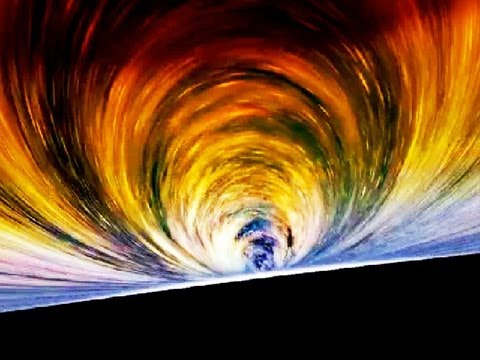
"Travel INSIDE a Black Hole" · Vsauce · 11 min · 33M views · 2012
In short: Crossing a black hole's event horizon leads toward spaghettification and a singularity where current physics cannot explain what happens to matter.
After establishing cosmic scale, the sequence moves into the effects of extreme gravity. Vsauce begins with the idea that anything could become a black hole if compressed into a sufficiently small space. It then follows an imagined trip toward one, using gravitational lensing, the event horizon, and the changing view seen by an outside observer to explain why entering a black hole is a one-way journey.
As the traveler approaches, the black hole's gravitational field bends light and increasingly distorts the sky. At the event horizon, light can no longer escape, so an outside observer would see the traveler appear frozen in time. Farther in, differences in gravitational pull stretch the body toward the singularity through spaghettification. A spinning black hole might theoretically create a wormhole, but the idea remains unproven.
Key takeaways
Anything can become a black hole if its mass is compressed into a small enough space.
Strong black-hole gravity bends light and produces gravitational lensing.
The event horizon is the point of no return because light cannot escape it.
Increasing gravitational forces stretch a falling body through spaghettification before it reaches the singularity.
Watch on YouTube · Read the summary and Q&A
3. What Are the Key Features of Our Solar System?
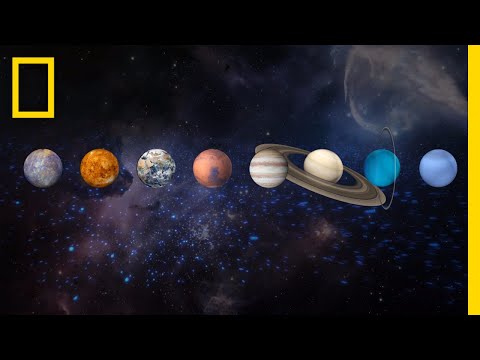
"Solar System 101 | National Geographic" · National Geographic · 4 min · 32M views · 2017
In short: Our 4.5-billion-year-old solar system contains eight terrestrial and Jovian planets, along with moons, rings, asteroids, and icy debris beyond them.
The third video returns from a black hole to our own cosmic neighborhood and supplies the basic map needed for the later mission stories. National Geographic explains how the solar system formed and divides its eight planets into terrestrial and Jovian groups. In four minutes, it connects the Sun and planets to the moons, ring systems, asteroid belt, Kuiper Belt, and Oort Cloud that make the system more than a row of planets.
The solar system formed about 4.5 billion years ago when interstellar gas and dust collapsed into a swirling solar nebula. Mercury, Venus, Earth, and Mars are rocky terrestrial planets with solid surfaces, while Jupiter, Saturn, Uranus, and Neptune belong to the much larger Jovian group of gas and ice giants. Beyond the planets, the Kuiper Belt contains space debris, comets, and dwarf planets such as Pluto.
Key takeaways
A collapsing solar nebula formed the solar system about 4.5 billion years ago.
Mercury, Venus, Earth, and Mars are the four rocky terrestrial planets.
Jupiter, Saturn, Uranus, and Neptune are the four Jovian gas and ice giants.
The Kuiper Belt and Oort Cloud contain dwarf planets and icy debris beyond the planets.
Watch on YouTube · Read the summary and Q&A
4. Why Do Black Holes Threaten the Universe's Information?

"Why Black Holes Could Delete The Universe – The Information Paradox" · Kurzgesagt – In a Nutshell · 10 min · 30M views · 2017
In short: Black-hole evaporation appears to destroy information, while the holographic principle suggests that the information may instead remain encoded on the event horizon.
With the solar system mapped, the sequence returns to black holes at a deeper level. The earlier Vsauce video asks what happens to a falling person; Kurzgesagt asks what happens to the information that made that person and every other object distinct. The possible loss of that information during black-hole evaporation creates a paradox that challenges fundamental laws of physics and our understanding of reality.
Black holes form when extraordinary amounts of matter are concentrated in very little space, creating gravity strong enough to trap light. Hawking radiation implies that a black hole slowly evaporates, raising the problem of whether its stored information disappears. The holographic principle offers another possibility: information may be encoded on the two-dimensional event horizon, making a black hole more like an ultimate hard drive than an eraser.
Key takeaways
Information encoded in particle arrangements gives objects their uniqueness and supports the universe's variety.
Hawking radiation indicates that black holes slowly evaporate, creating the possibility of information loss.
Destroying information would conflict with fundamental physical laws and force major changes in current theories.
The holographic principle proposes that black holes store information on their surfaces.
Watch on YouTube · Read the summary and Q&A
5. How Does Earth Move Through Space?

"How Earth Moves" · Vsauce · 22 min · 29M views · 2016
In short: Earth's rotation and tilted orbit shape day, night, seasons, shadows, and the timekeeping systems used to coordinate life across its surface.
The fifth video brings cosmic motion down to observations made from Earth. After the solar-system overview and abstract black-hole paradox, Vsauce shows how movement can be read in sunrise, sunset, the Sun's changing position, and shadows. It argues that a day is not merely a number on a clock: it comes from Earth's counterclockwise spin, while the seasons follow Earth along its tilted path around the Sun.
The subsolar point is the location directly beneath the Sun, and when it crosses an area, shadows fall straight down. During Lahaina noon, they can disappear. Local apparent solar time therefore varies with place, which is why time zones were created to keep neighboring regions consistent. Calendar design handles another mismatch: the Julian calendar added a leap day every four years, while the Gregorian calendar removed some leap years for greater accuracy.
Key takeaways
Earth's counterclockwise rotation makes the Sun appear to rise and set, producing day and night.
Earth's tilted revolution around the Sun causes seasons and changes the Sun's position in the sky.
The subsolar point shows Earth's motion through the direction and length of shadows.
Time zones standardize time across regions where local apparent solar time would differ.
Watch on YouTube · Read the summary and Q&A
6. What Is the Black Hole Bomb and How Can It Be Used?

"The Black Hole Bomb and Black Hole Civilizations" · Kurzgesagt – In a Nutshell · 9 min · 28M views · 2018
In short: The Penrose process could take rotational energy from a spinning black hole, while surrounding it with mirrors could amplify waves into an energy source or bomb.
This video follows the information paradox with a second question about what black holes might preserve and release. Kurzgesagt turns from passive observation to a theoretical use: extracting rotational energy from a spinning black hole. The explanation begins with massive stars collapsing and spinning faster as they shrink, then introduces the ringularity and ergosphere that make the Penrose process and the black hole bomb possible.
The Penrose process trades mass-energy placed in the ergosphere for some of the black hole's rotational energy. In the bomb concept, mirrors completely surround the black hole while electromagnetic waves undergo super-radiant scattering and gain energy. The result could be a massive explosion, or the process could be controlled as an energy supply for trillions of years, when black holes may be the only energy sources left in a dying universe.
Key takeaways
Collapsed massive stars spin faster as they shrink because angular momentum is conserved.
A spinning black hole has a ringularity and an ergosphere that distort space-time around it.
The Penrose process extracts rotational energy by trading mass-energy inside the ergosphere.
Mirrors could amplify electromagnetic waves into either a vast explosion or a long-lasting energy source.
Watch on YouTube · Read the summary and Q&A
7. How Will Artemis II Fly Around the Moon?

"NASA’s Artemis II Crew Flies Around the Moon (Official Broadcast)" · NASA · 610 min · 28M views · 2026
In short: Artemis II tests Orion with four astronauts aboard and uses a lunar flyby to place the spacecraft on a free-return path toward Earth.
The seventh video changes the scale of the list from theoretical physics to a crewed mission in operation. NASA follows the first people aboard the Space Launch System rocket as they test Orion, manually fly during a proximity demonstration, and commit to the Moon. Its place here shows how the ideas introduced earlier become navigation, observation, daily routines, and timed decisions during a human journey through space.
Commander Reid Wiseman, pilot Victor Glover, and mission specialists Christina Koch and Jeremy Hansen completed a five-minute, 52-second translunar injection burn before the flyby. The observation plan gives rotating pairs about six hours across five timed blocks, using a glare-reducing shroud and an 80–400mm lens. Orion passes roughly 4,000 miles above the Moon and uses lunar gravity to continue toward Earth on a free-return trajectory.
Key takeaways
Artemis II is the first mission to place humans aboard the Space Launch System rocket and Orion spacecraft.
A five-minute, 52-second translunar injection burn committed Orion to the lunar journey.
The free-return trajectory uses the lunar flyby to send Orion toward Earth without another major maneuver.
The crew's six hours of lunar observation include photography, annotations, audio notes, and reports to Mission Control.
Watch on YouTube · Read the summary and Q&A
8. How Did NASA Bring the Artemis II Crew Home?

"NASA’s Artemis II Crew Comes Home (Official Broadcast)" · NASA · 234 min · 26M views · 2026
In short: Orion returned the Artemis II crew through controlled reentry, roll maneuvers, staged parachutes, and a Pacific splashdown supported by more than 550 recovery personnel.
This section immediately follows the lunar flyby because departure is only half of a crewed mission. NASA tracks Orion Integrity and its four astronauts through the sequence required to come home after ten days around the Moon. The broadcast turns atmospheric entry into a chain of precise actions: a trajectory correction, service-module separation, a crew-module raise burn, computer-controlled rolls, communications loss, parachute deployment, and recovery off San Diego.
An eight-second correction refined Integrity's return path, and a 19-second raise burn established an angle intended to reduce peak heat-shield heating. Entry began at 400,000 feet near Mach 32, producing about 3.9 Gs and an expected six-minute blackout as ionized plasma blocked communications. Forward-bay-cover parachutes, drogues, and three main parachutes then slowed the capsule to about 19 miles per hour for its Pacific splashdown.
Key takeaways
Artemis II was the first crewed flight test of the Space Launch System rocket and Orion spacecraft.
The four astronauts completed a ten-day journey around the Moon aboard Orion Integrity.
Ionized plasma caused an expected six-minute communications blackout during atmospheric entry.
A staged parachute system slowed the capsule from approximately Mach 32 to about 19 miles per hour.
Watch on YouTube · Read the summary and Q&A
9. What Is the Hottest Temperature in the Universe?
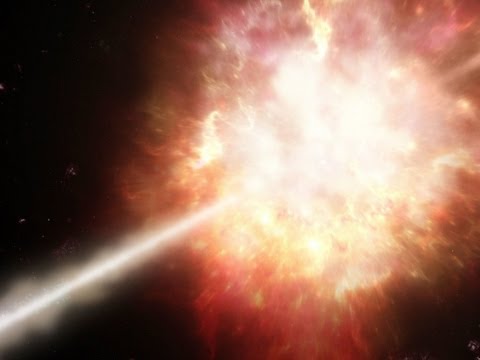
"How Hot Can It Get?" · Vsauce · 10 min · 21M views · 2012
In short: A supernova core can reach 3 billion Kelvin, while physics as currently understood breaks down beyond the far higher Planck temperature.
After Orion's heat-shield encounter, the ninth video expands heat into a scale spanning the human body, Earth, the Sun, explosions, and collapsing stars. Vsauce asks whether an absolute hot exists and explains that an object's radiation reveals information about its temperature. The progression also shows how matter changes at stellar temperatures, where it exists as plasma, before reaching a boundary where current theories can no longer describe what temperature means.
The ladder begins with body temperature fluctuating through the day and Death Valley's record air temperature of 129 degrees Fahrenheit. It rises to the Sun's 10,000-degree surface and 28-million-degree core, then to 350 million Kelvin reached momentarily in a thermonuclear explosion. A supernova core can reach 3 billion Kelvin. Above 1.41 times 10 to the 32 Kelvin, the Planck temperature, current understanding breaks down.
Key takeaways
Human body temperature fluctuates through the day and is usually highest around 7 p.m.
Death Valley's record air temperature is 129 degrees Fahrenheit.
The Sun's surface is about 10,000 degrees Fahrenheit, while its core reaches 28 million degrees Fahrenheit.
A collapsing star larger than the Sun can produce a supernova core at 3 billion Kelvin.
Watch on YouTube · Read the summary and Q&A
10. The Year of Pluto - New Horizons Documentary Brings Humanity Closer to the Edge of the Solar System
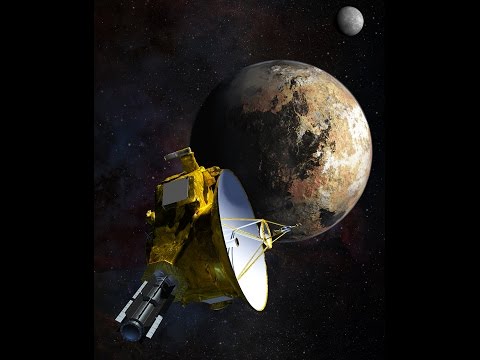
"The Year of Pluto - New Horizons Documentary Brings Humanity Closer to the Edge of the Solar System" · NASA · 59 min · 21M views · 2015
In short: New Horizons culminated decades of planning with the first spacecraft exploration of Pluto and a mission to study the distant Kuiper Belt.
Close with Pluto because the sequence ends by joining the solar-system map to the persistence required for actual exploration. NASA follows New Horizons toward the king of the Kuiper Belt, a region of icy worlds that may preserve clues to the solar system's origins. After videos about cosmic extremes and a crewed lunar flight, this documentary shows a long-running robotic mission extending direct study to the outer solar system.
Planning and preparation began as early as 1989, and New Horizons launched in 2006 before reaching Pluto in 2015. Its instruments were built to study Pluto's surface, composition, atmosphere, and moons, while its broader goal included understanding the Kuiper Belt. The mission was the first spacecraft exploration of Pluto and may lead to further study of the Kuiper Belt and other icy worlds beyond it.
Key takeaways
New Horizons grew from decades of planning, research, and engineering that began as early as 1989.
The spacecraft launched in 2006 and reached Pluto in 2015.
Its instruments study the surface, composition, and atmosphere of Pluto and its moons.
Data from the mission contributes to understanding the origins and evolution of the solar system.
Watch on YouTube · Read the summary and Q&A
Frequently asked questions
What are the best YouTube videos about space and the universe?
Three strong starting points are Kurzgesagt's What Is the Largest Star in the Universe? for stellar scale, Vsauce's What Happens When You Travel Inside a Black Hole? for extreme gravity, and NASA's The Year of Pluto documentary for real exploration. Together they move from comparing distant objects, to explaining difficult physics, to following a spacecraft into the outer solar system.
How long does it take to watch all ten videos?
The complete sequence takes 981 minutes, or 16 hours 21 minutes. The total is driven by NASA's two Artemis II broadcasts, which run 610 and 234 minutes. The shortest entry is National Geographic's four-minute Solar System 101, while the three compact Kurzgesagt videos run 12, 10, and 9 minutes.
What happens when someone falls into a black hole?
The black hole bends light more strongly as the traveler approaches. At the event horizon, light cannot escape, so an outside observer would see the person appear frozen in time. Increasing differences in gravitational pull then stretch the body through spaghettification toward the singularity, where current physics does not explain what ultimately happens to matter.
What is the black-hole information paradox?
Hawking radiation suggests that a black hole slowly evaporates, which raises the possibility that the information carried by everything it absorbed could vanish. That would challenge fundamental laws of physics. The holographic principle offers a different answer by proposing that the information remains encoded on the event horizon, as a two-dimensional representation of the three-dimensional world.
Could a black hole really provide energy?
The idea is theoretical. The Penrose process would trade mass-energy placed in a spinning black hole's ergosphere for rotational energy. Surrounding the black hole with mirrors could make electromagnetic waves undergo super-radiant scattering and gain energy. That mechanism could create a massive explosion or be controlled as a source of energy lasting trillions of years.
How did Artemis II return through Earth's atmosphere?
Orion Integrity used a trajectory correction and crew-module raise burn before entering the atmosphere at 400,000 feet near Mach 32. Computer-commanded rolls shed excess energy while heating and ionized plasma caused an expected six-minute communications blackout. A staged system of forward-bay-cover parachutes, drogues, and three main parachutes slowed the capsule to about 19 miles per hour.
Which video should I watch first?
Start with What Is the Largest Star in the Universe? because it establishes scale before the list turns to black holes, the solar system, Earth, and exploration. Its 12-minute comparison also distinguishes size from mass through Stephenson 2-18 and R136a1, giving you concrete reference points for the more abstract physics that follows.
Why do we use time zones if Earth already defines a day?
Earth's rotation creates day and night, but local apparent solar time changes with location because the Sun and shadows appear differently across the surface. Neighboring places would therefore keep slightly different times if each relied on its own sundial. Time zones standardize the clock across regions, replacing those local variations with a consistent shared time.
Are the older space videos still worth watching?
Yes. The 2012 Vsauce videos still explain black-hole lensing, the event horizon, spaghettification, solar temperatures, supernova heat, and the Planck temperature. NASA's 2015 New Horizons documentary records a mission that launched in 2006 after planning dating to 1989. Their subjects are foundational concepts and documented exploration rather than short-lived commentary.
How to use this list
Watch the videos in order to move from stellar scale into black-hole effects, the structure and movement of our solar system, deeper black-hole problems, crewed lunar operations, extreme heat, and outer-solar-system exploration. The two long Artemis II broadcasts work best as a paired mission story, with the flyby followed by reentry. If you only have twenty minutes, start with What Is the Largest Star in the Universe?, since its 12-minute scale comparison prepares you for the rest. If you want the single video that gives the quickest map of our local cosmic neighborhood, choose National Geographic's four-minute Solar System 101.
Related lists
💡 Want summaries and transcripts for any YouTube video? Try YouTube Summary with ChatGPT & Claude.