How Did NASA Bring the Artemis II Crew Home?
TL;DR
NASA brought the Artemis II crew home through a precisely controlled Orion reentry, parachute descent, and Pacific splashdown supported by Mission Control and more than 550 recovery personnel. The spacecraft entered the atmosphere near Mach 32, endured an expected six-minute communications blackout and about 3.9 Gs, then slowed to roughly 19 miles per hour for recovery off San Diego.
Transcript
AV650(CC1) NASA AV650(CC1) NASA AV650(CC1) NASA AV650(CC1) NASA AV650(CC1) NASA AV650(CC1) NASA AV650(CC1) NASA >> The Artemis two mission is a test mission of the Orion space capsule. >> Artemis two will be the first time we put humans on this rocket. >> We're going back to the moon because it's the next step in our journey to Mars. >> We were alw... Read More
Key Insights
- Artemis II is the first crewed flight test of NASA's Space Launch System rocket and Orion spacecraft, designed to test technologies needed for long-term lunar exploration and future human missions to Mars.
- The Artemis II crew consists of NASA astronauts Reid Wiseman, Victor Glover, and Christina Koch, plus Canadian Space Agency astronaut Jeremy Hansen. They traveled aboard the Orion spacecraft Integrity during a ten-day journey around the Moon.
- The final return trajectory correction was an eight-second burn that refined Integrity's path into the planned atmospheric entry corridor over the Pacific Ocean, preparing the spacecraft for splashdown off the coast of San Diego.
- The crew module raise burn is a 19-second thruster maneuver that slightly lifts Integrity's aft end. This final adjustment establishes the angle of attack intended to minimize peak heating on the spacecraft's heat shield during atmospheric entry.
- Entry interface occurs at an altitude of 400,000 feet, where Integrity first encounters measurable traces of Earth's atmosphere. The spacecraft was expected to be traveling 34,882 feet per second as atmospheric entry began.
- The communications blackout is an expected six-minute period caused by ionized plasma surrounding Integrity during high-speed atmospheric flight. This plasma prevents Mission Control from communicating with the crew or receiving spacecraft data until contact is reacquired.
- Computer-commanded roll maneuvers bleed off excess energy by turning the crew module slightly left and then right. Integrity was expected to reach 24,661.21 miles per hour, approximately Mach 33, before slowing in denser layers of the atmosphere.
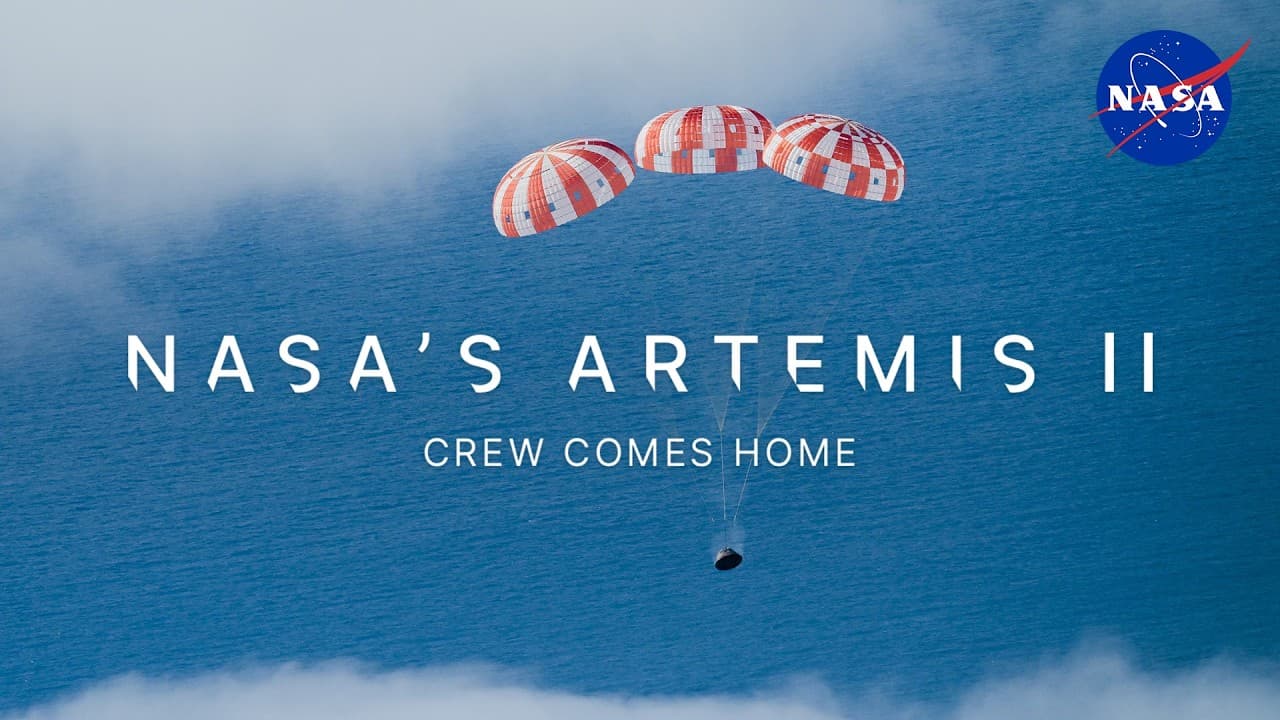
- The parachute system reduces Integrity's speed through a staged sequence involving three forward bay cover parachutes, drogue parachutes, and three main parachutes. The capsule was expected to splash down at about 19 miles per hour.
Install to Summarize YouTube Videos and Get Transcripts
Explore YouTube Video Summarizer or Get YouTube Transcript Extractor
Questions & Answers
Q: How did NASA bring the Artemis II astronauts home?
NASA guided the Orion spacecraft Integrity through a carefully sequenced return involving a trajectory correction burn, communications handover, service module separation, and a crew module raise burn. Integrity then entered Earth's atmosphere, completed computer-controlled rolls to dissipate energy, deployed drogue and main parachutes, and splashed down in the Pacific for recovery by NASA and U.S. military teams.
Q: What was the purpose of the Artemis II mission?
Artemis II was a test mission for the Orion space capsule and the first crewed flight test of NASA's Space Launch System rocket and Orion spacecraft. Its purpose was to test technologies required for long-term lunar exploration and eventual human missions to Mars while carrying four astronauts on a ten-day journey around the Moon and back to Earth.
Q: Who were the astronauts aboard Artemis II?
The Artemis II crew included four astronauts from two space agencies. NASA astronaut Reid Wiseman served as commander, NASA astronaut Victor Glover served as pilot, and NASA astronaut Christina Koch served as a mission specialist. Canadian Space Agency astronaut Jeremy Hansen also served as a mission specialist aboard the Orion spacecraft Integrity during its journey around the Moon.
Q: What happened during the Artemis II atmospheric entry?
Integrity reached entry interface at an altitude of 400,000 feet while traveling 34,882 feet per second. Atmospheric friction created intense heating and ionized plasma around the capsule, causing a planned communications blackout. Computer-commanded roll maneuvers dissipated excess energy, while the crew experienced forces expected to reach about 3.9 Gs before the parachute deployment sequence began.
Q: Why did Artemis II lose communications during reentry?
Artemis II experienced a planned communications blackout because Integrity's high velocity and friction with Earth's atmosphere produced ionized plasma around the spacecraft. That plasma blocked communications with the crew and prevented flight controllers from receiving spacecraft data. The blackout was expected to last approximately six minutes, after which communications and data would be reacquired through the satellite relay system.
Q: How did the Orion spacecraft slow down before splashdown?
Orion slowed through atmospheric drag, computer-commanded roll maneuvers, and a staged parachute sequence. The rolls turned the capsule slightly left and right to bleed off excess energy. Three parachutes removed the forward bay cover, followed by drogue parachutes and three main parachutes. Together, these systems reduced Integrity's speed from approximately Mach 32 at entry to about 19 miles per hour at splashdown.
Q: What was the Artemis II crew module raise burn?
The crew module raise burn was a final 19-second thruster maneuver performed after Integrity separated from the European Service Module. The maneuver slightly raised the aft end of the crew module, similar to tilting backward in a reclining chair. This adjusted Integrity's angle of attack for atmospheric entry and helped minimize peak heating on the spacecraft's heat shield.
Q: How was the Artemis II crew recovered after splashdown?
NASA and U.S. military recovery forces waited aboard the USS John Murtha west of San Diego, with the ship initially staged about six and a half miles from the expected splashdown point. Boats, helicopters, aircraft, cameras, and more than 550 personnel supported recovery. The ship planned to approach incrementally after debris landed safely, while helicopters retrieved the crew from the water.
Summary & Key Takeaways
-
Artemis II was the first crewed flight test of NASA's Space Launch System rocket and Orion spacecraft. Commander Reid Wiseman, pilot Victor Glover, mission specialist Christina Koch, and Canadian mission specialist Jeremy Hansen completed a ten-day journey around the Moon aboard Orion, named Integrity, before returning toward the Pacific Ocean.
-
The final return sequence included an eight-second trajectory correction burn, communications handover, separation from the European Service Module, and a 19-second crew module raise burn. Integrity then reached entry interface at 400,000 feet, where atmospheric friction produced intense heating, plasma, an expected communications blackout, and forces of about 3.9 Gs.
-
Integrity used computer-commanded roll maneuvers to dissipate excess energy before deploying its forward bay cover parachutes, drogue parachutes, and three main parachutes. The capsule slowed from approximately Mach 32 during atmospheric entry to about 19 miles per hour at splashdown, while coordinated NASA and military teams waited off San Diego to recover the astronauts.
Read in Other Languages (beta)
Share This Summary 📚
Summarize YouTube Videos and Get Video Transcripts with 1-Click
Try YouTube Summary with ChatGPT & Claude or YouTube Transcript Generator
Explore More Summaries from NASA 📚

Summarize YouTube Videos and Get Video Transcripts with 1-Click
Try YouTube Summary with ChatGPT & Claude or YouTube Transcript Generator