How Will Artemis II Fly Around the Moon?
TL;DR
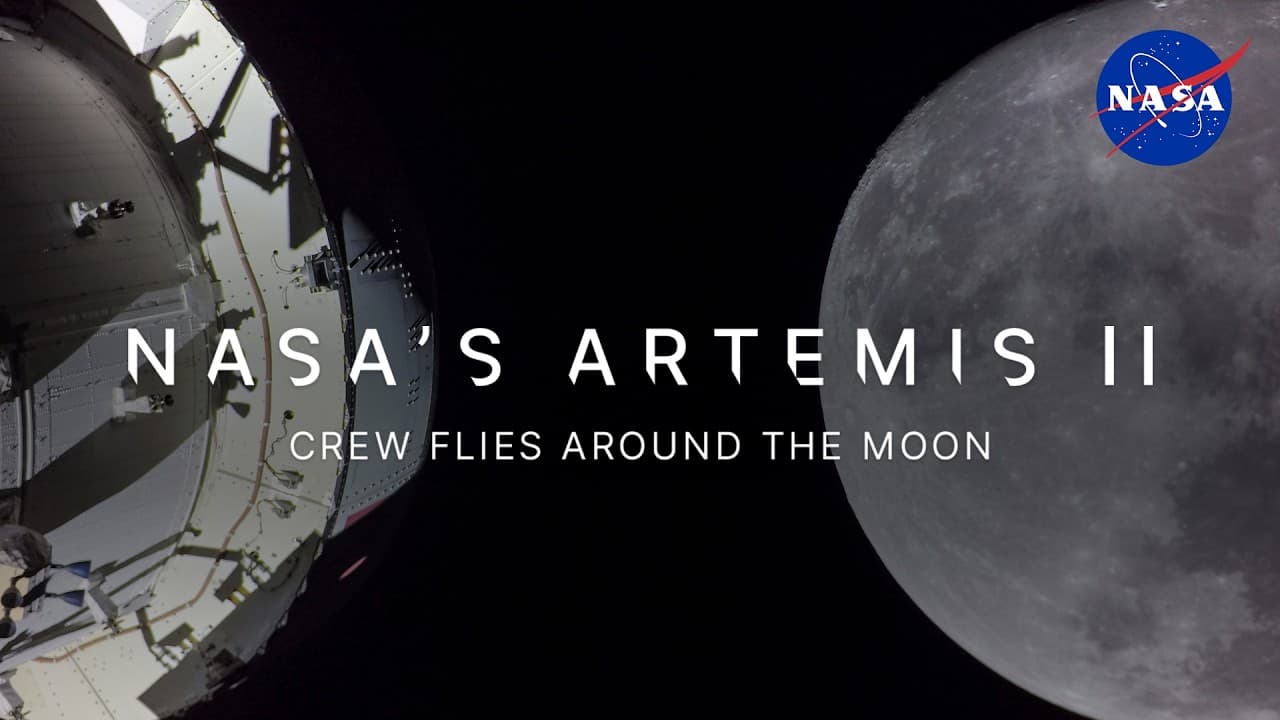
Artemis II will carry four astronauts around the Moon, test the Orion spacecraft with humans aboard, and use lunar gravity to enter a free-return path toward Earth. During the flyby, the crew will photograph lunar features, record observations, pass roughly 4,000 miles above the surface, and travel farther from Earth than the Apollo 13 astronauts did in 1970.
Transcript
The Artemis two mission is a test mission of the Orion space capsule. >> Artemis two will be the first time we put humans on this rocket. >> We're going back to the moon because it's the next step in our journey to Mars. >> We were always going to the moon. >> Pushing ourselves to explore is just core to who we are. It's a part of being a human.... Read More
Key Insights
- Artemis II is a crewed test of the Orion space capsule and the first mission to place humans aboard the Space Launch System rocket, supporting NASA’s stated progression from lunar exploration toward future journeys to Mars.
- The mission’s free-return trajectory uses a lunar flyby to send Orion back toward Earth without requiring another major maneuver, with splashdown scheduled for approximately 7:07 p.m. Central on Friday, April 10.
- The Artemis II crew is expected to surpass the farthest-distance record established by Apollo 13 astronauts in 1970, marking the first human journey around the Moon in more than 50 years.
- The translunar injection burn lasted five minutes and 52 seconds, committed Orion to leaving high Earth orbit, and also served as the spacecraft’s deorbit burn for the lunar flyby and return path.
- The proximity operations demonstration tested manual control of Orion after separation from the interim cryogenic propulsion stage, simulating maneuvers needed when future Orion crews dock with a lunar lander.
- The lunar observation plan provides about six hours divided into five timed blocks, with two astronauts working at the windows while the other two provide background support and deliver science situation reports.
- The photography procedure uses window two, a blue glare-reducing shroud, and an 80–400mm zoom lens, while a second astronaut at window three uses a portable computing device to annotate observations.
- The lunar flyby schedule includes observation beginning at 2:45 p.m. EDT, predicted communication loss at 6:41 p.m., closest approach near 7:00 p.m., and maximum distance from Earth at 7:05 p.m.
Install to Summarize YouTube Videos and Get Transcripts
Explore YouTube Video Summarizer or Get YouTube Transcript Extractor
Questions & Answers
Q: What is the main purpose of the Artemis II mission?
The main purpose of Artemis II is to test the Orion space capsule with humans aboard while sending a four-person crew around the Moon. The astronauts and Mission Control continue testing Orion’s systems and operations throughout the flight. NASA presents the mission as the next step in lunar exploration and part of a broader journey toward future human missions to Mars.
Q: How does Artemis II travel around the Moon and return to Earth?
Artemis II uses a translunar injection burn and the Moon’s gravity to follow a free-return trajectory. The five-minute, 52-second burn committed Orion to leaving high Earth orbit and set up the lunar flyby. As Orion swings around the Moon, its trajectory directs the spacecraft back toward Earth, with splashdown planned for approximately 7:07 p.m. Central on Friday, April 10.
Q: When does Artemis II break the Apollo 13 distance record?
The mission schedule states that the Artemis II crew will surpass the Apollo 13 distance record at 1:56 p.m. EDT, or 1756 UTC, on Monday, April 6. Apollo 13 astronauts established the previous record in 1970. Artemis II will therefore carry its crew farther from Earth than any humans previously traveled, according to the broadcast and mission description.
Q: How close does Artemis II get to the Moon?
Artemis II is expected to pass roughly 4,000 miles above the lunar surface at its closest point. The mission description schedules closest approach for 7:00 p.m. EDT, or 2300 UTC. Five minutes later, at 7:05 p.m. EDT, Orion is expected to reach its farthest distance from Earth while continuing around the Moon on its free-return trajectory.
Q: How will the Artemis II astronauts observe the Moon?
The astronauts have about six hours allocated for lunar observations, divided into five precisely timed blocks. Two crew members work at the windows at once. One takes photographs from window two using a blue glare-reducing shroud and an 80–400mm zoom lens. The other works at window three, using a portable computing device to annotate what the pair observes.
Q: Why are the Orion cabin lights dimmed during the lunar flyby?
The Orion crew dims the cabin lights to reduce reflections from the spacecraft’s interior on the windows. This improves conditions for viewing and photographing the lunar surface. The astronauts also use a blue shroud over one window to control glare. These preparations support the crew’s planned photography, visual observations, annotations, and audio recordings during the flyby.
Q: What happens when Orion passes behind the Moon?
Orion is predicted to lose communications with Earth at 6:41 p.m. EDT, or 2241 UTC, as it travels behind the Moon. The description estimates that this interruption will last roughly 40 minutes. During the broader flyby period, the astronauts continue their planned lunar observations, with closest approach scheduled for 7:00 p.m. EDT and maximum distance from Earth five minutes later.
Q: Who are the four astronauts flying on Artemis II?
The Artemis II crew consists of NASA astronauts Reid Wiseman, Victor Glover, and Christina Koch, plus Canadian Space Agency astronaut Jeremy Hansen. Wiseman serves as commander, Glover as pilot, and Koch and Hansen as mission specialists. Their combined responsibilities include operating and testing Orion, making lunar observations, taking photographs, recording annotations, supporting crewmates, and reporting observations to Mission Control.
Summary & Key Takeaways
-
Artemis II is the first mission to place humans aboard the Space Launch System rocket and Orion spacecraft. After launching from Kennedy Space Center, the crew tested manual flying during a proximity operations demonstration, then completed a five-minute, 52-second translunar injection burn that committed Orion to the lunar journey.
-
The four-person crew consists of commander Reid Wiseman, pilot Victor Glover, and mission specialists Christina Koch and Jeremy Hansen. Together, they are testing Orion while completing a precisely timed flight plan that includes spacecraft operations, daily living activities, photography, scientific observations, audio notes, and situation reports transmitted to Mission Control.
-
During six hours allocated for lunar observations, astronauts work in rotating pairs at Orion’s windows. One photographs the Moon through a glare-reducing shroud with an 80–400mm zoom lens, while another records annotations on a portable computing device. Orion then passes behind the Moon before continuing along its free-return trajectory toward Earth.
Read in Other Languages (beta)
Share This Summary 📚
Summarize YouTube Videos and Get Video Transcripts with 1-Click
Try YouTube Summary with ChatGPT & Claude or YouTube Transcript Generator
Explore More Summaries from NASA 📚

Summarize YouTube Videos and Get Video Transcripts with 1-Click
Try YouTube Summary with ChatGPT & Claude or YouTube Transcript Generator