10 Best Diary of a CEO Episodes on Health and Business

Aug 13, 2026
12 min read
12 views
Last updated: August 2026
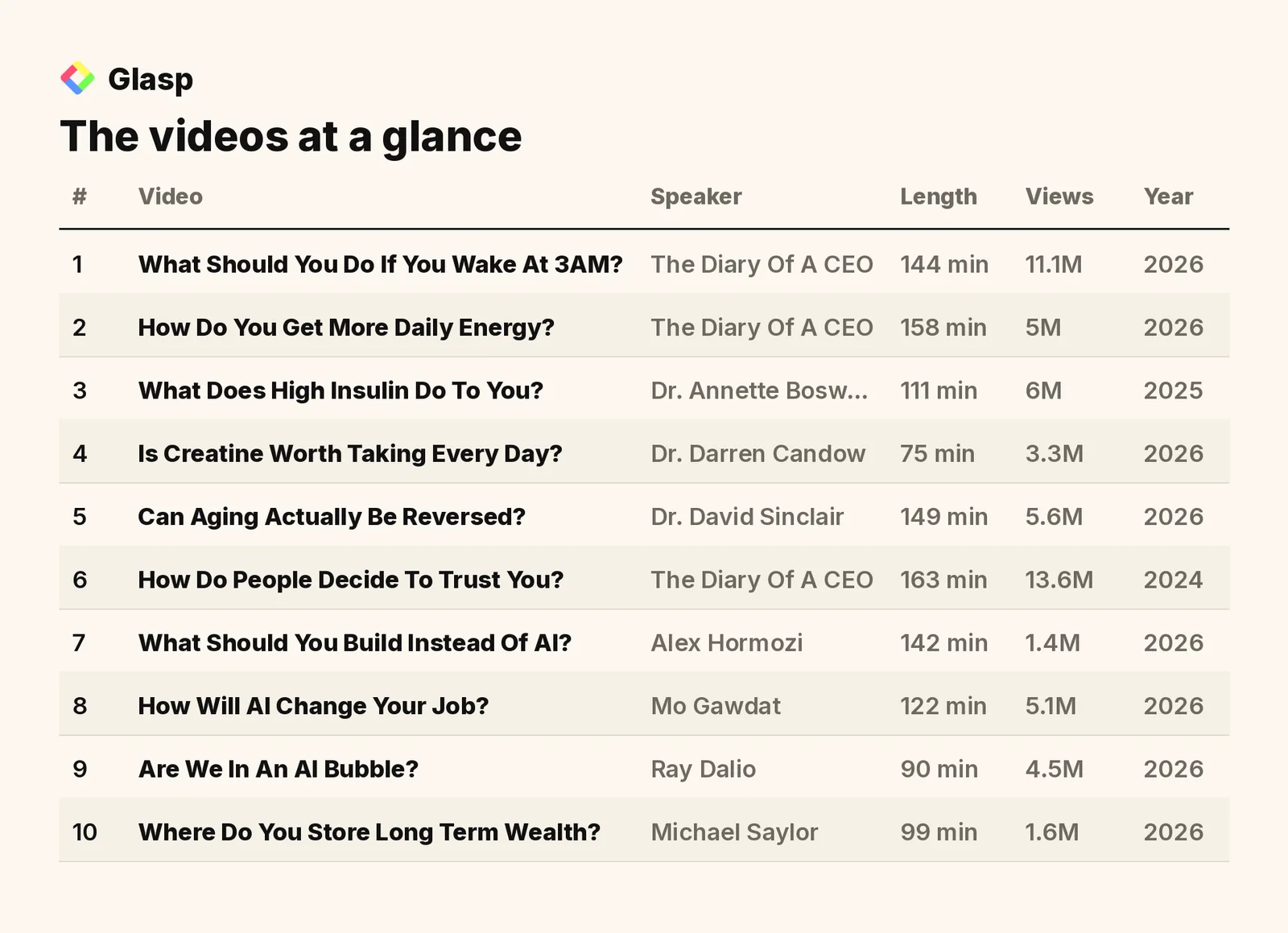
This is a curated list of ten Diary of a CEO episodes covering health, longevity, communication, and money. It is built for founders and operators who want the health inputs that keep them working and the business thinking that keeps the company alive.
Together the ten episodes run just under 21 hours. They earn a place here because each one is anchored to a specialist or an operator with a track record, from Harvard longevity researcher David Sinclair to Ray Dalio, Michael Saylor, and Alex Hormozi, and because the health half and the business half answer questions founders actually ask.
The videos on this list, in the order to watch them, are:
What Should You Do If You Wake At 3AM? (The Diary Of A CEO)
How Do You Get More Daily Energy? (The Diary Of A CEO)
What Does High Insulin Do To You? (Dr. Annette Bosworth)
Is Creatine Worth Taking Every Day? (Dr. Darren Candow)
Can Aging Actually Be Reversed? (Dr. David Sinclair)
How Do People Decide To Trust You? (The Diary Of A CEO)
What Should You Build Instead Of AI? (Alex Hormozi)
How Will AI Change Your Job? (Mo Gawdat)
Are We In An AI Bubble? (Ray Dalio)
Where Do You Store Long Term Wealth? (Michael Saylor)
Total: 10 videos, 1253 minutes of watch time (20 hours 53 minutes), and 57.2M combined views.
1. What Should You Do If You Wake At 3AM?

"Sleep Doctor: If You Wake Up At 3AM, DO NOT Do This!" · The Diary Of A CEO · 144 min · 11.1M views · 2026
In short: Stay in bed, avoid your phone, and use 4-7-8 breathing, since the 3AM wake is usually a temperature spike.
Sleep is the input that decides how every other hour of your day performs, so this episode starts the list. It answers the most common middle of the night question directly, then widens into chronotypes, melatonin, and the difference between sleep quality and sleep quantity.
Key takeaways
Waking up at 3AM is often caused by a natural rise in body temperature rather than by an underlying sleep disorder.
Checking your phone or getting out of bed raises your heart rate, which makes falling back asleep considerably harder.
Sleep apnea affects roughly one in seven people, and about 90 percent of those cases remain undiagnosed.
Melatonin regulates sleep timing rather than initiating sleep, and it interacts with a range of common medications.
Watch on YouTube · Read the summary and Q&A
2. How Do You Get More Daily Energy?

"The Mitochondria Doctor: This Reverses Gray Hair, Makes You Feel Young Again & Fixes Disease!" · The Diary Of A CEO · 158 min · 5M views · 2026
In short: Energy comes from improving mitochondrial efficiency through exercise, diet, and stress management, not from eating more food.
Once sleep is handled, the next question is where daily energy actually comes from. This episode reframes fatigue as an energy flow problem at the cellular level, and it connects stress load directly to how fast you age.
Key takeaways
Mitochondria convert food and oxygen into usable energy, and their efficiency determines how much energy the body actually has available.
Chronic stress increases energy expenditure by 60 percent, which lowers mitochondrial efficiency and accelerates the aging process.
Exercise can double the number of mitochondria in muscle tissue, improving both energy flow and metabolic efficiency.
A strong sense of purpose is linked to more efficient mitochondrial function and better overall health outcomes.
Watch on YouTube · Read the summary and Q&A
3. What Does High Insulin Do To You?

"Insulin Doctor: This Is The First Sign Of Dementia! The Shocking Link Between Keto & Brain Decline!" · Dr. Annette Bosworth · 111 min · 6M views · 2025
In short: High insulin drives chronic disease and cognitive decline, and a low carbohydrate, high fat diet can reverse insulin resistance.
This is the diet episode of the set, and it takes a specific position rather than a general one. Bosworth links insulin resistance to chronic disease and brain decline, then gives the dietary levers that move it.
Key takeaways
Insulin resistance contributes to chronic conditions including high blood pressure, cancer, and cognitive decline such as Alzheimer's and Parkinson's.
A ketogenic diet built on low carbohydrate and high fat intake can help reverse insulin resistance over time.
Eating late at night spikes insulin levels, which contributes to weight gain and to broader metabolic problems.
The Dr. Boz Ratio measures the balance between glucose and ketones to indicate the body's state of ketosis.
Watch on YouTube · Read the summary and Q&A
4. Is Creatine Worth Taking Every Day?
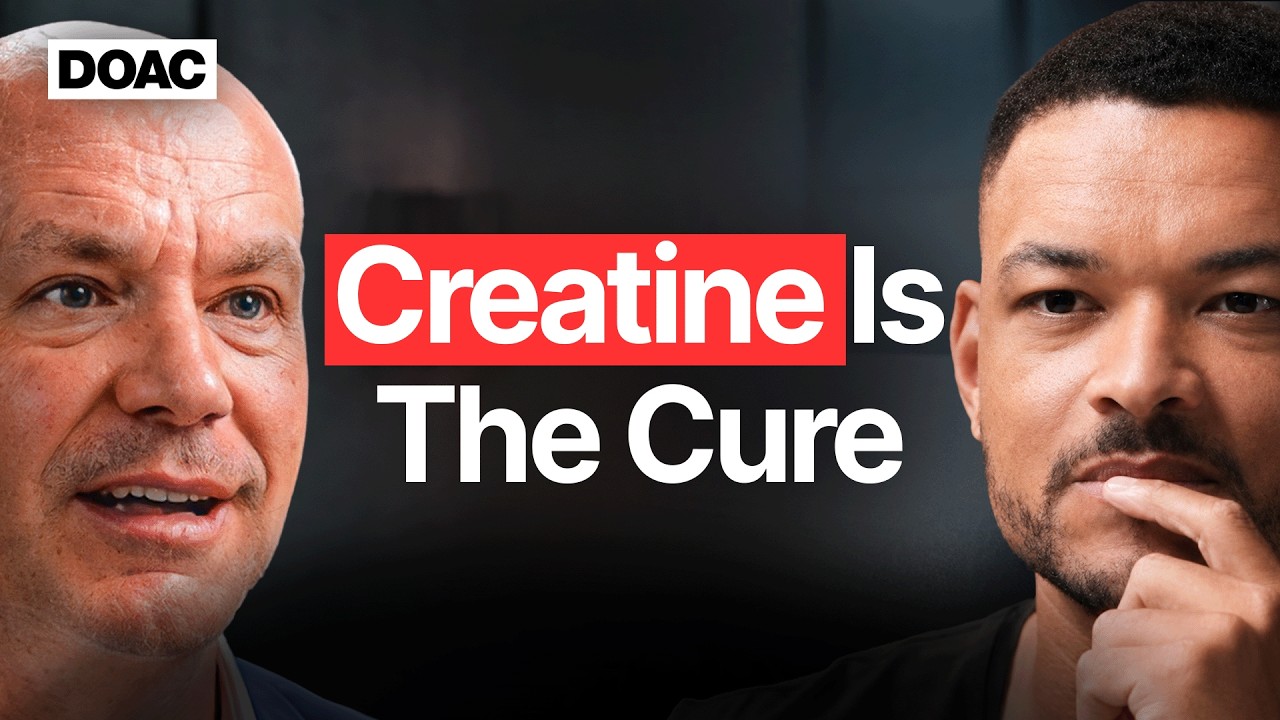
"Anti-Aging Expert: Creatine Is The Fat Loss Secret Doctors Don’t Tell You - Dr. Darren Candow" · Dr. Darren Candow · 75 min · 3.3M views · 2026
In short: Creatine is safe for most people and supports muscle, recovery, and brain energy, especially under stress or sleep deprivation.
Supplements are where most health advice gets vague, so this episode is useful precisely because it is narrow. Candow covers one heavily researched compound, separates the myths from the evidence, and explains where the cognitive benefits show up.
Key takeaways
Creatine monohydrate is the most researched and effective form, and it is safe for most people including children and older adults.
Claims that creatine causes kidney damage or hair loss are not supported by the research on kidney health.
Creatine shows promise for cognitive support under stress or sleep deprivation by potentially increasing the energy available to the brain.
Women see notable improvements in strength and bone health from creatine, so the benefits are not limited to men.
Watch on YouTube · Read the summary and Q&A
5. Can Aging Actually Be Reversed?

"Dr David Sinclair: Can Aging Be Reversed? After 8 Weeks, Cells Appeared 75% Younger In Tests!" · Dr. David Sinclair · 149 min · 5.6M views · 2026
In short: Sinclair's lab has reversed aging in animal tissue and expects human trials soon, beginning with conditions like blindness.
This episode closes the health half by zooming out from daily habits to the longest possible horizon. It is the most speculative pick on the list, and it is included because the claims come with lab work and imminent trials rather than assertion alone.
Key takeaways
Dr. David Sinclair has studied age reversal for 30 years and argues that aging is not inevitable.
His lab developed technology that reverses aging in animal tissues, and human trials are expected to target conditions such as blindness.
Reversing aging could eliminate the diseases it drives, including Alzheimer's and cancer, rather than treating each one separately.
Fasting and exercise create adversity that triggers cellular repair and defense mechanisms, which slows the aging process.
Watch on YouTube · Read the summary and Q&A
6. How Do People Decide To Trust You?

"Body Language Expert: Stop Using This, It’s Making People Dislike You, So Are These Subtle Mistakes!" · The Diary Of A CEO · 163 min · 13.6M views · 2024
In short: An estimated 82 percent of first impressions rest on warmth and competence, both signalled through gesture and expression.
The list turns from your body to other people here, because fundraising, hiring, and selling all run on first impressions. This episode gives the two variables those impressions are built from and the specific behaviors that move them.
Key takeaways
An estimated 82 percent of first impressions rest on warmth and competence, making both central to any social interaction.
Empathy shown through gestures, head tilts, and nodding increases perceived warmth and builds stronger connection in conversation.
Liars often show less gestural behavior, because high stakes raise anxiety and suppress natural non-verbal cues.
Building friendships as an adult takes deliberate effort similar to dating, organized around shared activities and mutual interests.
Watch on YouTube · Read the summary and Q&A
7. What Should You Build Instead Of AI?

"Alex Hormozi’s Warning: Stop Chasing AI, Build This Instead!" · Alex Hormozi · 142 min · 1.4M views · 2026
In short: Build reality and reputation, the two moats AI cannot erode, rather than chasing short lived AI trends.
The business half opens with fundamentals rather than forecasts. Hormozi argues that the durable advantages are unchanged by AI, and he is specific about which internal metric actually compounds.
Key takeaways
Chasing AI trends leads to unsustainable business models, while reality and reputation remain moats that AI cannot erode.
Revenue retention matters more for long term growth than aggressive marketing or sales tactics do.
The fastest path to a 10 million dollar business is not the same path as building a 100 million dollar one.
Delegating critical thinking to AI makes people weaker and holds back both personal and professional growth.
Watch on YouTube · Read the summary and Q&A
8. How Will AI Change Your Job?

"Ex-Google Officer: You Only Have 3 Years Left Before It Hits! - Mo Gawdat" · Mo Gawdat · 122 min · 5.1M views · 2026
In short: Entry level white collar jobs face disruption first, with significant societal change expected as early as 2027.
Having established what does not change, the list moves to what does. Gawdat puts a timeline on the disruption and locates the risk in human misuse rather than in the technology, which makes the episode useful for planning headcount.
Key takeaways
Mo Gawdat argues that AI is not the enemy, and that misuse of the technology by humans is the primary concern.
Job disruption is expected first in entry level white collar roles as AI capability spreads through the workplace.
AI's rapid development could produce significant societal change by 2027, compressing the time available for people to adapt.
Governments must prioritize ethical AI development so competitive pressure between nations is balanced against broader societal benefit.
Watch on YouTube · Read the summary and Q&A
9. Are We In An AI Bubble?

"Ray Dalio: I Predicted The 2008 CRASH, I Know What Comes Next!" · Ray Dalio · 90 min · 4.5M views · 2026
In short: Dalio believes we are in an AI bubble that could collapse like past ones when asset prices rise unsustainably.
This is the counterweight to the previous episode. Dalio agrees AI will reshape work, then places it inside the mechanics of economic cycles, which is the frame a founder needs when deciding how much runway to hold.
Key takeaways
Ray Dalio believes we are in an AI bubble comparable to past economic bubbles that ended in financial collapse.
Bubbles burst when asset prices rise unsustainably and then collapse, often triggered by rising interest rates or other financial pressure.
Cash is a poor long term investment because inflation steadily erodes its purchasing power over time.
Dalio advises adaptability, continuous learning, and aligning personal passions with work in order to navigate future economic uncertainty.
Watch on YouTube · Read the summary and Q&A
10. Where Do You Store Long Term Wealth?
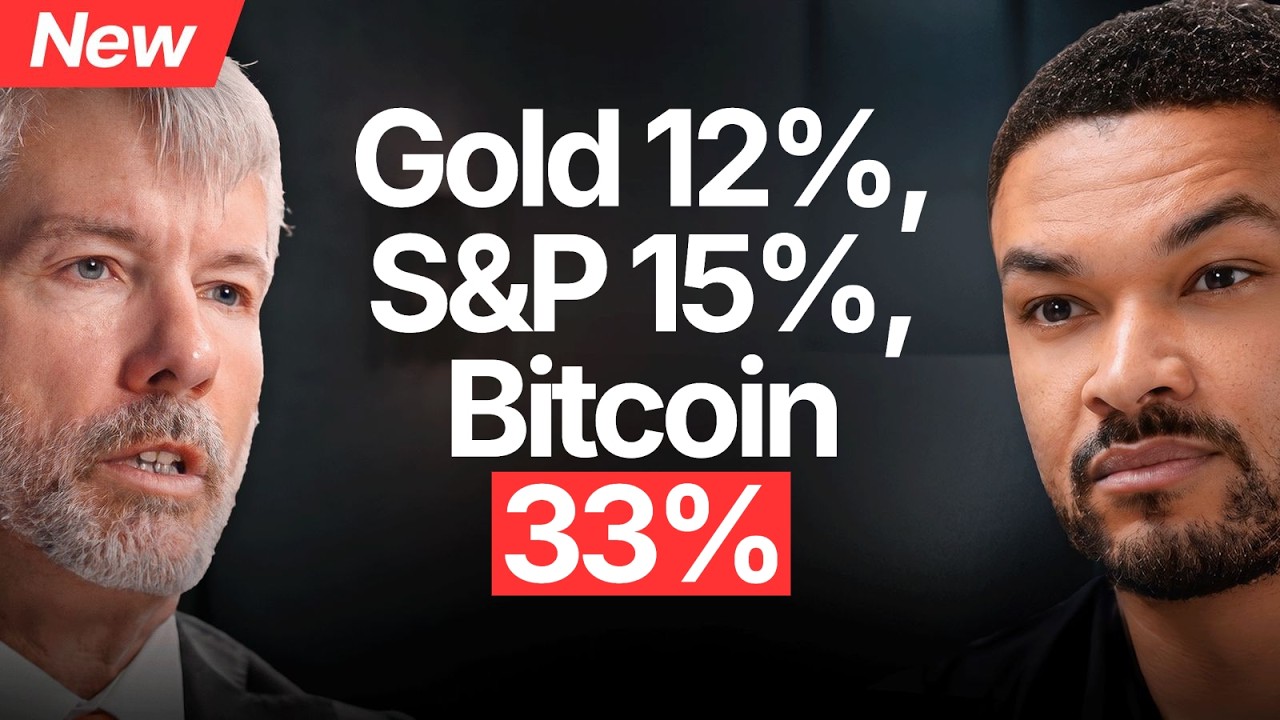
"The Man Who Owns 4% Of All Bitcoin: "I Made $15 Billion By Using ChatGPT!" | Michael Saylor" · Michael Saylor · 99 min · 1.6M views · 2026
In short: Saylor argues Bitcoin is the best long term capital asset for investors who can hold four years or more.
The list ends with the most concentrated position in the set, which is why it comes last rather than first. After Dalio's case for diversification, Saylor's case for a single asset is the sharper contrast, and the episode also shows AI used to design a real financial instrument.
Key takeaways
Bitcoin has appreciated about 33 percent annually, compared with 12 percent for gold and 15 percent for the S&P 500.
The US dollar has lost roughly 7 percent of its value every year for a century, according to Saylor.
Saylor used AI to design a novel financial instrument that generated 15 billion dollars, showing AI applied to finance.
Real estate carries significant tax and maintenance burdens, which in Saylor's view makes it less attractive than Bitcoin.
Watch on YouTube · Read the summary and Q&A
Frequently asked questions
Why do I keep waking up at 3AM?
Waking at 3AM is often caused by a natural rise in body temperature rather than a sleep disorder. The advice is to stay in bed, leave your phone alone, and use 4-7-8 breathing to lower your heart rate.
How do I get more energy during the day?
Eating more food does not create more energy. Energy improves when mitochondria work more efficiently, which comes from exercise, a suitable diet, and lowering chronic stress.
Can a ketogenic diet reverse insulin resistance?
Dr. Annette Bosworth argues that a ketogenic diet, built on low carbohydrate and high fat intake, can help reverse insulin resistance. She links high insulin to chronic disease and to cognitive decline.
Is creatine safe to take every day?
Creatine monohydrate is safe for most people at recommended dosages, including children and older adults. Research does not support the common claims that it damages the kidneys or causes hair loss.
Can aging be reversed?
Dr. David Sinclair's lab has reversed aging in animal tissues and expects human trials to begin soon, initially targeting conditions such as blindness. Reversing aging could eliminate the diseases it drives, including Alzheimer's and cancer.
What makes a good first impression?
An estimated 82 percent of first impressions are based on warmth and competence. Eye contact, open gestures, nodding, and genuine interest in the other person are the behaviors that signal both.
Which jobs will AI disrupt first?
Mo Gawdat expects entry level white collar jobs to be disrupted first, with significant societal change possible by 2027. He argues the risk lies in how humans use AI rather than in the technology itself.
Are we in an AI bubble right now?
Ray Dalio believes we are in an AI bubble comparable to past ones, which burst when asset prices rise unsustainably and then collapse. He recommends diversification and adaptability rather than holding cash.
Should founders chase AI trends?
Alex Hormozi argues that chasing AI trends produces unsustainable business models, and that reality and reputation are the moats AI cannot erode. Revenue retention matters more for growth than aggressive marketing.
How to use this list
Watch these in the order listed. The first five build from the ground up, starting with sleep, then daily energy, then diet, then supplementation, then the long horizon of aging, so each one assumes the previous fix is in place. The last five run the same way for business, moving from the fundamentals that AI does not change, to the disruption it causes, to the economic cycle around it, and finally to where you put capital. If you only have time for one, watch the sleep episode first: it is the input every other episode on this list depends on, and its advice can be applied tonight.
Related lists
💡 Want summaries and transcripts for any YouTube video? Try YouTube Summary with ChatGPT & Claude.