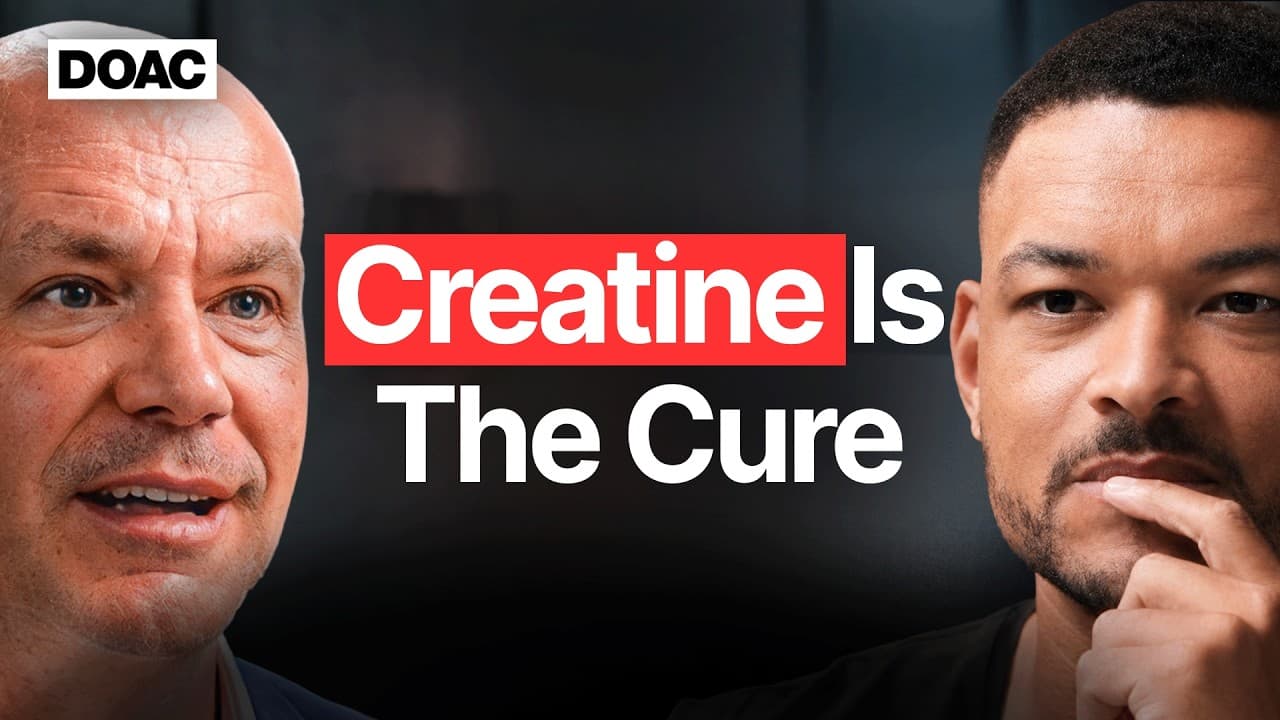
How Does Creatine Support Fat Loss, Brain Health, and Healthy Aging?, Dr. Darren Candow
TL;DR
Creatine may support fat loss indirectly by improving lean muscle, training capacity, and recovery, while its brain benefits appear most relevant during stress or sleep deprivation. Dr. Darren Candow, who has published over 120 creatine papers, also discusses recommended dosing, muscle and bone health, safety myths, and why creatine monohydrate is the best-researched form. Read on to understand who may benefit and how dosage varies by goal.
Transcript
A healthy brain likely doesn't need any creatine. But what if you're stressed? What about sleep deprivation? Night shift workers, university students cramming for a midterm. Then all of a sudden, the healthy brain becomes a metabolically stressed brain. And most people fall into the stressed environment. And that's where creatine comes to the rescu... Read More
Key Insights
- Creatine is synthesized naturally in the liver and brain, but supplementation can provide additional benefits.
- Creatine supplementation is safe for most people, including children and older adults, at recommended dosages.
- Creatine can enhance muscle mass and performance, especially when combined with weight training.
- There are myths about creatine causing kidney damage and hair loss, but research shows it is safe for kidney health and does not cause hair loss.
- Creatine may reduce inflammation and support recovery, particularly in endurance athletes.
- Creatine shows promise in cognitive support, especially under stress or sleep deprivation, by potentially enhancing brain energy levels.
- Creatine is beneficial for both men and women, with females experiencing notable improvements in strength and bone health.
- The optimal type of creatine is monohydrate, which is well-researched and effective.
Install to Summarize YouTube Videos and Get Transcripts
Explore YouTube Video Summarizer or Get YouTube Transcript Extractor
Questions & Answers
Q: How does creatine aid fat loss and brain health?
Creatine indirectly supports fat loss by increasing lean muscle and exercise capacity, which can contribute to greater energy expenditure and fat reduction. For brain health, it may support brain energy and cognitive performance when the brain is metabolically stressed by circumstances such as sleep deprivation, night-shift work, or intense studying.
Q: Does creatine directly burn body fat?
No, the existing information describes creatine as an indirect aid rather than a direct fat burner. Its contribution comes through improved lean muscle, training capacity, and recovery, especially when supplementation is combined with weight training.
Q: When is creatine most useful for cognitive support?
A healthy brain may not need supplemental creatine, according to Dr. Darren Candow. Its potential value increases when the brain is metabolically stressed, including during sleep deprivation, night-shift work, or university exam preparation, and higher stress may call for a higher dose.
Q: What are the muscle benefits of creatine?
Creatine can increase muscle water content, stimulate protein synthesis, and improve training capacity. These effects can support greater training volume, recovery, strength, and muscle size over time, particularly alongside resistance training.
Q: Is creatine safe, and does it cause kidney damage or hair loss?
Creatine is described as safe for most people at recommended dosages. The page identifies kidney damage and hair loss as myths, stating that research has not shown creatine to harm kidney function or cause hair loss.
Q: How much creatine should adults take?
The existing guidance gives 3–5 grams per day as a typical adult dose for muscle benefits. Cognitive support during stressful conditions may use higher doses of up to 20 grams, with the appropriate amount varying by body size, individual needs, and stress level.
Q: Can children take creatine?
Dr. Darren Candow says the current body of evidence suggests children should get at least one gram per day. The stated goals are optimization of bone health and muscle development, although the page also advises parents to consult a healthcare professional before beginning supplementation.
Q: Which type of creatine is most effective?
Creatine monohydrate is identified as the most researched and effective form. It serves as the standard for comparison, and the existing information says no alternative form has proved more effective or safer.
Q: Do vegans and vegetarians benefit more from creatine supplements?
Vegans and vegetarians may respond especially well to creatine supplements because their diets provide no dietary creatine. The body still produces creatine from amino acids, but dietary creatine is found only in animal-based flesh such as red meat, seafood, and poultry.
Q: Where does the body make and store creatine?
The body makes creatine in the liver and brain, while about 95% of it is stored in skeletal muscle. Creatine made in the liver is transported through the blood to the muscles, while the brain keeps the creatine it produces.
Q: How does creatine help with weightlifting and sprinting?
Creatine helps maintain ATP, the energy currency cells use during muscular work. During high-intensity activities such as weightlifting and sprinting, ATP stores can become jeopardized, so creatine supports their maintenance.
Summary & Key Takeaways
-
Creatine is a natural metabolite produced in the liver and brain, but supplementation can enhance muscle mass, performance, and recovery. It is particularly beneficial when combined with weight training, and safe for most people, including children and older adults.
-
Creatine myths include misconceptions about kidney damage and hair loss, both of which research has debunked. It may also reduce inflammation and support recovery in endurance athletes, and shows promise in cognitive support under stress or sleep deprivation.
-
Creatine is effective for both men and women, with females experiencing improvements in strength and bone health. The most researched and effective form is creatine monohydrate, which is recommended for optimal supplementation.
Read in Other Languages (beta)
Share This Summary 📚
Summarize YouTube Videos and Get Video Transcripts with 1-Click
Try YouTube Summary with ChatGPT & Claude or YouTube Transcript Generator
Explore More Summaries from The Diary Of A CEO 📚





Summarize YouTube Videos and Get Video Transcripts with 1-Click
Try YouTube Summary with ChatGPT & Claude or YouTube Transcript Generator