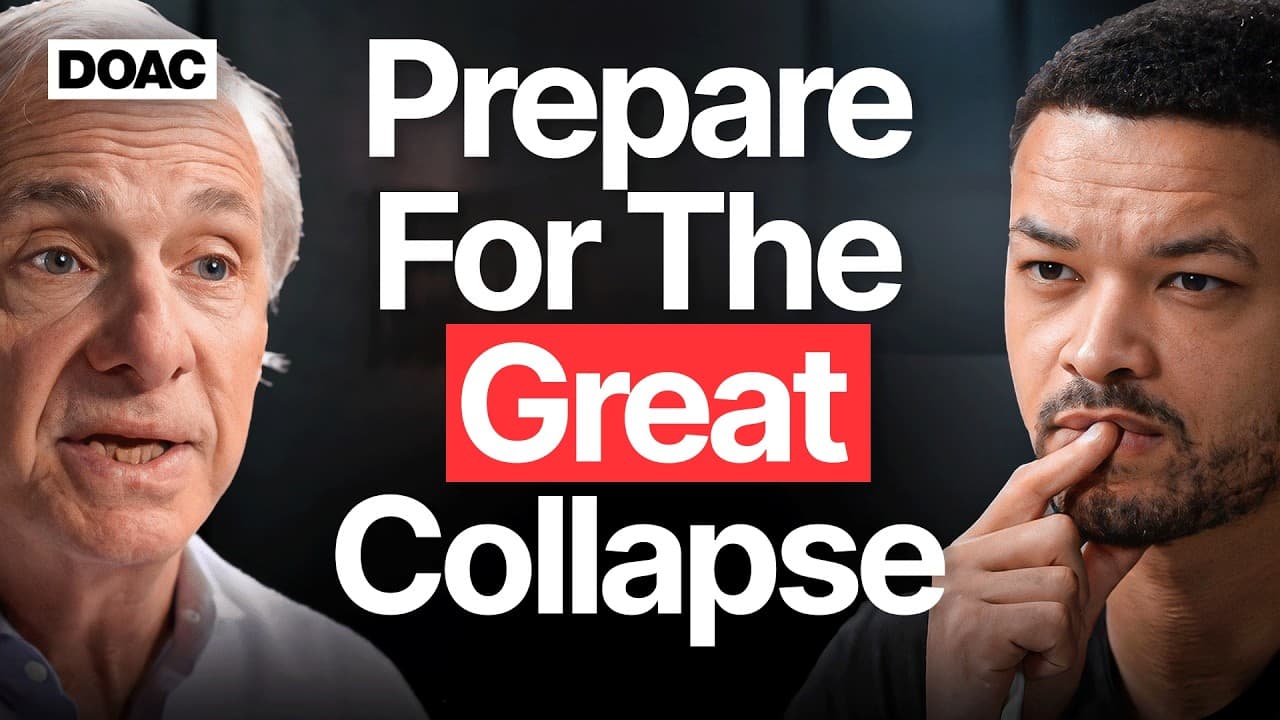
Ray Dalio Predicted the 2008 Crash, Does He Think an AI Bubble Could Cause an Economic Collapse?
TL;DR
Ray Dalio agrees that current conditions show classic signs of an AI investment bubble that could burst and damage markets, the economy, and society. He compares the pattern with the 1929 and 2000 bubbles: enthusiasm drives prices higher, investors borrow money, and pressure from debt service, rising interest rates, or tax changes can trigger a reversal. Read on for his explanation of the bubble’s mechanics and wider risks.
Transcript
Are you seeing signs that we're in an AI bubble and therefore a economic collapse? >> The classic signs and that has implications for the economy and it's bad for the society and everybody loses money but we also have some other things that are going on that happen around the same time and I can go through these if you want please. >> So what I'm s... Read More
Key Insights
- Ray Dalio believes we are in an AI bubble, similar to past economic bubbles, which could lead to a financial collapse.
- Economic bubbles burst when asset prices rise unsustainably and then collapse, often triggered by rising interest rates or other financial pressures.
- Cash is considered a poor long-term investment due to inflation, which erodes purchasing power over time.
- Diversification is crucial in financial planning to mitigate risks associated with economic downturns.
- The US and UK are perceived to be in a decline, affected by geopolitical changes, wealth inequality, and political instability.
- AI is expected to disrupt job markets, benefiting those who adapt and innovate while widening the wealth gap.
- New jobs may emerge from AI advancements, but the transition could be challenging for many workers.
- Dalio advises focusing on adaptability, continuous learning, and aligning personal passions with work to navigate future uncertainties.
Install to Summarize YouTube Videos and Get Transcripts
Explore YouTube Video Summarizer or Get YouTube Transcript Extractor
Questions & Answers
Q: Does Ray Dalio think an AI bubble could lead to economic collapse?
Dalio says the assessment that the market is in an AI bubble is right and that classic bubble signs have implications for the economy. He explains that a collapse makes people lose money and can become especially damaging alongside geopolitical change, large wealth gaps, and governments lacking enough money.
Q: What does Ray Dalio mean by an investment bubble?
Dalio describes a bubble as a period when prices rise substantially, companies perform well, and the market later collapses. Investors become captivated by a revolutionary technology and may overlook whether the price they pay for it is justified.
Q: Why does Dalio compare the AI boom with the 1929 and 2000 bubbles?
He says revolutionary technologies attract investors who believe the opportunity will succeed and want exposure to it. Dalio cites the 1929 bubble and the 2000 dot-com bubble as examples of rising prices followed by collapses with consequences for markets, the economy, and ordinary people.
Q: How can borrowing make an AI bubble more dangerous?
Dalio says some investors borrow money to bet on a promising technology and use their rising wealth as collateral for further borrowing. This compounds gains on the way up, but debt-service needs can force selling and make the same mechanism work in reverse when prices fall.
Q: What can prick an investment bubble according to Ray Dalio?
A bubble can be pricked when investors need money because taxes change, interest rates rise, or debt-service payments come due. They must sell wealth to obtain spendable money, prices fall, and the process begins reversing.
Q: Why does Dalio distinguish wealth from money?
Dalio says wealth cannot be spent directly; it must first be sold to obtain money. That distinction matters during a bubble because investors who need cash may have to sell assets, helping turn falling prices into broader losses.
Q: What other risks could worsen the effects of an AI bubble bursting?
Dalio points to geopolitics, changing world order, large wealth gaps, and governments that do not have enough money. He notes that China is a larger trading partner than the United States for most countries and warns that a downturn can leave people at each other’s throats.
Q: What was Ray Dalio’s record at Bridgewater during the 2008 crash?
The interview states that Dalio founded Bridgewater Associates in a two-bedroom apartment in 1975 and grew it into the world’s largest hedge fund. It says Bridgewater posted a positive 9.5% return in 2008 while the S&P 500 plunged by almost 40%; Dalio also recalls roughly $53 billion in cumulative net gains and about a 12% return without significant losses.
Q: Does Ray Dalio still think AI will be revolutionary even if it is a bubble?
Yes, Ray Dalio says AI will bring revolutionary changes even as he agrees there are signs of a bubble. He compares this with earlier technologies that succeeded in the long term despite investment bubbles around them.
Q: How could an AI stock market crash affect restaurants and everyday spending?
An AI stock market crash could cause investors who lose money to reduce their everyday spending. Dalio says that when people stop going to restaurants and buying other things, someone else’s income falls and the downturn spreads through the economy.
Q: Why is it difficult for AI companies to know how much money to invest?
AI companies cannot precisely predict how much money their investments will generate because so little is known during periods of tremendous technological change. Dalio says they risk either investing too little and letting competitors run away or investing huge amounts without knowing whether the returns will justify it.
Summary & Key Takeaways
-
Ray Dalio discusses the potential for an AI bubble to lead to economic collapse, drawing parallels with past financial crises. He emphasizes the need for understanding economic cycles and diversifying investments to mitigate risks. Dalio highlights geopolitical shifts, wealth gaps, and financial mismanagement as exacerbating factors.
-
Dalio advises against holding cash long-term due to inflation and stresses the importance of investment diversification. He warns that the US and UK are in decline, facing challenges from geopolitical changes and wealth inequality. He suggests adapting to technological advancements as a key strategy.
-
AI's impact on job markets is significant, with potential job losses and wealth gaps. Dalio suggests that new job opportunities may arise, but adapting to these changes is crucial. He recommends focusing on adaptability, continuous learning, and aligning personal passions with work to navigate future uncertainties.
Read in Other Languages (beta)
Share This Summary 📚
Summarize YouTube Videos and Get Video Transcripts with 1-Click
Try YouTube Summary with ChatGPT & Claude or YouTube Transcript Generator
Explore More Summaries from The Diary Of A CEO 📚



Summarize YouTube Videos and Get Video Transcripts with 1-Click
Try YouTube Summary with ChatGPT & Claude or YouTube Transcript Generator