How to build a voice AI agent with Vappy and n8n
TL;DR
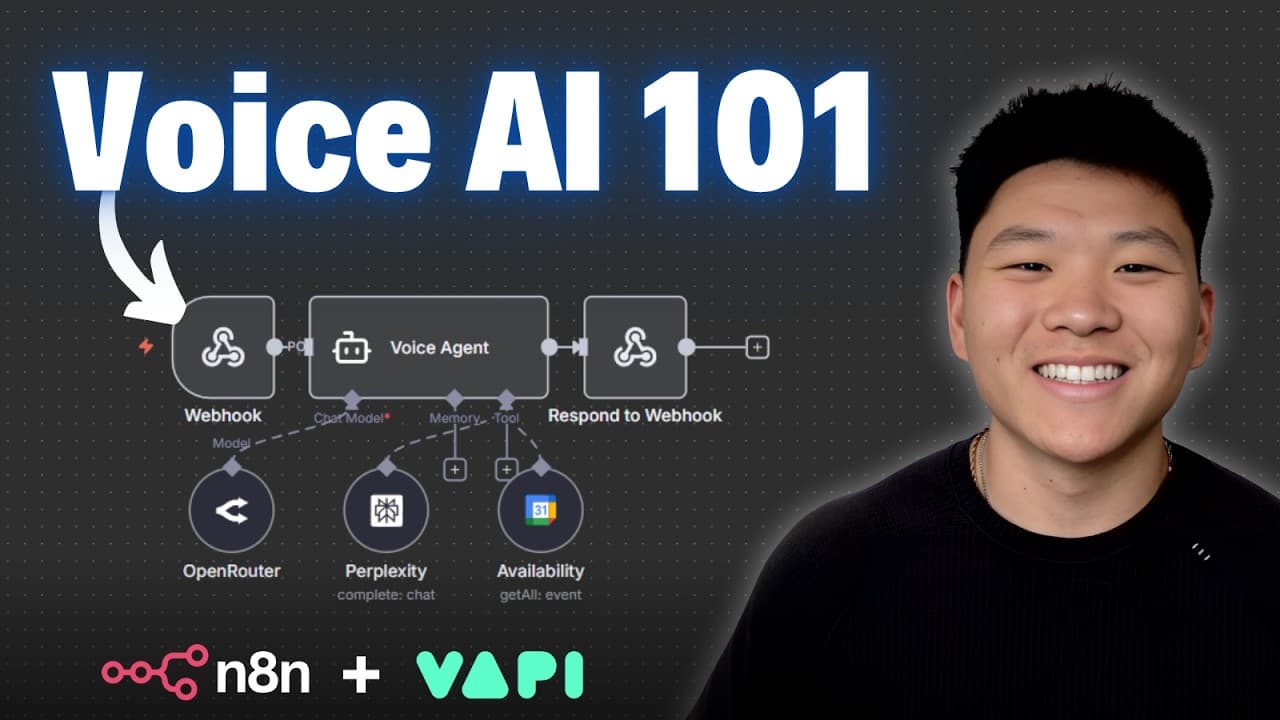
A voice AI agent can be built without coding using Vappy and n8n. The video explains the three core components of voice agents, how to set up prompts, and how to connect tools to automate tasks like calendar events and emails. It also covers inbound and outbound use cases and why the field is growing. The approach is practical and beginner friendly.
Transcript
In this video, I'm going to take you from zero to building your very first voice AI agent. By the end, not only will you understand the value of voice agents, but you'll also understand exactly how you set one up and all of the different components that go into building effective voice agents. So, let's not waste any time and get straight into the ... Read More
Key Insights
- Voice agents are defined by real time spoken interactions that require a speech to text module, a large language model, and text to speech.
- The brain of a voice agent is the LLM, while the system prompt acts as the playbook that shapes personality and rules.
- Voice models can be swapped across providers like OpenAI, Anthropic, or Google, affecting cost and latency.
- The input and output of a voice agent are converted to and from text, keeping the underlying processing consistent with chat based systems.
- Prompts are the most important part of a voice agent and require iteration to improve performance in real world use.
- In we set up knowledge bases, agents can access external information to answer questions more accurately.
- Tools allow voice agents to perform actions such as checking calendars, creating events, or sending emails, enabling automation of workflows.
- Inbound and outbound are two main use cases, with website widgets acting as a hybrid inbound entry point
- More videos from this channel:
- More from this channel: Nate Herk | AI Automation
Install to Summarize YouTube Videos and Get Transcripts
Explore YouTube Video Summarizer or Get YouTube Transcript Extractor
Questions & Answers
Q: How do voice AI agents differ from traditional chatbots?
Voice AI agents differ from traditional chatbots in that they handle spoken language instead of text, using a speech to text step at input and text to speech at output. The process still relies on an LLM to generate responses, but the interaction modality is auditory rather than textual, enabling real time conversations over phone lines or website widgets.
Q: What are the core components of a voice agent as explained in the video?
The core components are speech to text, a large language model, and text to speech. These three parts convert spoken input to text, process it with the LLM, and then convert the generated text back into natural sounding speech for the user. This structure mirrors chat based systems with a different input and output modality.
Q: What platform is used to build voice agents in the video?
The video uses Vappy as the platform to build voice agents and shows how it can integrate with n8n for automation. Vappy provides the interface to configure models, system prompts, voice options, and tools, while n8n enables the automation workflows that the agents can trigger.
Q: Why is prompting emphasized as critical in building voice agents?
Prompting is critical because it defines the agent’s identity, purpose, rules, and conversational flow. A well crafted prompt guides the agent on how to start interactions, handle different scheduling scenarios, and manage user expectations, with ongoing iteration recommended as real world conversations reveal new needs.
Q: What are inbound and outbound voice agents and give examples of each?
Inbound agents answer calls when a user reaches out, handling tasks such as customer support or scheduling. Outbound agents proactively call people for use cases like sales outreach, appointment reminders, and surveys. Both types rely on the same underlying voice agent architecture but differ in who initiates the contact.
Q: How can tools enhance a voice agent’s capabilities?
Tools extend a voice agent by granting it access to external systems like calendars or email, enabling actions such as viewing or creating events, and sending confirmations. By connecting with these tools, the agent can perform meaningful tasks automatically rather than just providing information.
Q: What is the significance of knowledge bases for voice agents?
Knowledge bases allow a voice agent to load and reference domain specific information, which improves accuracy and relevance of responses. By feeding structured data into the agent, it can answer questions more confidently and handle specialized scenarios that go beyond generic language patterns.
Q: What ROI potential and market trend does the video highlight for voice agents?
The video points to growing interest and expected expansion in the voice agent space by 2026, suggesting clear ROI opportunities. As demand for automated conversational experiences increases, mastering platforms like Vappy and n8n can empower developers to build scalable voice solutions with tangible business impact.
Summary & Key Takeaways
-
The video introduces voice agents as conversational systems that use speech input and output, connecting to existing systems for tasks like scheduling and customer support. It emphasizes the three core components: speech to text, a large language model, and text to speech. It also explains that Vappy and n8n enable no code automation for these agents.
-
The tutorial walks through the Vappy interface, including model selection, system prompts, and voice configurations. It highlights the importance of prompts in defining behavior and shares best practices for crafting effective agent instructions and workflow with tools.
-
Finally, the guide discusses practical use cases such as inbound and outbound voice agents, website widgets, and the ROI potential by 2026. It promises a hands on demonstration of setting up Vappy, knowledge base loading, and tool integration for automation
Read in Other Languages (beta)
Share This Summary 📚
Summarize YouTube Videos and Get Video Transcripts with 1-Click
Try YouTube Summary with ChatGPT & Claude or YouTube Transcript Generator
Explore More Summaries from Nate Herk | AI Automation 📚






Summarize YouTube Videos and Get Video Transcripts with 1-Click
Try YouTube Summary with ChatGPT & Claude or YouTube Transcript Generator