How to Build Andromeda Ads That Convert
TL;DR
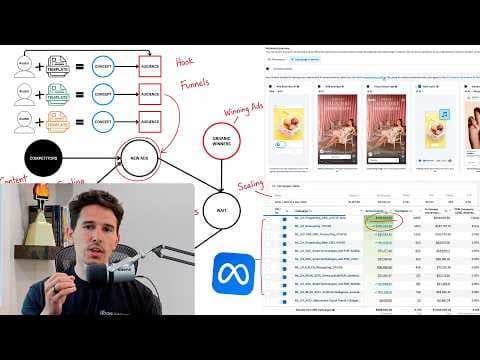
Build each ad by matching a defined customer avatar with a repeatable creative template, then connect that concept to relevant product mechanisms, education, and a compelling offer. Start with customer data and specific wants, show how product features solve those needs, explain the underlying problem, and test discounts, bundles, or shipping benefits that can turn consideration into purchase.
Transcript
This creative strategy is hands down the most effective one I think I've ever used. [music] It's specifically built for Andromeda and it's the highest performing strategy that I've used in the last 5 years managing over 100 plus e-commerce businesses across literally every category. And by using this creative strategy, I've helped create ads that h... Read More
Key Insights
- An avatar plus a creative template forms an advertising concept. The avatar defines who the message addresses, while the template supplies the creative structure, such as an us-versus-them comparison, three reasons why, or user-generated content filmed in a car.
- A precise sub-avatar is the starting point for effective creative. Brands should combine their informed view of the customer with available data, then narrow the audience into groups with distinct circumstances, such as mothers who want attractive nails but lack time for a lengthy routine.
- Customer wants and needs guide the rest of the advertising system. After selecting an avatar, advertisers should document the outcomes that person values and the gaps they currently experience, creating a clear basis for choosing features, educational messages, and offers.
- Product mechanisms are features that solve an avatar’s specific problem. A mechanism should connect directly to the desired outcome, such as press-on nails that provide quick application, an attractive result, and all necessary components in one kit for a customer who values convenience.
- Mechanisms should be divided among relevant sub-avatars rather than promoted identically to everyone. The full feature list provides the raw material, but each advertisement should emphasize only the mechanisms that match the selected audience’s needs and make that audience’s life easier.
- Education closes a curiosity gap by revealing a problem and explaining its cause. An effective educational opening frames what competing products do poorly, identifies the feature responsible for the difference, and positions the advertised product’s mechanism as the practical solution.
- Offers include more than percentage discounts. Bundles can raise average order value and perceived value while potentially reducing shipping, fee, and fulfillment costs, and logistical benefits such as free two-day shipping can also give customers a concrete reason to choose a seller.
- A strong offer helps move customers from consideration to purchase. The speaker says discounts under 20% often do not change behavior, while 30% or more can have greater impact, but businesses must evaluate every discount against their margins before adopting it.
Install to Summarize YouTube Videos and Get Transcripts
Explore YouTube Video Summarizer or Get YouTube Transcript Extractor
Questions & Answers
Q: How do you build an Andromeda ad creative strategy?
Start by defining a specific customer avatar and documenting that person’s wants and needs. Next, identify the product mechanisms, meaning the features that solve those needs, and select the mechanisms most relevant to that sub-avatar. Build education that frames the underlying problem and presents those features as the solution. Finally, add an offer, such as a discount, bundle, or shipping benefit, that can encourage purchase.
Q: What is an avatar in the Andromeda advertising framework?
An avatar is the specific type of customer an advertisement addresses. It should be narrower than a brand’s general customer base and grounded in both informed judgment and available data. The nail-care example uses mothers who want attractive nails but do not have much time. Their circumstances clarify the relevant needs, messages, product benefits, and offers for the advertisement.
Q: How does an avatar become an advertising concept?
An avatar becomes a concept when it is paired with a creative template. The avatar identifies the person being addressed, while the template establishes the common structure of the creative. Suggested templates include an us-versus-them comparison, three reasons why, or user-generated content filmed in a car. Together, the audience and structure create a concept intended to attract a specific audience.
Q: What are product mechanisms in ad creative?
Product mechanisms are the features that provide solutions to the selected avatar’s wants and needs. Advertisers should first list every mechanism associated with the product, then assign the most relevant ones to each sub-avatar. For quick press-on nails aimed at busy mothers, suitable mechanisms include speed, ease of application, attractive results, and having all components available in one convenient kit.
Q: Why should advertisements educate customers about the problem?
Education addresses curiosity and can reveal a problem customers did not realize they had. The advertisement first frames the underlying issue, then explains why it happens and how a product mechanism solves it. In the shirt example, poor fibers or stitching create an unflattering fit, while better stitching grips around the bicep. That explanation makes the feature’s value easier to understand.
Q: What discount percentage does the speaker recommend testing?
The speaker says discounts below 20% often do not meaningfully move customers from cart to purchase, unless the business rarely runs sales. According to the transcript, discounts of 30% or more can have a stronger effect, and 40% represents a substantial increase from 30%. These are testing suggestions, and the business must consider its margins before choosing any percentage discount.
Q: How can product bundles improve an ecommerce offer?
Bundles can increase perceived customer value by lowering the apparent price per product while increasing the total amount paid in the order. They may therefore raise average order value. The business may also reduce certain operational expenses because grouped products can require less shipping, fewer additional fees, and less pick-and-pack work than the same items handled through separate purchases.
Q: Can free shipping or fast delivery count as an offer?
Yes. An offer is not limited to a price reduction, because logistical benefits can also influence the purchase decision. The transcript uses Amazon’s free two-day shipping as an example of built-in value that gives shoppers a reason to buy. An ecommerce business can similarly test shipping speed or cost as part of its offer, alongside discounts and product bundles.
Summary & Key Takeaways
-
The strategy starts by defining a specific customer avatar from informed intuition and available data, then identifying that sub-avatar’s wants and needs. Pairing the avatar with a repeatable creative template creates a concept designed to attract a relevant audience instead of producing broad creative that may fail to connect with anyone clearly.
-
Product mechanisms are the features that address the avatar’s desired outcome or current problem. Advertisers should list every relevant feature, divide those mechanisms among customer sub-avatars, and emphasize the most suitable benefits. For time-constrained mothers buying press-on nails, the relevant mechanisms include speed, easy application, appearance, and a convenient all-in-one kit.
-
Education frames the customer’s real problem and presents the product mechanism as its solution, while the offer gives shoppers another reason to purchase. The suggested offer tests include substantial percentage discounts, product bundles, and logistical benefits such as free, fast shipping. Every offer must still be evaluated against margins and operating costs.
Read in Other Languages (beta)
Share This Summary 📚
Summarize YouTube Videos and Get Video Transcripts with 1-Click
Try YouTube Summary with ChatGPT & Claude or YouTube Transcript Generator
Explore More Summaries from Sam Piliero 📚

Summarize YouTube Videos and Get Video Transcripts with 1-Click
Try YouTube Summary with ChatGPT & Claude or YouTube Transcript Generator