How does Retrieval Augmented Generation boost enterprise AI?
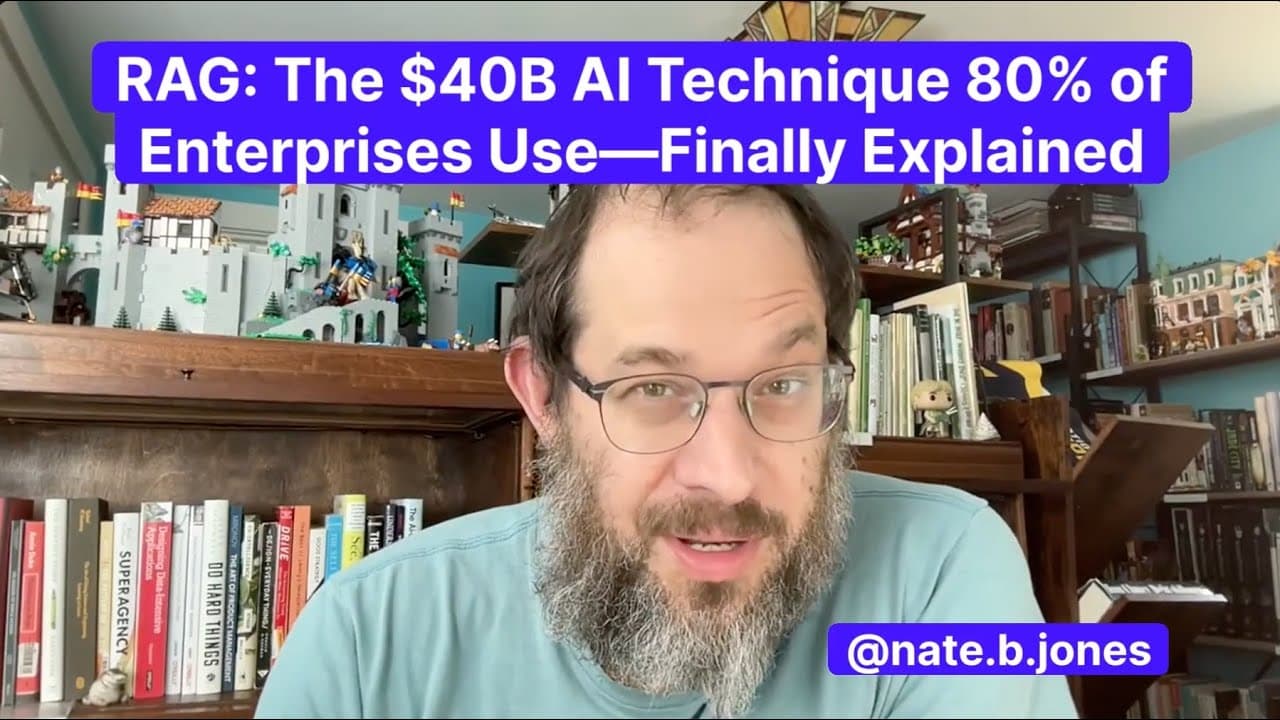
TL;DR
RAG combines vector search with a large language model to remove knowledge cutoffs and reduce hallucinations without fine-tuning. It emphasizes clean data, metadata, and overlapping semantic chunks to drive accuracy, and it envisions a path from basic FAQ bots to multimodal, enterprise-grade RAG with robust data pipelines.
Transcript
What if Chad GPT had perfect memory and never hallucinated? That is the $40 billion promise that Rag is making to the industry. Rag is retrieval augmented generation. In this video, you're going to get a one-stop shop that unpacks all the current debates, all the current best practices on Rag, how companies are implementing RAG, a few success stori... Read More
Key Insights
- RAG uses embedding and cosine similarity to retrieve relevant information, not keyword matches, enabling contextually accurate responses tied to real documents.
- Chunking strategy, including overlap and boundary respect, is critical to preserving meaning and improving retrieval accuracy in RAG systems.
- Metadata such as source, section, and date dramatically improves retrieval relevance, enabling recency-aware results and better version control.
- Hybrid search, which combines keyword matching with semantic retrieval, often yields higher accuracy and handles edge cases more effectively than single-method approaches.
- Multimodal RAG extends capabilities to text, images, video, and audio, but demands substantial data and chunking engineering to maintain performance.
- Agentic rag adds multi-step reasoning and self-improvement layers, trading speed for higher accuracy and more sophisticated task execution.
- Graph rag preserves entity relationships in knowledge graphs, improving retrieval when structured connections are essential to the query.
- Production-grade enterprise RAG requires robust security, compliance, monitoring, and load handling across a scalable architecture.
- More videos from this channel:
- More from this channel: AI News & Strategy Daily | Nate B Jones
Install to Summarize YouTube Videos and Get Transcripts
Explore YouTube Video Summarizer or Get YouTube Transcript Extractor
Questions & Answers
Q: What is Retrieval Augmented Generation and why does it matter for enterprises?
Retrieval Augmented Generation is an approach that pairs vector search with a large language model to access real data and provide grounded answers, avoiding knowledge cutoffs and reducing hallucinations without fine-tuning. It matters for enterprises because it enables up-to-date, data-backed responses at scale, supports governance through controlled data sources, and offers a path from simple FAQs to sophisticated multimodal, enterprise-grade systems with robust data pipelines and monitoring.
Q: How does chunking affect RAG performance and what strategies work best?
Chunking affects how the model understands relationships and semantic meaning in documents. Effective strategies include sentence-based chunks that respect boundaries, semantic chunks that group by topic, and recursive chunks that reflect hierarchy. Overlap between chunks is crucial to avoid missing context, and the goal is to maximize the likelihood that similar content appears in related chunks, improving retrieval accuracy and downstream answers.
Q: Why is metadata important in RAG and what metadata should be included?
Metadata guides the retrieval process by providing context about each chunk, which improves accuracy and recency-based ranking. Key metadata includes source, section, and date, helping the system prefer newer updates when appropriate and enabling provenance tracking, which is essential for compliance and trust in enterprise deployments.
Q: What are the levels of RAG implementation and what do they entail?
Level one is a basic FAQ-style Q&A using simple vector search, Level two adds hybrid search combining keywords with semantics for better edge-case handling, Level three expands to multimodal content like images and video, and Level four introduces agentic RAG with multi-step reasoning and self-improvement, with Level five focusing on large-scale enterprise deployment requiring governance and performance tuning.
Q: What is graph RAG and when is it advantageous?
Graph RAG preserves entity relationships by encoding data in a knowledge graph, which improves retrieval when queries depend on structured connections between entities. LinkedIn reported better retrieval with knowledge graphs, suggesting graph-based structures can enhance accuracy for complex relational queries and domain-specific data where relationships are critical.
Q: How does RAG address hallucinations and knowledge cutoffs without fine-tuning?
RAG reduces hallucinations and extends knowledge by retrieving documents and grounding responses in real data from a curated knowledge base, rather than relying solely on the model’s internal training data. This approach removes the static cutoffs of the model and provides up-to-date, source-backed answers tied to specific documents and sections.
Q: What are common pitfalls to avoid when implementing RAG in production?
Common pitfalls include poor chunking that breaks context, ignoring data quality from PDFs and scans, insufficient metadata, and overinvesting in ring-fenced prototypes without planning for scale, security, and latency. Enterprises should also beware of data drifts, stale sources, and latency constraints that can undermine user trust and system reliability.
Q: What is the business case for RAG becoming a dominant enterprise architecture?
The business case rests on the ability to deliver accurate, timely information at scale while avoiding expensive model fine-tuning. RAG enables organizations to leverage existing data assets, improve customer support and decision-making, and build a data-driven competitive moat through disciplined data pipelines, governance, and continuous optimization of retrieval quality.
Summary & Key Takeaways
-
RAG changes the enterprise AI game by tying real data access to LLMs, reducing errors and enabling up-to-date answers without model retraining, which lowers the barrier to deployment. It emphasizes practical data operations like chunking, metadata tagging, and careful data preparation to achieve reliable results.
-
From prototype to scale, the roadmap covers simple Q&A, hybrid search, multimodal inputs, and agentic dynamics, while highlighting the need for governance, security, and latency planning in production environments.
-
The core insight is that data quality and retrieval discipline matter more than model size, with a focus on accurate chunking, provenance, and recency to maintain trust and performance in enterprise contexts.
Read in Other Languages (beta)
Share This Summary 📚
Summarize YouTube Videos and Get Video Transcripts with 1-Click
Try YouTube Summary with ChatGPT & Claude or YouTube Transcript Generator
Explore More Summaries from AI News & Strategy Daily | Nate B Jones 📚






Summarize YouTube Videos and Get Video Transcripts with 1-Click
Try YouTube Summary with ChatGPT & Claude or YouTube Transcript Generator