Can Open Source Models Outperform GPT-4?
TL;DR
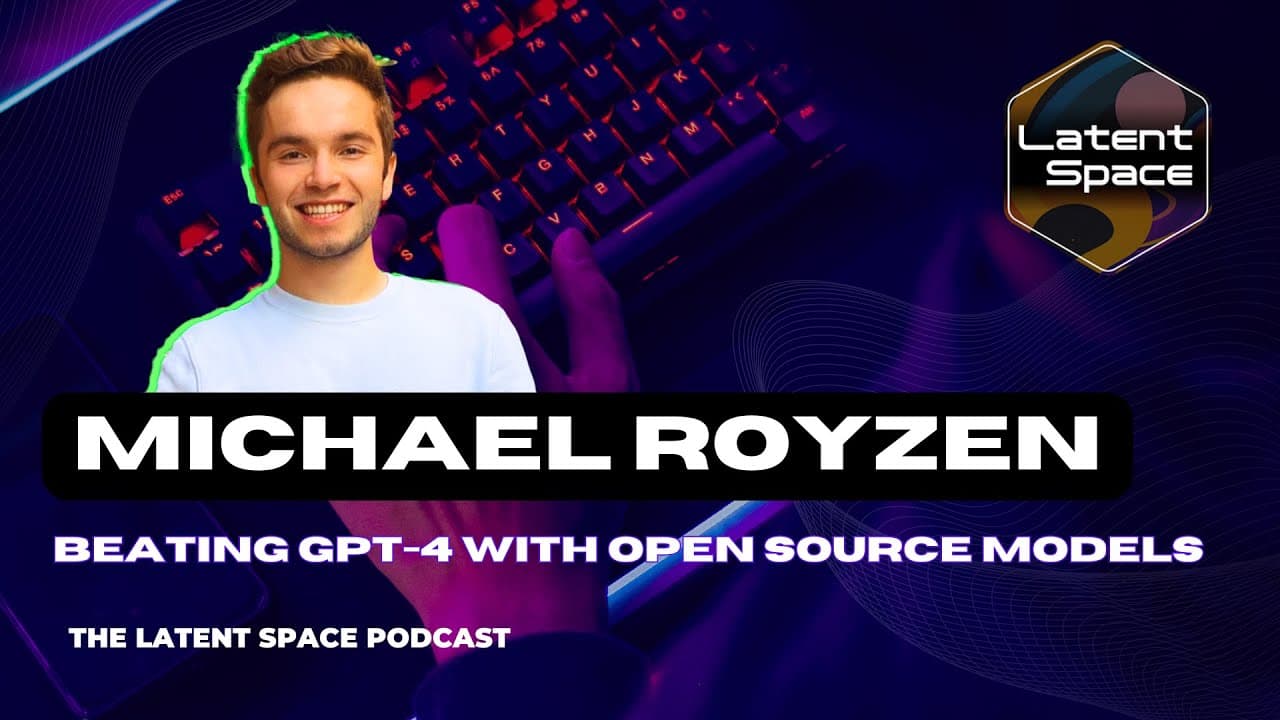
Open source models are proving competitive with GPT-4 in coding tasks. Michael Royzen of Phind discusses how Find leverages advanced deep learning models to provide efficient solutions for programmers. The evolution from a computer vision project to a specialized search engine shows the significant impact of AI on software development.
Transcript
hey everyone welcome to the laden space podcast this is alesio partner and CTO of residents and deible partners and I'm joined by my co-host swix founder of small AI hey and today we have in the studio Michael royen from findes welcome thank you so much it's great to be here yeah we are recording this in a surprisingly hot October in San Francisco ... Read More
Key Insights
- ✋ The journey of a high school entrepreneur from Smart Lens to Find showcases the transformative power of AI and deep learning models.
- 👨🔬 Find's adoption of advanced models like GPT-4 has significantly improved its search capabilities and addressed the specific needs of programmers.
- 😫 The integration of code context and the ability to solve complex reasoning problems sets Find apart from other conversational search systems.
- 👨🔬 Find's focus on verticalizing its features for programmers highlights the potential of AI in supporting technical tasks beyond traditional search algorithms.
- 👤 The development of Find's models and features has been guided by user feedback and the aim of providing efficient and accurate solutions to coding and development queries.
- ✊ As the AI landscape evolves, the convergence of different approaches, such as IDE integration and code interpretation, will shape the future of AI-powered development tools.
Install to Summarize YouTube Videos and Get Transcripts
Explore YouTube Video Summarizer or Get YouTube Transcript Extractor
Questions & Answers
Q: How did the idea for Smart Lens come about?
The idea for Smart Lens emerged when Michael Royen attended Apple's WWDC conference and saw the potential of running computer vision models locally on devices. This sparked the idea of creating a model that could recognize almost anything and operate without an internet connection.
Q: What led to the development of Find and its focus on serving programmers?
The development of Find was a natural progression for Royen, who realized the need for a conversational search system tailored to the specific queries and frustrations of programmers. This led to the integration of code context and programming-related documentation in Find's search capabilities.
Q: How has Find evolved since its launch?
Find started as an enterprise classification product and later transitioned into a question-answering system for programmers. It has continually improved its underlying models, incorporating GPT-4 to enhance its search capabilities. Feedback from users has also played a crucial role in shaping its development.
Q: How does Find differentiate itself in the competitive AI landscape?
Find sets itself apart by focusing on complex reasoning and problem-solving for programmers. While other AI systems may provide basic answers and summaries, Find aims to be the go-to platform for solving advanced coding issues and providing in-depth technical assistance.
Summary & Key Takeaways
-
Find's origin story dates back to the launch of Smart Lens, a computer vision startup, by the then-high school entrepreneur, Michael Royen.
-
Inspired by the release of TensorFlow and Apple's WWDC conference, Royen embarked on the creation of a model that could recognize various objects and run locally on devices, leading to the genesis of Smart Lens.
-
Smart Lens gained traction but tapered off over time. Royen then delved into natural language processing and launched Find, first as an enterprise classification product and then as a question-answering system for programmers.
-
Find has continually improved its models and leveraged technologies like GPT-4 to enhance its search capabilities, offering programmers fast and accurate answers to coding and development queries.
Read in Other Languages (beta)
Share This Summary 📚
Summarize YouTube Videos and Get Video Transcripts with 1-Click
Try YouTube Summary with ChatGPT & Claude or YouTube Transcript Generator
Explore More Summaries from Latent Space - The AI Engineer Podcast (Video Podcast) 📚

Summarize YouTube Videos and Get Video Transcripts with 1-Click
Try YouTube Summary with ChatGPT & Claude or YouTube Transcript Generator