How to 10x Claude Code with Karpathy's methods
TL;DR
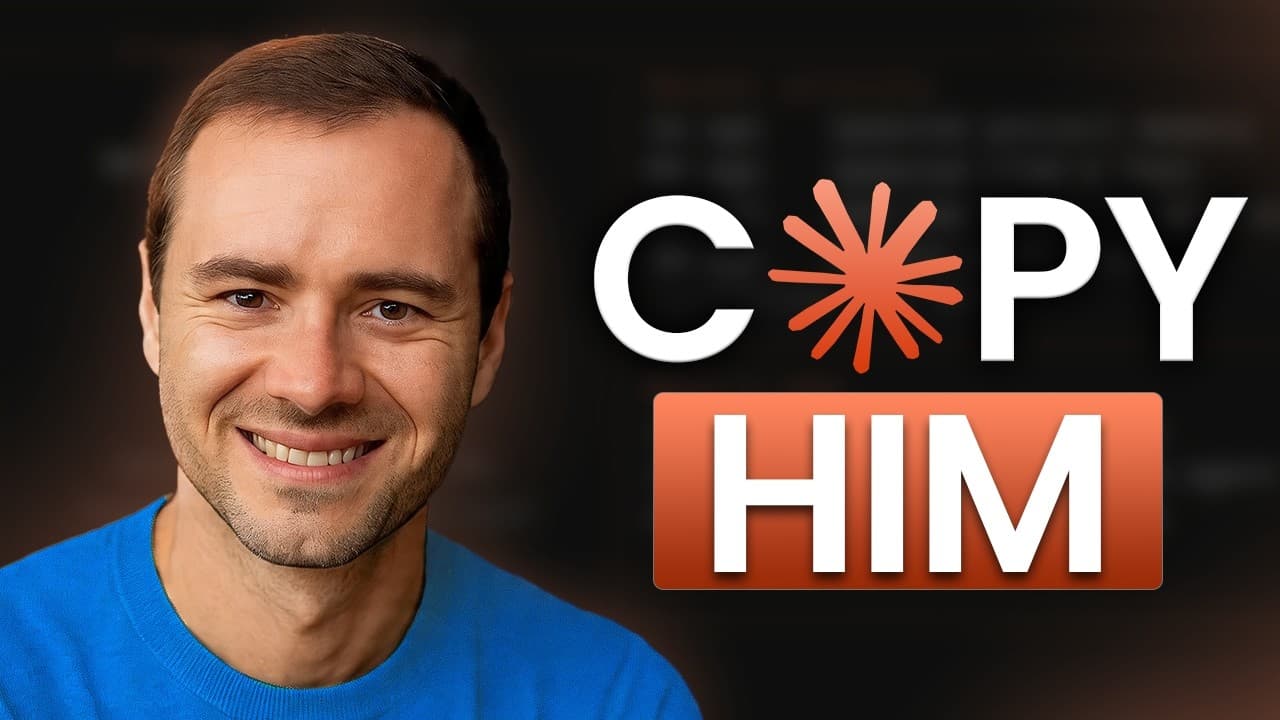
The video explains three strategies to 10x Claude Code outputs: building a persistent LLM knowledge base (a wiki) with a three-layer setup, using auto research loops to optimize performance, and practicing context engineering to feed the model the right information. It cites real-world gains like 11 percent from Karpathy’s auto research and 19 percent from Shopify when applied to their data, plus practical prompts and tools.
Transcript
Andrei Karpathy, the former head of AI at Tesla, just won viral for this post titled LLM knowledge bases. And that's because he shared the secret to 10x'ing your output with Claude Code, but unfortunately, a lot of what he says sounds complicated when in reality it's actually pretty simple. So, I'm going to break down and simplify the three key str... Read More
Key Insights
- LLM knowledge bases create a persistent, cross-referenced information network that Claude can query instead of re-reading raw sources for every task.
- The wiki layer should reference raw data and organize it into summaries, concepts, and structured profiles, enabling precise retrieval and reduced cognitive load for the model.
- A three-layer system is proposed: raw resources as the source of truth, the knowledge base as the organizing layer, and the schema as the guiding instruction for structure and behavior.
- Auto research is a loop where a model proposes changes, tests them, evaluates results, and iterates, leading to measurable performance gains in tasks with clear metrics.
- Context engineering is critical to maximize outputs, requiring a Claude MD file that defines project scope, conventions, and goals to guide the model’s behavior.
- Context scope must be carefully bounded to avoid loading irrelevant code or data that could degrade results, preserving signal quality in Claude’s context window.
- The approach scales beyond measurable metrics by using back-and-forth dialogue history as a proxy for output quality, enabling non-numeric improvements to refine the system over time.
- Tools like loops, schedules, and hooks automate repetitive refinement tasks, reducing manual overhead and accelerating continuous improvement through automation.
Install to Summarize YouTube Videos and Get Transcripts
Explore YouTube Video Summarizer or Get YouTube Transcript Extractor
Questions & Answers
Q: What are Karpathy's three Claude Code strategies in brief?
Karpathy advocates three Claude Code strategies: building an LLM knowledge base or wiki to maintain accumulated knowledge, using auto research loops to continuously test and improve code or outputs, and applying context engineering to feed Claude the right information at the right time. The knowledge base uses a three-layer structure including raw resources, a wiki, and a schema to guide operations. Auto research creates an iterative feedback loop where proposed changes are tested and evaluated for improvement, while context engineering focuses on optimizing the context window with relevant information to maximize output quality.
Q: How is the knowledge base structured in Karpathy’s approach?
The knowledge base is organized into three layers. Layer one is raw resources, a folder of articles, transcripts, notes, PDFs and other training data that serves as the source of truth and is not modified by Claude. Layer two is the wiki, where Claude summarizes, breaks down concepts, creates profiles, and cross-references items to the raw data. Layer three is the schema, an instruction file that tells Claude how the knowledge base should be structured and how to act when new data is added, including a health check for contradictions and gaps.
Q: What is auto research and how does it work?
Auto research is an automated loop used to improve performance without personal prompts for every iteration. A small AI agent is given a goal and a way to measure progress, then it proposes changes, runs training or tests, evaluates the results, and decides whether to keep or discard the change. The loop repeats, accumulating improvements over time and reducing the need for constant manual intervention.
Q: What example demonstrates measurable gains from auto research?
In Karpathy’s demonstration, auto research produced about 11 percent performance gain when applied to a specific model’s training. The Shopify CEO reportedly ran his own auto research loop on his data and achieved 19 percent improvement across 37 experiments, illustrating how automated iteration can yield tangible performance benefits.
Q: How does context engineering affect Claude Code results?
Context engineering is the practice of placing the right information into Claude Code’s context window to maximize results. A properly crafted Claude MD file under 50 lines helps define the project scope, structure, conventions, and common mistakes, ensuring Claude has the necessary context while avoiding irrelevant data that could degrade output quality.
Q: What are loops, schedules, and hooks in Claude Code, and how are they used?
Loops and schedules are automation features that enable Claude Code to run commands at set intervals or times. Hooks automate commands based on events during use, such as starting a new session. These tools support ongoing improvement by regularly executing refinement steps or reminders to implement improvements without manual prompting.
Q: Why is a Claude MD file important, and what should it include?
A Claude MD file is essential because it provides a concise, explicit instruction set that defines what the project is, its folder structure, current goals, and common mistakes to avoid. Keeping the file under around 50 lines helps prevent bloating, while clearly delineating conventions ensures Claude behaves consistently and efficiently.
Q: What caution does the video offer about applying auto research to non-measurable tasks?
The video cautions that non-measurable tasks, such as assessing the quality of a non-numeric output like an email draft or a script, require careful interpretation of results. While auto research can still be applied, it should be adapted to the context by using qualitative feedback, user experience signals, or surrogate metrics to guide improvements rather than relying solely on numeric measurements.
Summary & Key Takeaways
-
The video presents a three-strategy framework for Claude Code that combines knowledge bases, auto research, and context engineering to improve results over time, using a simple, scalable setup. It stresses building a wiki like knowledge base, layered data organization, and a lightweight schema to guide Claude. Real-world examples illustrate measurable gains and the importance of reducing manual bottlenecks.
-
A practical workflow is offered: upload raw data, generate interlinked wiki entries, and use an instruction file to govern how Claude navigates information. The approach emphasizes maintaining a source of truth, cross-referencing materials, and auditing for contradictions, stale info, and gaps to sustain long-term improvements.
-
The video also covers automation concepts such as loops, schedules, and hooks to keep Claude Code iteratively improving output while you focus on higher-level tasks, and it cautions about applying verification to non-measurable outputs like email drafts or scripts, adapting the method to different domains.
Read in Other Languages (beta)
Share This Summary 📚
Summarize YouTube Videos and Get Video Transcripts with 1-Click
Try YouTube Summary with ChatGPT & Claude or YouTube Transcript Generator
Explore More Summaries from Austin Marchese 📚




Summarize YouTube Videos and Get Video Transcripts with 1-Click
Try YouTube Summary with ChatGPT & Claude or YouTube Transcript Generator