How to Scale AI Faceless YouTube Channels
TL;DR
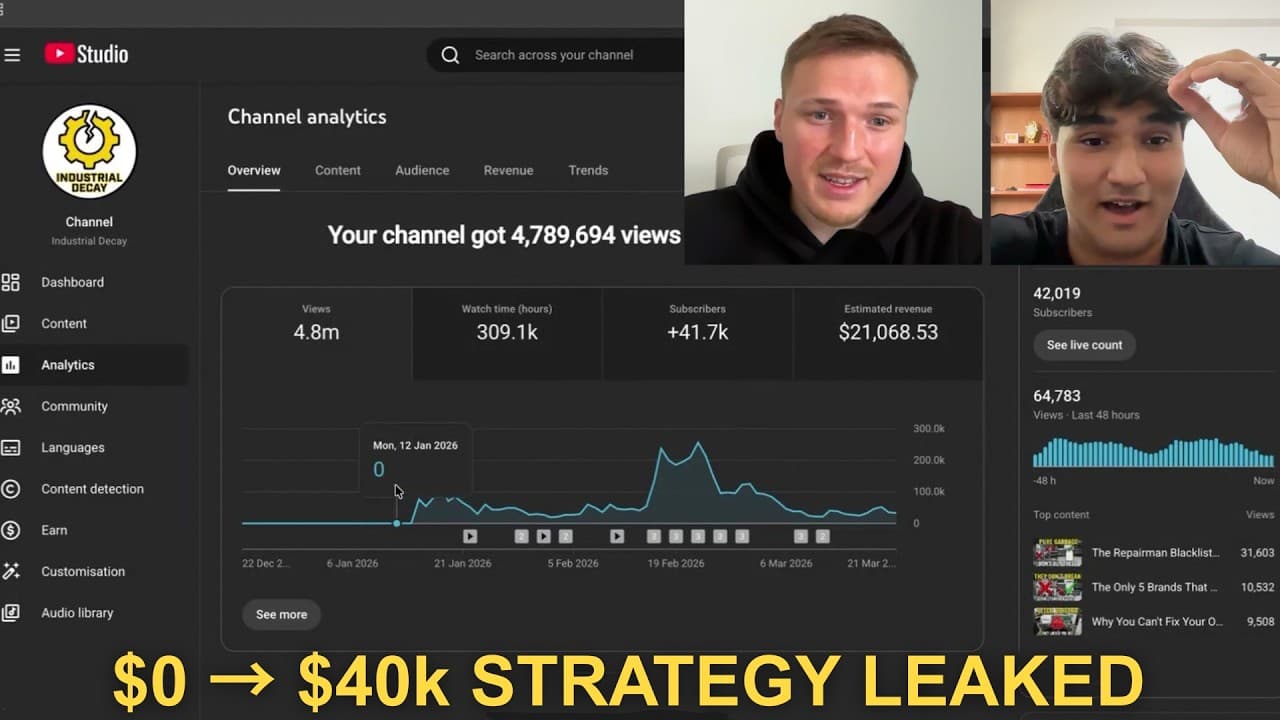
Build a repeatable production system around one proven niche, format, packaging style, and psychological trigger, then outsource the workflow and expand across similar channels. Aryan attributes his reported income of close to $40K in February to this focused long-form strategy, strong topic research, AI tools, team support, and horizontal scaling rather than personally managing unrelated formats.
Transcript
Number one thing for YouTube especially in business is system. >> Can you show your screen so people can see the proof? >> Um I thought they had a real voice over voice over artist just to make AI story. >> Yeah. So you have like two videos more than one mill on a new channel. >> See I just started long form two two three months ago. >> People who ... Read More
Key Insights
- A repeatable system is the foundation of the featured YouTube strategy. Aryan says creators who continue doing everything themselves, without using AI tools or a team, will struggle to scale their channel operations into a broader business.
- Long-form production is more efficient for Aryan than his previous Shorts workflow. He says his team can produce many videos within the time he formerly spent personally editing and scripting short content, making delegation central to his preference for long-form channels.
- Focused experimentation is more productive than launching unrelated channel types simultaneously. Aryan recommends selecting one niche and format that already performs well, improving its process, and expanding horizontally into similar channels instead of dividing effort among AI stories, sleep content, explainers, and other formats.
- Consistent packaging can transfer a successful audience response across related channels. Aryan describes using similar titles, presentation, and psychological triggers on channels within the same format, allowing the established production system and creative approach to support additional launches.
- Evergreen packaging is presented as a safer long-term choice than repeated breaking-news framing. Aryan says he observed strong earlier performance from breaking-news channels but avoided copying that approach because of audience fatigue and concerns about content appearing inauthentic.
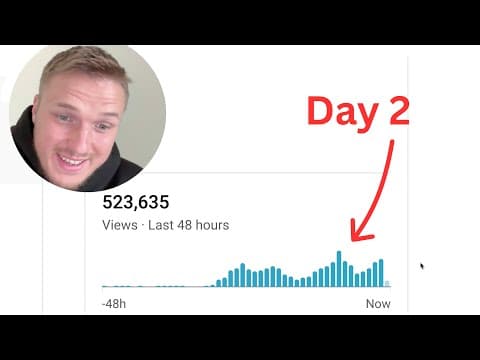
- Strong ideation and topic research can influence a new channel's early performance. One featured channel reportedly received 75K views on its second day, and the discussion attributes that result to topic selection, channel trust, and packaging rather than frequent posting alone.
- Gradually increasing video length can support improved revenue per thousand views. Aryan says his team began with shorter videos and later moved toward roughly 10 to 12 minutes, although he notes that the resulting RPM improvement was limited at that stage.
- Operational fear can prevent otherwise viable scaling. Aryan says concerns about inauthentic-content enforcement caused him to reduce posting, but he later decided to resume publishing and spread the model across additional channels rather than depend entirely on one property.
Install to Summarize YouTube Videos and Get Transcripts
Explore YouTube Video Summarizer or Get YouTube Transcript Extractor
Questions & Answers
Q: How do you scale AI faceless YouTube channels?
Scaling begins by proving one niche, format, packaging style, and psychological trigger, then documenting a repeatable production system around them. Aryan recommends outsourcing the workflow, using AI tools, and launching related channels horizontally instead of personally operating many unrelated formats. The featured channels apply similar titles and packaging so that successful research and production methods can be reused.
Q: Why are systems important for YouTube automation?
Systems allow research, scripting, production, publishing, and team coordination to continue without one person completing every task. Aryan says his earlier approach lacked proper systems, included unnecessary channel launches, and required too much personal work. After stepping back, optimizing operations, and outsourcing almost everything, he felt prepared to expand with a format his team could reproduce consistently.
Q: Why did long-form YouTube work better than Shorts for Aryan?
Long-form content fit Aryan's production model because his team could create videos more efficiently than he could personally script and edit Shorts. He says Shorts consumed significant time without producing the outcome he wanted. Long-form production became easier after he incorporated AI tools, Vid Rush, and delegated team workflows, allowing him to concentrate on strategy and scaling.
Q: Should YouTube creators operate several unrelated niches?
Aryan advises against dividing attention among unrelated niches and formats when one approach is already working. He recommends focusing on a particular audience, mastering the relevant packaging and psychological trigger, and then opening similar channels. His reasoning is that a proven system can be reused horizontally, while unrelated AI stories, sleep channels, explainers, and other formats require different operational knowledge.
Q: How should a new faceless channel choose video topics?
The featured approach emphasizes good ideation, topic research, established audience interest, and packaging that matches a proven format. Aryan's channel reportedly reached 75K views on its second day, which the discussion connects to those factors and a good trust score. The strategy is to identify what already works for the chosen audience and adapt it consistently across related channels.
Q: Is breaking-news packaging effective for faceless channels?
Breaking-news packaging can attract attention, but Aryan and the interviewer describe it as less dependable than before because audiences may become tired of the format. They also connect it with greater inauthentic-content risk. Aryan therefore chose a more evergreen presentation based on subjects and packaging that were already working, aiming for longer-term channel value rather than constant urgency.
Q: How does video length affect RPM on these channels?
Aryan's team began with shorter videos and gradually increased the length to roughly 10 to 12 minutes. He says RPM improved a little, but not dramatically at that point. The discussion also notes that revenue conditions vary across quarters, so longer videos were treated as one optimization within the broader strategy, not as a guaranteed solution by themselves.
Q: What mistakes did Aryan make before building successful channels?
Aryan says he launched random channels, tested many audiences, formats, and niches, and sometimes created channels simply for the sake of launching them. He also tried to manage too much work personally and lacked proper systems. His approach changed after receiving mentorship, focusing on one audience, refining team operations, and applying the resulting model to closely related channels.
Summary & Key Takeaways
-
Aryan says experimentation with e-commerce, Shorts, Snap shows, audiences, niches, and formats produced mixed results. His progress improved after mentorship helped him concentrate on a particular audience. He then shifted toward long-form channels, where AI-assisted production and a team made creating videos easier than personally scripting and editing Shorts.
-
The featured strategy begins with strong topic research, suitable channel trust, and packaging that can attract attention without relying on breaking-news framing. Aryan favors more evergreen subjects because he considers breaking-news packaging vulnerable to audience fatigue and inauthentic-content concerns. His newer channels reportedly gained substantial early traffic using this approach.
-
Aryan identifies systems as the foundation of a scalable YouTube business. After initially launching channels without proper processes and completing much of the work himself, he paused to optimize operations and outsource nearly everything. His intended next step is horizontal expansion through channels sharing proven packaging, topics, and psychological triggers.
Read in Other Languages (beta)
Share This Summary 📚
Summarize YouTube Videos and Get Video Transcripts with 1-Click
Try YouTube Summary with ChatGPT & Claude or YouTube Transcript Generator
Explore More Summaries from Andrew 📚
Summarize YouTube Videos and Get Video Transcripts with 1-Click
Try YouTube Summary with ChatGPT & Claude or YouTube Transcript Generator