How to Revive a Faceless AI YouTube Channel
TL;DR
Revive an established channel by pairing its existing trust with a proven niche, long-form content, realistic visuals, and topics that offer a fresh angle on demonstrated audience demand. Sustainable growth depends on studying outliers, preserving factual accuracy, gathering viewer feedback, and repeating successful formats with meaningful variations instead of copying competitors directly.
Transcript
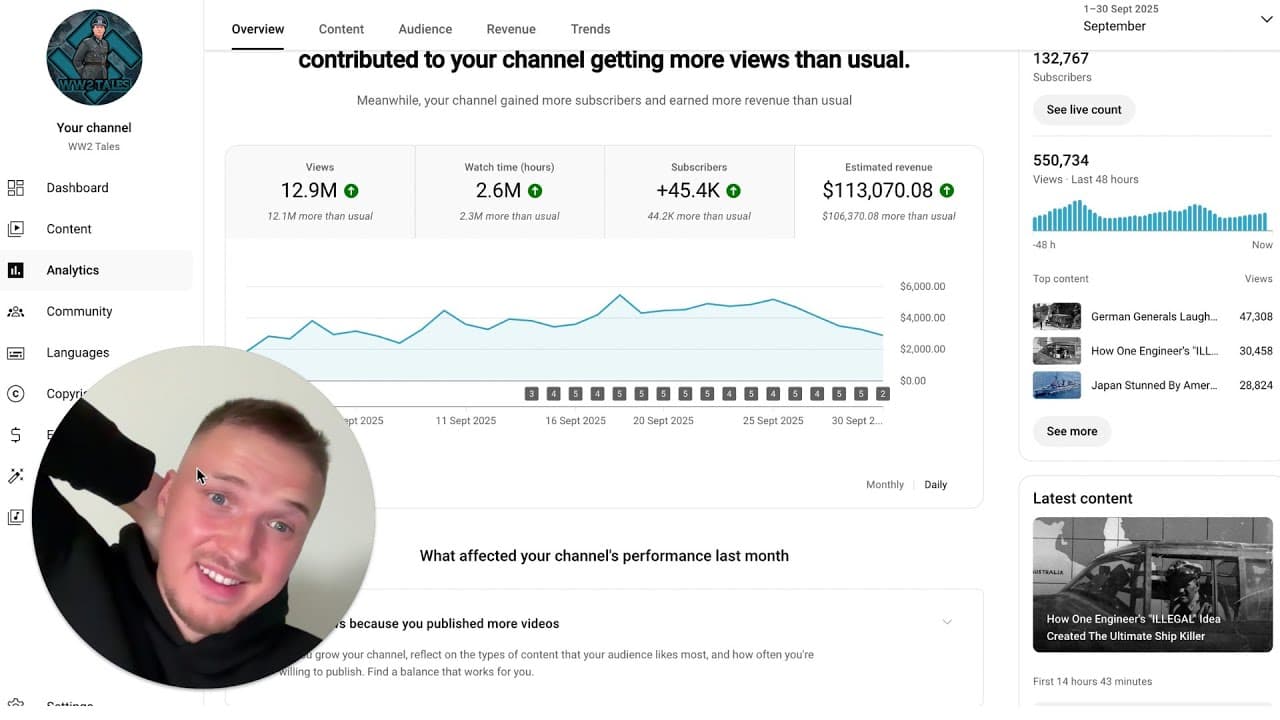
Hey, so today I'm going to do something no one has ever done before. Showing a dead YouTube channel that we revived with my student. So now it's doing six figures per month. Last month you can see September it did 113K and you can see it's also US dollar, right? So I'm going to put it one more time. US dollar. Um I can switch it into euros. So you ... Read More
Key Insights
- An established channel is presented as more valuable than repeatedly launching new channels because its age, prior videos, and previous revenue may contribute to YouTube trust. The strategy began by reviving a declining channel instead of abandoning it for another new experiment.
- The production format is intentionally simple: AI supports script creation and voice-over, while videos combine generated and real images. Some long uploads use only a small set of visuals, suggesting that detailed narration and topic selection matter more than constant visual changes for this audience.
- Niche validation is based on observable demand from established channels rather than guessing whether an audience exists. Competitor performance, audience characteristics, and popular subjects provide data for selecting a market with demonstrated interest and enough room for repeated publishing.
- The target audience is already knowledgeable about World War II, so factual accuracy is essential. Historical claims, images, and story details must remain credible because experienced viewers can recognize misinformation and may stop trusting a channel that repeatedly misrepresents familiar events.
- Cross-transfer works by moving a proven storytelling format from one niche or community into another while adding a distinct perspective. The transcript recommends preserving the structure that attracts viewers but changing the subject, group, setting, or narrative angle enough to create something new.
- Prisoner-of-war daily life is a productive editorial angle because it explores routines and experiences that viewers may not have encountered repeatedly. Topics involving meals, hygiene, barbers, movies, family dinners, pilots, and camp life turn broad military history into focused human stories.
- Long-form content is favored for the described older audience because it supports deeper coverage and stronger viewing duration. The featured format relies on prompts and scripts that sustain attention across multiple subjects instead of competing primarily in the separate market for short videos.
- Audience feedback is a strategic source of topic ideas and quality control. Comments, requests, repeated viewing patterns, and Super Thanks can reveal which viewers are loyal, what they expect next, and whether frequent publishing is strengthening or weakening their relationship with the channel.
Install to Summarize YouTube Videos and Get Transcripts
Explore YouTube Video Summarizer or Get YouTube Transcript Extractor
Questions & Answers
Q: How can an old YouTube channel be revived with AI content?
An old channel can be revived by identifying a proven niche, studying established competitors, and publishing content that matches demonstrated audience expectations while adding a fresh angle. The described workflow uses AI-assisted scripts, an AI voice-over, realistic thumbnails, and a limited mixture of generated and real images. The existing channel history is treated as an advantage, especially when the channel has already published videos and earned revenue.
Q: Why use an established YouTube channel instead of a new one?
An established channel is preferred because its age, publishing history, and previous revenue are presented as signals that may support YouTube trust. The creator argues that many people abandon old channels too quickly because they are distracted by new niches. Reviving an existing asset allows the operator to focus on repositioning, stronger ideas, and consistent execution instead of repeatedly restarting without collecting useful performance data.
Q: How should a faceless YouTube niche be validated?
A faceless YouTube niche should be validated by examining channels that already attract a substantial audience in that subject area. Their popular uploads, recurring themes, audience characteristics, and content styles reveal whether demand exists. The goal is not to copy a competitor. It is to find the overlap between a proven format and an underserved perspective that can support many related videos without exhausting audience interest immediately.
Q: What content format worked for the faceless history channel?
The featured history channel used long narrated videos with a simple AI voice-over and relatively few visual changes. Its visuals mixed AI-generated images with real images, while thumbnails were designed to appear as realistic as possible. The format concentrated on stories about World War II, prisoners of war, pilots, planes, and daily routines, showing that topic relevance and narration can carry content without elaborate editing.
Q: How can creators find fresh ideas without copying competitors?
Creators can study outlier videos, identify the format or emotional appeal behind their performance, and transfer those elements into a different angle. Examples in the transcript include shifting from general World War II stories to prisoner routines, changing the featured group from men to women, or adapting community-focused storytelling from Amish life to another setting. Each idea should remain recognizable to the audience while contributing a meaningful variation.
Q: Why is factual accuracy important for historical YouTube channels?
Factual accuracy is important because the described audience already understands World War II topics and has consumed extensive material about them. Knowledgeable viewers can notice false claims, implausible images, or misleading details. If a channel lies or repeatedly presents misinformation, even a broad audience can lose interest and stop watching. Credibility therefore supports loyalty, feedback, repeat viewing, and continued expansion into related historical stories.
Q: Why does the strategy favor long-form YouTube videos?
The strategy favors long-form videos because the target audience is described as older and willing to consume detailed historical narratives. Longer scripts can cover multiple aspects of a subject and give viewers reasons to remain engaged. The creator also treats short videos as a different market. Strong prompts, structured narration, and relevant ideas are therefore used to sustain attention instead of relying on rapid visual editing.
Q: How should a channel respond when one topic performs well?
When one topic performs well, the channel should treat that result as useful data and publish related ideas with controlled variations. The creator recommends doubling down on successful subjects instead of reinventing the channel after every upload. A history channel might continue exploring prisoners of war, pilots, planes, or daily camp life while changing the event, perspective, routine, or group featured in each story.
Summary & Key Takeaways
-
An established channel that had previously earned revenue was repositioned around World War II stories. The production system used AI-written scripts, an AI voice-over, a limited mixture of generated and real images, and realistic thumbnails. The creator argues that this simple format works because the target audience already consumes long historical narratives.
-
Niche selection began with channels that had already demonstrated demand. The strategy preserved familiar subject matter while introducing less-covered perspectives, particularly the routines, meals, hygiene, entertainment, and treatment of prisoners of war. Related channels showed how focusing on smaller communities or changing the featured group could produce a recognizable but distinct editorial angle.
-
Growth depended on long videos, broad audience potential, frequent publishing, factual credibility, and systematic ideation. Successful topics were treated as data for future uploads, then adjusted rather than duplicated exactly. Viewer loyalty was visible through engagement such as Super Thanks, while audience feedback helped identify expectations and protect the channel from repetitive or inaccurate content.
Read in Other Languages (beta)
Share This Summary 📚
Summarize YouTube Videos and Get Video Transcripts with 1-Click
Try YouTube Summary with ChatGPT & Claude or YouTube Transcript Generator
Explore More Summaries from Andrew 📚






Summarize YouTube Videos and Get Video Transcripts with 1-Click
Try YouTube Summary with ChatGPT & Claude or YouTube Transcript Generator