How to Manage 100+ Faceless YouTube Channels
TL;DR
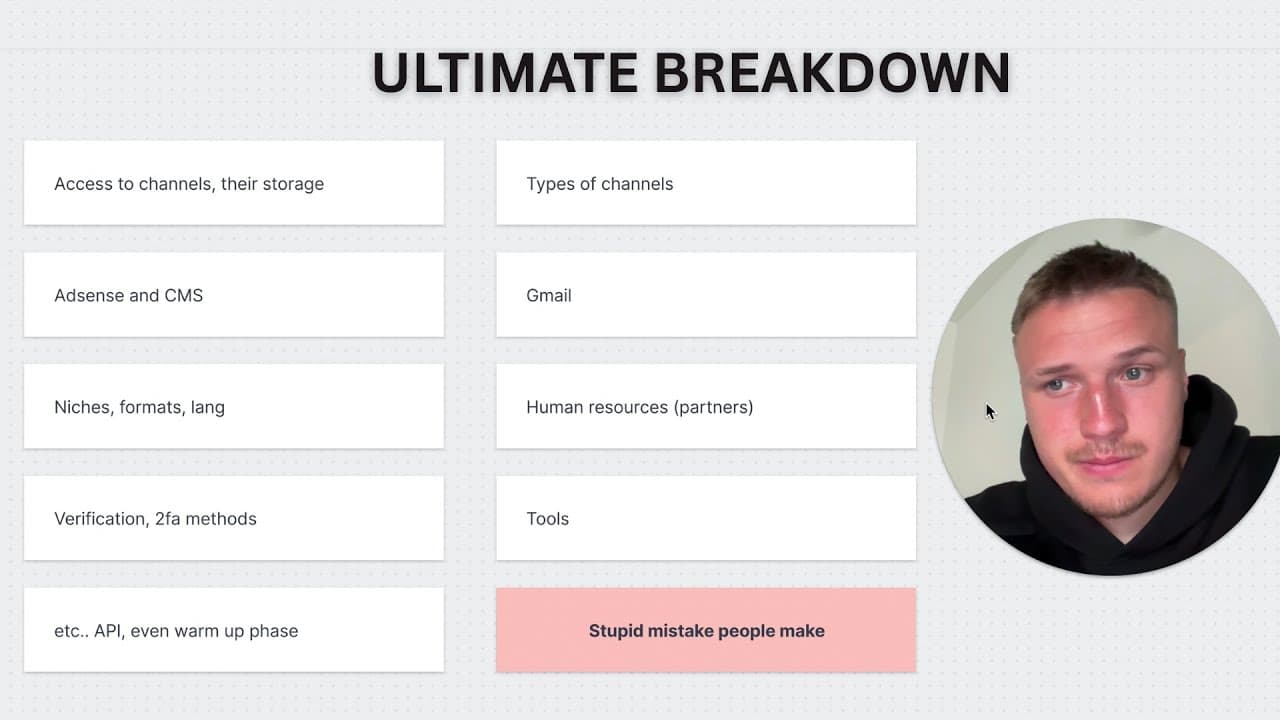
Managing more than 100 faceless YouTube channels requires diversified operations across channel ownership, monetization, verification, access, and content workflows. The central recommendation is to avoid depending on any single Gmail, AdSense account, CMS, phone number, verification identity, or channel type, because one enforcement action or operational failure could otherwise affect a large portion of the business.
Transcript
Hey. Okay. So, people started to ask me about management, about operational things on Twitter more and more often, right? It can be two things because like there are channels, for example, AI channels, they are working and they are ready to start new ones. They are ready to scale, but they don't know. And also the second thing is that uh due to AI,... Read More
Key Insights
- Gmail ownership is a major concentration risk because the presenter estimates that, in roughly 90% of observed cases, terminating one channel also removes the other channels owned by that Gmail. Manager access is distinguished from ownership when assessing this risk.
- Diversification is the central operating principle for channel networks because a single Gmail, AdSense account, CMS, verification identity, phone number, or channel type can become a common failure point. The presenter summarizes this principle as never having only one of anything important.
- AdSense allocation should reflect channel risk because the presenter recommends placing fewer risky channels on each account and allowing more comparatively safe channels to share one. This structure is intended to limit how many channels are affected when a risky channel is terminated.
- CMS dependence can interrupt both traffic and payments because the presenter says a CMS may stop receiving recommendation traffic or fail to pay channel operators. Moving every channel out of one affected CMS can also consume time and reduce revenue during the transition.
- Advanced-feature verification can link channels when the same person verifies many of them. The presenter recommends using different people, including friends, relatives, managers, or editors, because one termination could cause connected channels to lose advanced features or face further enforcement.
- Phone verification is another shared dependency because using one number across every channel creates an identifiable connection. The suggested setup distributes two-factor notification and verification methods instead of attaching the entire operation to one phone number.
- Aged profiles are not uniformly reliable because sellers obtain and transfer them through different sources and processes. The presenter recommends testing them individually and warns that widespread use of aged profiles for AI channels could become a recognizable platform pattern.
- New Google accounts are suitable for beginners but difficult to scale from one computer because creating many accounts on the same device may appear to YouTube as spam. The suggested alternatives involve account creation through friends, managers, editors, or separate laptops.
Install to Summarize YouTube Videos and Get Transcripts
Explore YouTube Video Summarizer or Get YouTube Transcript Extractor
Questions & Answers
Q: How can more than 100 faceless YouTube channels be managed?
More than 100 faceless YouTube channels can be managed through outsourced production, distributed account ownership, multiple monetization arrangements, varied verification methods, and several channel acquisition sources. The core operational rule presented is to avoid relying on one Gmail, AdSense account, CMS, phone number, verification identity, computer, or channel type across the entire network.
Q: Why should multiple YouTube channels not share one Gmail?
Multiple channels should not share one Gmail because a termination may affect every channel that the Gmail owns. The presenter estimates that this happens in roughly 90% of observed cases, although not every case follows that pattern. Manager access is treated differently from ownership, so the warning specifically concerns a Gmail serving as the owner of several channels.
Q: When should multiple translated channels use the same Gmail?
The presenter identifies closely related translated channels as the only stated reason for keeping several channels on one Gmail. If minimally changed translations are spread across unrelated Gmail accounts, YouTube may not understand why separate accounts are publishing another channel’s translated content and may classify the activity as spam. The arrangement still carries concentration risk if one channel is terminated.
Q: How should AdSense accounts be distributed across channel networks?
AdSense accounts should be distributed according to the risk level of the channels attached to them. The presenter recommends placing only a few risky channels on one AdSense account so a termination affects a smaller group. Comparatively safe channels can be grouped in larger numbers, while operators running tens or more than 100 channels are advised to use multiple accounts.
Q: Why should a channel network use more than one CMS?
A channel network should use more than one CMS because a CMS can become a shared traffic or payment problem. The presenter reports situations where channels connected to a CMS stopped receiving browse and suggested traffic from nonsubscribers. A CMS may also fail to pay, and moving every channel from one affected system can cost both time and revenue.
Q: How should advanced features be verified across many channels?
Advanced features should not be verified by only one person across a large channel network. Beginners may initially verify channels themselves, but the presenter recommends involving different friends, relatives, managers, or video editors as operations expand. If many channels share one verification identity, a termination could cause connected channels to lose advanced features or potentially face termination.
Q: Why is relying only on aged YouTube profiles risky?
Relying only on aged profiles is risky because the channels come from different sources and are transferred through different processes, so their quality is inconsistent. The presenter also argues that widespread use of aged profiles for AI channels may create a recognizable pattern. As more similar channels are terminated, that pattern could receive greater weight in YouTube’s detection systems.
Q: What channel types can a scaled faceless operation use?
The channel types discussed include newly created Google accounts, aged profiles, organically aged channels with some views and subscribers, and organically monetized channels already participating in the YouTube Partner Program. The presenter recommends mixing and testing these sources rather than depending on one type, because each option has distinct scaling, sourcing, transfer, monetization, and enforcement risks.
Summary & Key Takeaways
-
The business objective presented is to maximize revenue while minimizing operational problems. YouTube has its own interest in revenue and risk control, while faceless channel operators focus on building outsourced systems that do not require their personal involvement in daily production, uploading, or management across every individual channel.
-
The proposed scaling principle is to avoid concentrating channels around one shared dependency. Gmail ownership, AdSense accounts, CMS providers, advanced-feature verification, phone numbers, computers, and channel acquisition methods can create connections or failure points that expose multiple channels when one account encounters termination, payment, recommendation, or verification problems.
-
The operational setup uses several channel sources, including newly created Google accounts, aged profiles, organically aged channels approaching monetization, and organically monetized channels. Each source has limitations, so operators are advised to test channels, distribute account creation, assess risk levels, and avoid relying exclusively on one acquisition pattern.
Read in Other Languages (beta)
Share This Summary 📚
Summarize YouTube Videos and Get Video Transcripts with 1-Click
Try YouTube Summary with ChatGPT & Claude or YouTube Transcript Generator
Explore More Summaries from Andrew 📚


Summarize YouTube Videos and Get Video Transcripts with 1-Click
Try YouTube Summary with ChatGPT & Claude or YouTube Transcript Generator