How to turn Claude into a one person marketing team

TL;DR
Claude Code links with Higgsfield to automate marketing from a single desktop setup. The three Ps framework guides asset creation: pain, person, and promise. The process includes project setup, brand guidelines, and reusable skills to scale campaigns like ads, carousels, and sizzle reels, with outputs that still benefit from human QA.
Transcript
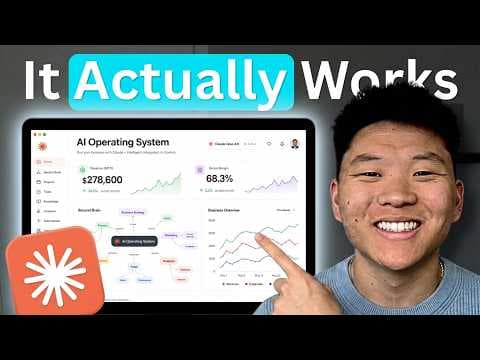
Today, I'm going to show you guys how we're able to turn Claude into a oneperson marketing team. You don't have to be technical at all. You don't have to know how to edit videos or edit photos or anything like that. You just have to know what to ask for. I'm not going to make any assumptions today. I'm going to assume that we're starting at the beg... Read More
Key Insights
- The Three Ps define the project: pain, person, and promise, forming the baseline for every asset and outreach effort.
- Claude Code is used to manage the project locally and automate prompts, which enables non technical users to build a scalable marketing workflow.
- Higgsfield provides multiple AI models for video, image, and marketing tasks, integrated through Claude to produce cohesive assets.
- Brand guidelines are essential and must be loaded into Claude so generated assets follow specific colors, typography, and logos.
- Assets are organized into structured folders like brand guidelines and product shots, enabling reuse and consistency across campaigns.
- A project folder is created on the desktop to host all generated assets and to serve as the live workspace for Claude Code.
- Outputs include logos, product shots, studio shots, and UGC prompts, all generated by AI but connected to real brand intent.
- A human QA step remains necessary to ensure quality, tone, and brand alignment before publishing final assets.
- More videos from this channel:
- More from this channel: Nate Herk | AI Automation
Install to Summarize YouTube Videos and Get Transcripts
Explore YouTube Video Summarizer or Get YouTube Transcript Extractor
Questions & Answers
Q: What is the purpose of the Three Ps in this workflow?
The Three Ps provide a structured framework to align marketing outputs with a specific business need. Pain identifies the problem the target customer experiences, Person defines who experiences it, and Promise explains how the product or service solves the problem. This setup helps Claude generate assets that are purposeful and tailored rather than generic AI outputs, ensuring consistency across all channels.
Q: How does Claude Code interact with Higgsfield in this setup?
Claude Code acts as the project manager that organizes assets, prompts, and brand guidelines while Higgsfield supplies the AI models for creating images, videos, and other marketing assets. The integration enables automated generation of components like logos and product shots within a single project, reducing manual steps and maintaining brand coherence.
Q: What steps are taken to start a new marketing project with Claude Code?
A new marketing project begins by creating a dedicated folder on the desktop, then opening Claude Code in local mode and selecting that folder as the workspace. A claw.md file is created to instruct Claude on project goals, the brand context, and the tasks it should perform, setting the foundation for scalable asset generation.
Q: Why are brand guidelines important in this workflow?
Brand guidelines ensure that all generated assets follow a consistent visual identity, including color schemes, typography, and logo usage. By loading these guidelines into Claude, every asset—whether a logo, product shot, or ad creative—adheres to the same brand voice, reducing the risk of disconnected or off brand outputs.
Q: What kinds of assets can be generated with this setup?
The workflow can generate logos, product shots, studio assets, storyboard assets for UGC, and various ad creatives like carousels and sizzle reels. It can also drive the creation of a branded website and a marketing tracker, all coordinated through Claude Code and Higgsfield for cohesive output.
Q: What role does the three Ps play in ongoing content creation?
The three Ps guide new content by re evaluating who the content is for (Person), what problem it solves (Pain), and how the brand promises a solution (Promise). This ongoing focus helps Claude produce assets that stay relevant to the target audience and aligned with the brand, even as campaigns evolve.
Q: Is human involvement still needed with this AI driven process?
Yes, human involvement remains essential for QA to ensure tone, quality, and brand alignment before anything goes live. While Claude Code and Higgsfield automate many steps, final review validates accuracy, messaging, and creative quality, preventing misalignment or errors in published assets.
Q: How does the workflow support scalability for an AI driven agency?
By creating reusable skills and a structured project with folders and prompts, the workflow scales across multiple campaigns and clients. Claude Code automates repetitive tasks, Higgsfield supplies powerful models, and brand guidelines keep outputs consistent, allowing a one person team to manage a growing marketing operation.
Summary & Key Takeaways
-
This summary explains how Claude Code and Higgsfield are connected to automate marketing tasks for a small team, using a project structure and brand guidelines to generate consistent assets. The approach emphasizes starting from the basics, establishing a project folder, and training Claude Code to understand the brand. Outputs include websites and various ad creatives, with ongoing human oversight.
-
The method centers on the three Ps—pain, person, and promise—to ensure assets stay brand aligned and purpose driven, avoiding generic AI results. It demonstrates setting up a local Claude environment, linking tools, and generating base assets like logos, product shots, and brand materials for scalable campaigns.
-
The video showcases end to end execution from project creation to asset generation and QA, highlighting outputs such as websites and ads while acknowledging that first-pass generations may need human refinement to meet quality standards.
Read in Other Languages (beta)
Share This Summary 📚
Summarize YouTube Videos and Get Video Transcripts with 1-Click
Try YouTube Summary with ChatGPT & Claude or YouTube Transcript Generator
Explore More Summaries from Nate Herk | AI Automation 📚





Summarize YouTube Videos and Get Video Transcripts with 1-Click
Try YouTube Summary with ChatGPT & Claude or YouTube Transcript Generator