How Do Claude’s New Managed Agents Work, and When Should You Use Them?
TL;DR
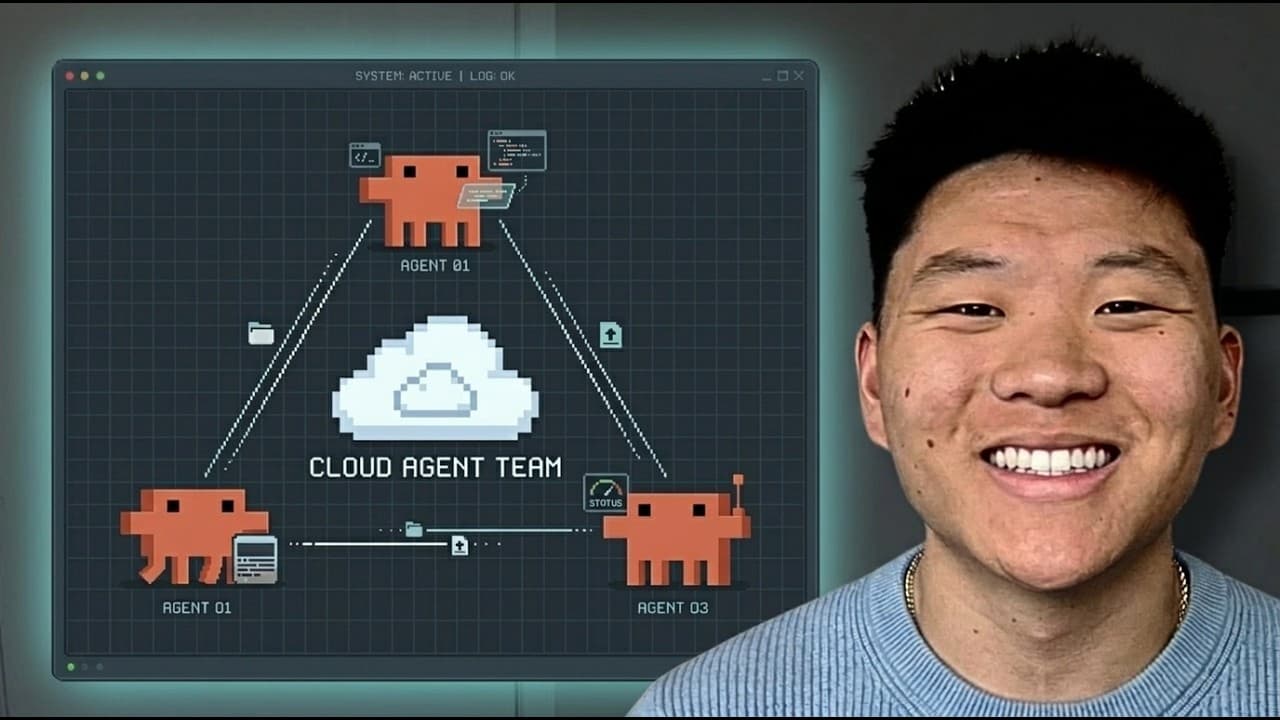
Claude’s Managed Agents let you deploy agents on Anthropic’s cloud by defining their tasks, tools, and guardrails instead of building the underlying infrastructure yourself. Anthropic says this can make deployment 10 times faster, and the setup follows a five-step process with hosted environments, sessions, MCP connections, and shared credential vaults. Read on for costs, limitations, integrations, and who benefits most.
Transcript
4 days ago, Claude came out and said, "Hey, you're no longer allowed to use your subscription inside of third party harnesses like OpenClaw." And people were upset because now they're paying a lot more for AI unless they're using something local. And then yesterday, Anthropic says, "Hey, we literally have a model that's too dangerous to release. It... Read More
Key Insights
- Managed Agents allow users to deploy AI agents without infrastructure setup, speeding up production by tenfold.
- Users define agent tasks, tools, and guardrails, and Anthropic's cloud provides a sandbox environment for execution.
- Businesses can integrate Managed Agents with platforms like Notion to automate task delegation and processing.
- The service is beneficial for those unfamiliar with cloud code, offering a simplified interface for agent creation.
- Pricing is based on active session time, costing 8 cents per hour, plus API token usage.
- Managed Agents lack features like cron jobs, limiting automation capabilities compared to alternatives like trigger.dev.
- Upcoming features include outcomes, multi-agent orchestration, and persistent memory, enhancing agent functionality.
- The CLI tool allows integration with existing cloud code projects, offering potential for more tailored agent setups.
Install to Summarize YouTube Videos and Get Transcripts
Explore YouTube Video Summarizer or Get YouTube Transcript Extractor
Questions & Answers
Q: How do Claude’s Managed Agents work?
You define an agent’s tasks, tools, guardrails, model, system prompt, and optional skills or MCP servers. Anthropic then runs it in a hosted cloud sandbox, so you do not have to set up the underlying infrastructure yourself.
Q: How do you create a Managed Agent in the Claude console?
Open Managed Agents in the Claude console and choose a template or describe the agent you want through the chat-style interface. The interface generates its name, description, model, system prompt, MCP server, and tools, which you can refine before creating the agent.
Q: Do you need a Claude subscription to use Managed Agents?
No subscription is required according to the walkthrough. You can set up an API key instead, although the presenter says you need to put in about five dollars to get started.
Q: How much do Anthropic Managed Agents cost?
Managed Agents cost 8 cents per hour of active session time, plus API token usage. You are charged while a session is live and running, rather than while its environment is idle.
Q: Who benefits most from Claude’s Managed Agents?
They provide the most value to people who mainly use Claude chat and have not worked with Claude Code or similar development tools. Experienced Claude Code users may find the interface less useful because it offers less customization than tools they already use.
Q: How are tools and credentials connected to a Managed Agent?
Tools such as ClickUp can be connected through MCP using an access token, OAuth credentials, or a sign-in flow. The resulting credentials are stored in a vault, which can be shared among different people on a team.
Q: What are the main limitations of Managed Agents?
Managed Agents lack advanced automation features such as cron jobs, so they cannot natively handle some scheduled workflows. The presenter also finds them less flexible than alternatives such as trigger.dev or OpenClaw, especially for experienced users seeking deeper customization.
Q: What future features are planned for Managed Agents?
Expected additions include outcomes for defining task success, multi-agent orchestration for delegating subtasks, and persistent memory across sessions. A CLI also allows Managed Agents to be integrated with existing Claude Code projects for more tailored setups.
Summary & Key Takeaways
-
Anthropic's Managed Agents provide a cloud-based solution for deploying AI agents, eliminating the need for infrastructure setup. Users can quickly define tasks and set up agents, making it ideal for those new to AI development. However, experienced developers may find it lacks customization compared to other tools.
-
Managed Agents are integrated with platforms like Notion, enabling automated task management. Pricing is based on session activity, with costs incurred only when agents are actively running. Despite its ease of use, the service lacks advanced automation features such as cron jobs.
-
Future updates promise to enhance Managed Agents with features like outcomes, multi-agent orchestration, and persistent memory. The CLI tool offers additional flexibility for integrating Managed Agents into existing cloud code projects, potentially increasing their utility for experienced users.
Read in Other Languages (beta)
Share This Summary 📚
Summarize YouTube Videos and Get Video Transcripts with 1-Click
Try YouTube Summary with ChatGPT & Claude or YouTube Transcript Generator
Explore More Summaries from Nate Herk | AI Automation 📚






Summarize YouTube Videos and Get Video Transcripts with 1-Click
Try YouTube Summary with ChatGPT & Claude or YouTube Transcript Generator