How to build an AI mobile app that earns $20K/mo

TL;DR
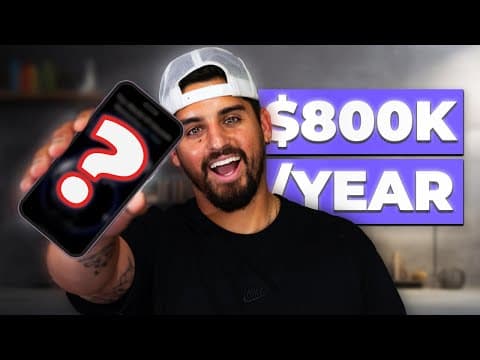
Mal built Prayer Lock in 3 days using AI tools and grew it to over $20K per month with a 58K download base. The playbook emphasizes fast AI driven development, high velocity testing, strong onboarding, and organic growth on social platforms before scaling with paid ads.
Transcript
I launched my app 6 months ago and now it makes over 20K a month. This is Matt, a regular guy who changed his life by building an app with AI. It took me 3 days to code the app with AI. But this is not a story about how to build. It's a story about how fast apps can grow if you focus on the right things. I asked Ma to come on to the channel to brea... Read More
Key Insights
- The app is a subscription based model with a strong pricing page and on device data storage to reduce friction.
- Rapid prototyping using AI tools allowed building the app in about three days, followed by a week of App Store approval.
- Onboarding quality is critical, with a reported 43 percent conversion rate and high review rate driving trust and retention.
- A singular viral format on a single platform, started through DIY content, can generate thousands of views and hundreds of downloads per day.
- Volume in content creation was essential; initial attempts failed until a highly repeatable format was found and scaled.
- Paid ads were tested after organic growth, with lessons learned about optimizing for trials versus downloads.
- Avoiding complex authentication reduces friction and costs while preserving user experience and retention.
- Understanding the niche and competitive landscape allowed the founder to pivot from a prior project to a more aligned Christian space.
- More videos from this channel:
- More from this channel: Starter Story
Install to Summarize YouTube Videos and Get Transcripts
Explore YouTube Video Summarizer or Get YouTube Transcript Extractor
Questions & Answers
Q: How do you decide what app to build to maximize early traction?
The core approach is to study successful apps in the target niche and even related niches, then translate the best onboarding and flow into your own app. Start coding rather than perfecting mockups, use a combination of AI tools for different tasks, and avoid overbuilding the initial product. Focus on a defensible, frictionless onboarding and a clear value proposition to push early adoption.
Q: What enables you to build an app in three days with AI?
The key is breaking the build into manageable blocks and using AI to generate sections rather than attempting to generate the entire app at once. Tools like Cursor, Codex CLI, and ChatGPT help with coding questions, task automation, and rapid iteration. Avoid trying to create a perfect product from day one; instead, assemble a working core quickly and iterate.
Q: How important is the onboarding experience to monetization?
Onboarding quality directly correlates with conversion rates and user retention. A fast, clear path from installation to value with minimal friction reduces drop-off and improves revenue metrics. In this case, a high onboarding rate and a strong evaluation of user actions led to a sustained monthly revenue growth and a favorable user base.
Q: What role did content marketing play in growth?
Content marketing served as the primary growth engine in the early phase. Posting frequently, finding a repeatable format that resonates with viewers, and scaling that format across platforms generated significant organic downloads. The emphasis on volume plus a single effective format allowed the founder to reach thousands of daily views and convert them into paying users.
Q: Did paid advertising work for scaling the app, and how was it approached?
Paid ads were explored after organic growth proved viable. The learning curve involved optimizing for trials versus downloads and aligning ad spend with the funnel stages. While initial attempts faced challenges, the insights gained informed a more strategic approach to ads, including targeting and value proposition alignment to encourage longer subscriptions.
Q: What is the recommended setup for a non technical founder to start building with AI?
Use simple, cost effective tools for different tasks: a daily driver for coding, a CLI like Codex for automation, and a question based AI for problem solving. Prioritize learning by doing and avoid large upfront investments in token usage. This approach keeps costs predictable while enabling rapid experimentation and iteration.
Q: How did you validate the market and your product concept?
Validation came from a combination of market research, product analytics, and real user feedback. A clear revenue stream from subscriptions and a measurable user base provided proof of demand. The founder also used transparent dashboards to monitor performance and iterated the product and marketing based on observed metrics, keeping the project aligned with user needs.
Q: What pitfalls should new founders avoid when trying to replicate this success?
Avoid building a product with no market fit or overcomplicating the architecture early on. Don’t chase hype formats without data and avoid overinvestment before proven demand. Focus on a frictionless onboarding, a repeatable growth method, and a clear monetization path. Learn from failed experiments and iterate with intent rather than just chasing views or traffic.
Summary & Key Takeaways
-
Prayer Lock blocks your phone until you pray and uses AI generated prayers for a personalized user experience, enabling a subscription model that contributed to rapid revenue growth.
-
The creator leveraged a multi-phase growth strategy starting with high volume content posting, finding a single effective video format, and then scaling with one successful creator before experimenting with paid ads.
-
The interview emphasizes practical, execution-focused advice over theory, highlighting tools like Cursor, Codex CLI, and ChatGPT to minimize costs and accelerate app development and growth.
Read in Other Languages (beta)
Share This Summary 📚
Summarize YouTube Videos and Get Video Transcripts with 1-Click
Try YouTube Summary with ChatGPT & Claude or YouTube Transcript Generator
Explore More Summaries from Starter Story 📚

Summarize YouTube Videos and Get Video Transcripts with 1-Click
Try YouTube Summary with ChatGPT & Claude or YouTube Transcript Generator