Real Analysis: How Do You Test the Differentiability of a Function?
TL;DR
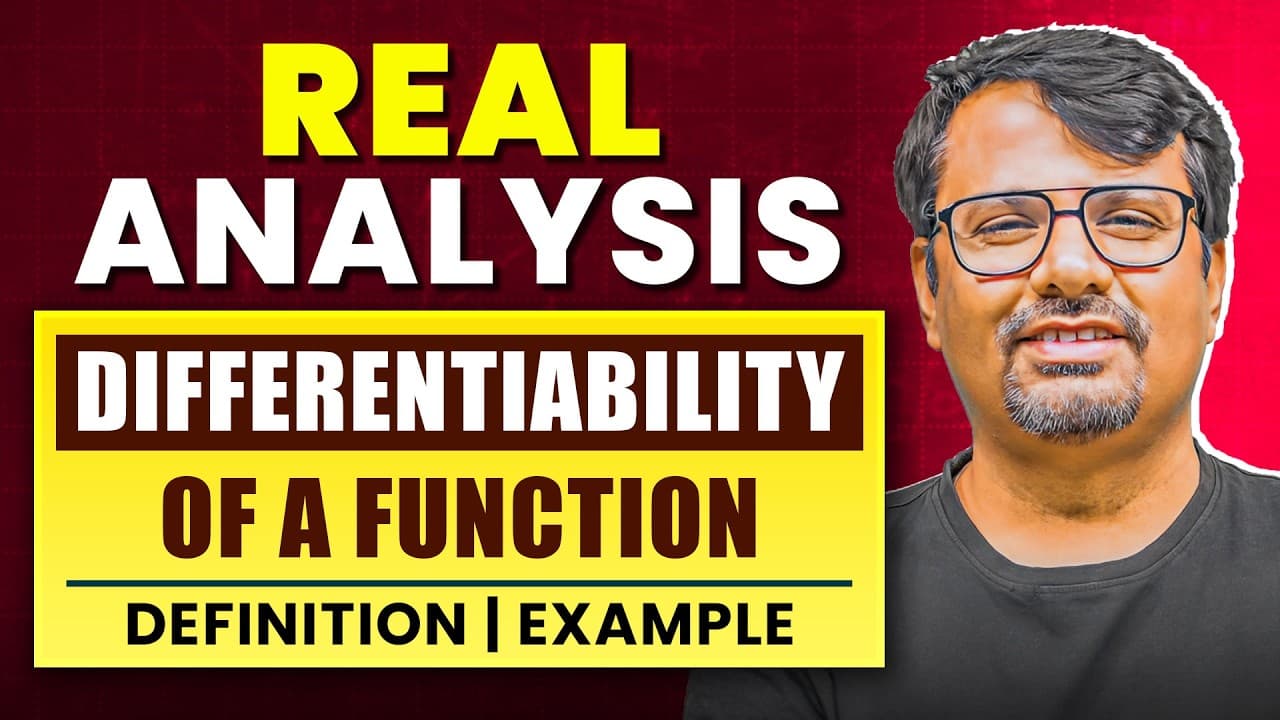
A function is differentiable at an interior point when its derivative limit exists, or equivalently when its left-hand and right-hand derivatives both exist and are equal. Continuity alone is insufficient: |x| is continuous at x = 0 but has a sharp edge and unequal one-sided derivatives. The worked examples show how limits and branch derivatives reveal differentiability, so read on for practical tests at x = 0 and x = 1.
Transcript
Hello students I'm Dr Gajendra Purohit You are watching my YouTube channel where I upload videos for Engineering Mathematics BSc students If you are preparing for any competition exams where higher mathematics asked than my YouTube channel is very helpful for you here is the i tab where my previous videos related to real analysis where I describe m... Read More
Key Insights
- Differentiability at an interior point is determined by whether the defining derivative limit exists. The difference quotient compares the change in the function with the change in its input as the increment approaches zero.
- Left-hand and right-hand derivatives are decisive tests for differentiability. A function is differentiable at a specified point only when both one-sided derivatives exist and have exactly the same value there.
- Continuity is necessary for differentiability, but continuity does not by itself prove that a derivative exists. A continuous graph may still contain a sharp edge that prevents the assignment of one consistent tangent slope.
- The function |x| is continuous but not differentiable at x = 0. Its graph has a sharp corner at that point, and the derivative obtained from one side does not equal the derivative obtained from the other side.
- A tangent-based interpretation connects differentiability with graph shape. Smooth points admit a well-defined slope, while a sharp edge indicates that the slope changes abruptly and the derivative at that point does not exist.
- An oscillating difference quotient does not have a derivative limit. In the first limit example, cancellation leaves a term whose value oscillates between -1 and 1 as x approaches zero, so the function is not differentiable there.
- Replacing the first example's factor x with x² changes the difference quotient so that the remaining expression approaches zero. The resulting limit exists, making the modified function differentiable at zero. The stated parameter condition is alpha greater than 1.
- Piecewise differentiability can be checked by differentiating each formula and evaluating both derivatives at the joining point. Equal values of zero establish differentiability for the cubic example at zero, while values 2 and -1 establish failure at x = 1.
Install to Summarize YouTube Videos and Get Transcripts
Explore YouTube Video Summarizer or Get YouTube Transcript Extractor
Questions & Answers
Q: What does it mean for a function to be differentiable at a point?
A real-valued function is differentiable at an interior point when its derivative limit exists there. Equivalently, its left-hand and right-hand derivatives must both exist and have the same value.
Q: How do you test differentiability using left-hand and right-hand derivatives?
Calculate the derivative while approaching the point separately from the right and the left. The function is differentiable only when both one-sided derivatives exist and are equal; unequal values mean it is not differentiable.
Q: Does continuity guarantee that a function is differentiable?
No. The transcript explains that continuity is required for differentiability, but a continuous function can still have a sharp edge that prevents a consistent derivative from existing.
Q: Why is |x| not differentiable at x = 0?
Although |x| is continuous at x = 0, its graph has a sharp edge there. Its left-hand and right-hand derivatives do not agree, so no single tangent slope can be assigned at zero.
Q: How does an oscillating derivative limit affect differentiability?
A derivative limit must settle at one value to exist. In the example, the resulting expression oscillates between -1 and 1 as x approaches zero, so the limit does not exist and the function is not differentiable at zero.
Q: Why does the modified example with x² become differentiable at zero?
After x² is divided by x in the difference quotient, the remaining expression approaches 0. Because the derivative limit exists and equals 0, the modified function is differentiable at x = 0; the stated parameter condition is alpha greater than 1.
Q: How can you quickly test a piecewise function for differentiability at x = 0?
Differentiate the formulas used on the two sides and evaluate both derivatives at the joining point. In the cubic example, the derivatives are 3x² and -3x², and both equal 0 at x = 0, so the function is differentiable there.
Q: Why is the piecewise example not differentiable at x = 1?
The right-hand derivative at x = 1 is 2, while the left-hand derivative is -1. Because these values are unequal, the function is not differentiable at x = 1.
Summary & Key Takeaways
-
Differentiability at an interior point is defined through the existence of a derivative limit. The same condition can be tested by calculating the left-hand and right-hand derivatives. If both one-sided derivative values exist and are equal, the function is differentiable at that point. Unequal or nonexistent values establish non-differentiability.
-
Continuity is required before differentiability can be considered, but continuity alone is insufficient. The function |x| is continuous at zero, yet its graph has a sharp edge there and its one-sided derivatives disagree. The geometric interpretation is that a consistent tangent slope cannot be assigned at the corner.
-
For piecewise examples, each branch can first be differentiated and evaluated at the joining point as a shortcut. Cubic branches producing 3x² and -3x² both give zero at x = 0, so differentiability holds. At x = 1, derivative values of 2 and -1 disagree, so differentiability fails.
Read in Other Languages (beta)
Share This Summary 📚
Summarize YouTube Videos and Get Video Transcripts with 1-Click
Try YouTube Summary with ChatGPT & Claude or YouTube Transcript Generator
Explore More Summaries from Dr.Gajendra Purohit 📚





Summarize YouTube Videos and Get Video Transcripts with 1-Click
Try YouTube Summary with ChatGPT & Claude or YouTube Transcript Generator