How to Prevent AI Agent Privilege Escalation
TL;DR
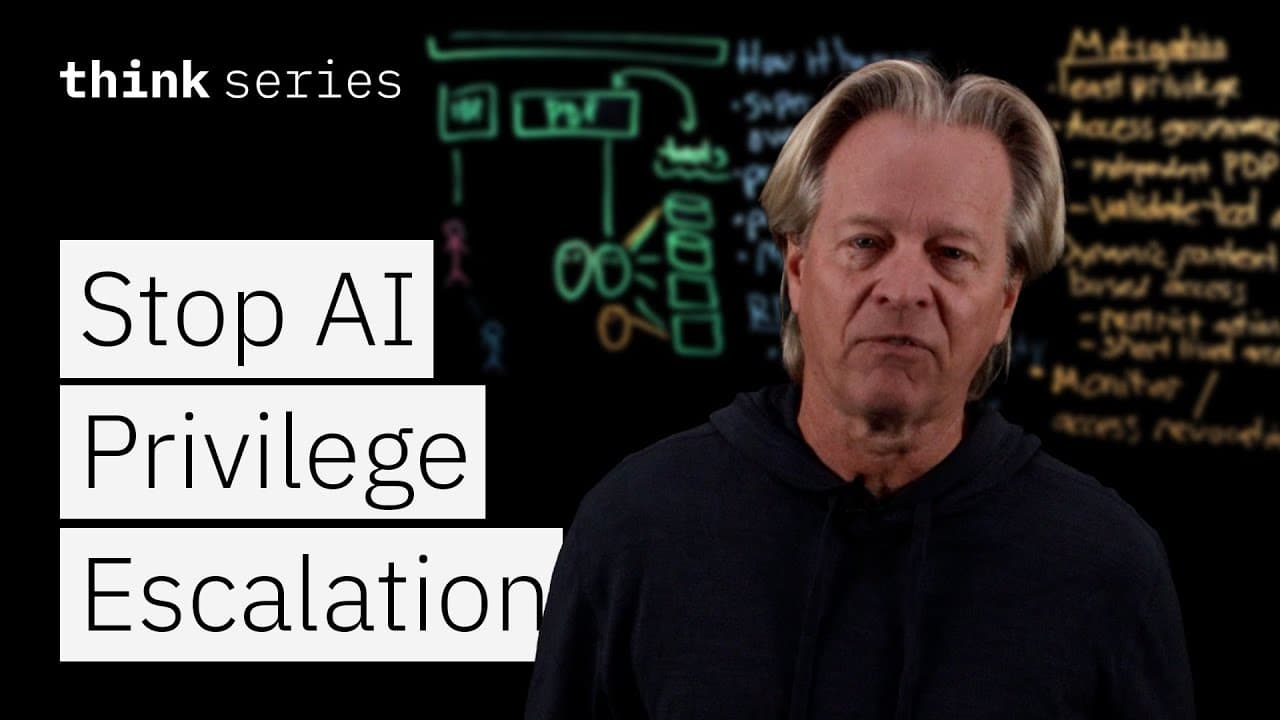
Prevent AI privilege escalation by giving each agent only the permissions required for a narrow task, then applying the least privileged union of the user and agent permissions. An independent policy decision point, tool-level validation, and dynamic context-based access further restrict what an agent can do, reducing opportunities for prompt injection, privilege inheritance, and misconfiguration to expose data, tools, or processes.
Transcript
Howdy, everyone! In this video, we're going to look at AI privilege escalation and get an understanding of how agentic identity can help. We're also going to look at security considerations involved when AI agents are granted elevated permissions. To begin with, let's start out with a definition. So we understand what we're talking about. What is p... Read More
Key Insights
- AI privilege escalation is the use of an AI system by a malicious actor to obtain unauthorized, elevated access. It involves exploiting vulnerabilities so the actor receives permissions beyond those normally assigned and can reach protected data, tools, processes, or other system resources.
- Over-permission is a primary enabler of privilege escalation because an agent with broad agency can interact with many parts of a system and take many actions. If a malicious actor controls or manipulates that agent, the actor may indirectly gain access to everything the agent can reach.
- Privilege inheritance is the use of another identity or agent's permissions to access resources that the user could not access directly. It can occur when a low-privilege user operates through a highly privileged agent or when an attacker compromises the identity of an authorized person.
- Prompt injection is a method for manipulating an agentic system through crafted prompts. A malicious actor can probe for vulnerabilities and attempt to make an over-permissioned agent provide access or perform actions that the actor would not normally be authorized to request.
- Misconfiguration is a common path to exploitation in both traditional and agentic systems. Missing or improper controls can create an unnoticed backdoor or access point, which an attacker may exploit through prompts or through an agent capable of inspecting and manipulating exposed system configurations.
- Least privilege is the practice of granting an agent only the permissions required for a narrow task. Agents should not connect to everything. Separate agents can be assigned to separate resources, limiting the reach of any compromised agent and reducing opportunities for unauthorized privilege escalation.
- The least privileged union is an authorization approach that evaluates both the requesting user and the acting agent. The resulting access should reflect the least privilege available between them, preventing a low-privilege actor from exploiting an agent with broader permissions to reach restricted resources.
- Independent access governance is a control that prevents users and agents from defining their own authorization. A separate policy decision point defines allowed actions, tools validate agent requests against governance, and dynamic context-based access narrows each permission to the specific action required by the request.
Install to Summarize YouTube Videos and Get Transcripts
Explore YouTube Video Summarizer or Get YouTube Transcript Extractor
Questions & Answers
Q: What is AI privilege escalation?
AI privilege escalation is the act of using an AI system to gain unauthorized and elevated access within a system. A malicious actor exploits vulnerabilities to obtain permissions beyond those normally assigned. In an agentic environment, that access can extend to the data, tools, processes, and other resources available to an agent, especially when the agent has broad permissions or extensive agency.
Q: How does over-permission enable AI privilege escalation?
Over-permission enables privilege escalation by giving an agent access to many resources and the ability to take many actions across a system. When a malicious actor gains access to or manipulates that agent, the actor can use the agent's capabilities indirectly. The resulting exposure can include data, tools, processes, and other system components that the actor could not access through their own assigned permissions.
Q: How does privilege inheritance create security risk for AI agents?
Privilege inheritance creates risk when a user gains the benefit of permissions assigned to an agent or another person. A user without direct access to tools or data may operate through an agent that has broad access. A malicious actor may also compromise an authorized person's identity and use that identity so the agent recognizes elevated privileges and performs actions the attacker could not otherwise request.
Q: How can prompt injection cause privilege escalation?
Prompt injection can cause privilege escalation when a malicious actor crafts or repeatedly changes prompts to manipulate an agentic system. The attacker probes for vulnerabilities and tries to persuade an agent to provide additional access or perform unauthorized actions. The risk becomes greater when the targeted agent is over-permissioned because a successful manipulation can expose every tool, data source, or process available to that agent.
Q: Why are misconfigurations dangerous in agentic systems?
Misconfigurations are dangerous because missing or improper controls can create an unnoticed backdoor or access point. A malicious actor may exploit that opening directly, through prompt injection, or by using an over-permissioned agent to inspect and manipulate the system. Once the configuration is exploited, the attacker may gain access to resources that should remain protected, compromising security and increasing potential damage.
Q: How should least privilege be applied to AI agents?
Least privilege should limit each agent to the permissions needed for a narrow task. An agent responsible for one resource should not automatically connect to every tool or system. If another connection is required, a separate agent can handle that responsibility. Authorization should also evaluate both the user and the agent, applying the least privileged union so neither party can use the other's broader access.
Q: What is an independent policy decision point for AI agents?
An independent policy decision point is a governance mechanism that defines what an agent is allowed to access and do. It prevents an agent or user from self-defining permissions or escalating access when a task arises. The agent authenticates against this separate governance system, which establishes its permitted actions. Prompt manipulation cannot authorize additional access unless enterprise-level governance already allows the requested capability.
Q: How do tool validation and context-based access reduce AI risk?
Tool validation requires a tool to check whether it trusts the requesting agent, whether the agent has permission, and whether the requested action is appropriate. Dynamic, context-based access adds another restriction by evaluating the prompt or request and narrowing permission to the exact action required. For example, when a task only requires reading, the agent's effective access should be restricted to a read action rather than broader modification or deletion capabilities.
Summary & Key Takeaways
-
AI privilege escalation occurs when a malicious actor exploits an agentic system to obtain unauthorized, elevated access. The main enabling conditions are agents with excessive agency, inherited privileges, prompt injection, and security misconfigurations. Because agents may interact with data, tools, and processes, compromised access can weaken security and increase damage.
-
Least privilege limits every agent to the permissions needed for a narrow responsibility. Instead of allowing one agent to connect broadly across a system, separate agents can handle separate resources or tasks. Effective authorization also considers both the user and agent, applying the least privileged union so neither can borrow excessive access from the other.
-
Access governance should remain independent from users and agents so they cannot define or elevate their own permissions. Agents authenticate against a policy decision point, while tools validate the agent, its permissions, and the requested action. Dynamic, context-based controls then narrow access further, such as permitting only a read action when the request requires reading.
Read in Other Languages (beta)
Share This Summary 📚
Summarize YouTube Videos and Get Video Transcripts with 1-Click
Try YouTube Summary with ChatGPT & Claude or YouTube Transcript Generator
Explore More Summaries from IBM Technology 📚
Summarize YouTube Videos and Get Video Transcripts with 1-Click
Try YouTube Summary with ChatGPT & Claude or YouTube Transcript Generator