How to Prepare for Every Section of IELTS

TL;DR
Improve your IELTS score by diagnosing your weakest skill and practicing it actively with reliable materials. For writing, compare your own ideas and paragraph development with real Band 7, 8, and 9 essays, focusing on relevance, clarity, explanations, and examples instead of memorizing language or copying complete responses.
Transcript
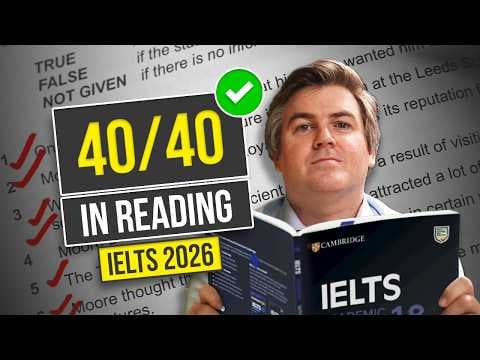
you've just found the ultimate I preparation resource this is the longest most detailed most comprehensive I preparation course on YouTube it's going to help you be successful by giving you real band8 and N samples free practice tests and complete courses on reading writing speaking and listening so I success is just around the corner for you all y... Read More
Key Insights
- Reliable sample essays are essential because studying responses inaccurately presented as Band 9 can reinforce weak writing habits. The course provides essays marked by real IELTS examiners and written by students who later received Band 7, 8, or 9 scores.
- Passive reading is not sufficient writing practice because merely looking through many strong essays does not automatically improve writing ability. Students need to analyze questions, produce their own ideas and paragraphs, and compare their work actively with the samples.
- High-scoring IELTS writing is clear and relatively simple, rather than filled with unnecessarily complicated language. The transcript says students often misjudge Band 6 work as Band 9 and underestimate Band 9 essays because they are easy to understand.
- Band 7 essays can contain grammar and vocabulary mistakes, so the presence of errors does not automatically make a response low-level. Students should avoid trying to replace examiner judgment with their own unsupported scoring of authentic sample essays.
- Memorized phrases are not a substitute for communication because IELTS writing tests whether a candidate can express ideas clearly in English. Samples may support grammar and vocabulary development, but copying memorized chunks into an unrelated response will not demonstrate that ability.
- Complete essays should never be copied into a test response regardless of the question. A previously written high-level answer cannot produce a strong result when it fails to address the actual task, and using samples this way wastes both preparation time and test fees.
- Effective preparation begins with the student's biggest weakness, not the skill that feels most comfortable. The course recommends reviewing all proposed techniques, selecting the most difficult or necessary area, and working on it first to improve as quickly as possible.
- Strong idea generation depends on relevant, straightforward answers to the question, not unusually complex arguments. Students can cover a sample response, generate the simplest obvious ideas themselves, and then compare them with the main ideas in Band 7, 8, and 9 essays.
Install to Summarize YouTube Videos and Get Transcripts
Explore YouTube Video Summarizer or Get YouTube Transcript Extractor
Questions & Answers
Q: How should I use IELTS sample essays to improve my writing?
Use sample essays as active practice rather than reading material. First, hide the response and analyze only the question. Generate your own simple, relevant ideas, then identify the sample's main ideas in its introduction, body paragraphs, and conclusion. Compare the two sets of ideas to check whether you understood the task and avoided making your answer unnecessarily complicated.
Q: Why does passively reading IELTS essays not improve writing?
Passive reading does not require you to perform the skills tested in writing. Simply viewing a strong response does not make you better at analyzing questions, selecting relevant ideas, explaining reasoning, or producing examples. Improvement requires active work, such as drafting your own ideas and paragraphs before comparing them with authentic Band 7, 8, and 9 samples.
Q: Should IELTS essays use complex ideas and language?
IELTS essays do not need unusually complex ideas to earn strong scores. The course emphasizes choosing simple ideas that directly and relevantly answer the question. It also notes that Band 9 responses are often clear, straightforward, and easy to understand, while lower-scoring essays may appear impressive because they contain complicated words and language without the same clarity.
Q: Can I memorize phrases from high-scoring IELTS essays?
Memorizing phrases or large chunks from sample essays is not presented as an effective strategy. IELTS writing is described as a test of whether candidates can communicate clearly in English, not a memorization test. Samples can help develop grammar and vocabulary, but candidates still need to create a relevant response that directly addresses the particular question given on test day.
Q: How can IELTS sample essays improve idea generation?
Cover the sample response and look only at its question. Think of the simplest and most obvious ideas that answer it, rather than conducting an elaborate brainstorming exercise. Write several ideas, uncover the response, and compare them with its main points. Major differences may indicate misunderstood wording, irrelevant reasoning, or a tendency to make the task more complicated than necessary.
Q: How can I practice developing IELTS body paragraphs?
Read the question and identify the main ideas stated in the sample's introduction, but do not examine its body paragraphs yet. Choose one idea and independently develop it with an explanation and an example on a blank page. Afterward, compare your paragraph development with the student's version to see how a Band 7, 8, or 9 writer supported that idea.
Q: What should I work on first when preparing for IELTS?
Start with the area you consider your greatest weakness or the technique you find most difficult. The course advises against spending most of your time practicing skills you already perform comfortably. Reviewing all available techniques before selecting the weakest area helps direct preparation toward the problems most likely to limit your performance in writing or another test section.
Q: What does the complete IELTS course cover?
The course addresses all four IELTS skills: listening, reading, writing, and speaking. The description includes sample-essay analysis, a seven-step essay builder, question analysis, idea generation, introductions, body paragraphs, topic sentences, explanations, examples, and conclusions. It also covers speaking practice and marking criteria, real reading practice tests, practice principles, common reading and listening mistakes, and vocabulary.
Summary & Key Takeaways
-
The course covers IELTS listening, reading, writing, and speaking, with free practice materials and real Band 7, 8, and 9 writing samples. Its central recommendation is to identify your weakest area and practice it deliberately, because repeatedly studying comfortable skills does not address the problems limiting your score.
-
Sample essays should be treated as active practice tools, not material for passive reading or memorization. Students can hide each response, analyze the question, generate straightforward ideas, and then compare their choices with ideas used in higher-scoring work. This process reveals misunderstandings, irrelevant reasoning, and unnecessary complexity in their writing.
-
Essay development can be practiced by identifying a sample response's main ideas without reading its body paragraphs. The student then independently writes an explanation and example before comparing that work with the original response. The wider course also provides instruction on essay structure, introductions, conclusions, speaking strategies, and practice principles for reading and listening.
Read in Other Languages (beta)
Share This Summary 📚
Summarize YouTube Videos and Get Video Transcripts with 1-Click
Try YouTube Summary with ChatGPT & Claude or YouTube Transcript Generator
Explore More Summaries from IELTS Advantage 📚

Summarize YouTube Videos and Get Video Transcripts with 1-Click
Try YouTube Summary with ChatGPT & Claude or YouTube Transcript Generator