How to Find Your IELTS Reading Weaknesses
TL;DR
Analyze wrong answers from two or three unused official practice tests completed under exam conditions, then group mistakes by question type, test section, reading subskill, timing, or spelling. Improvement becomes more targeted when you identify the exact recurring weakness and practice that area instead of trying to improve every reading skill at once.
Transcript
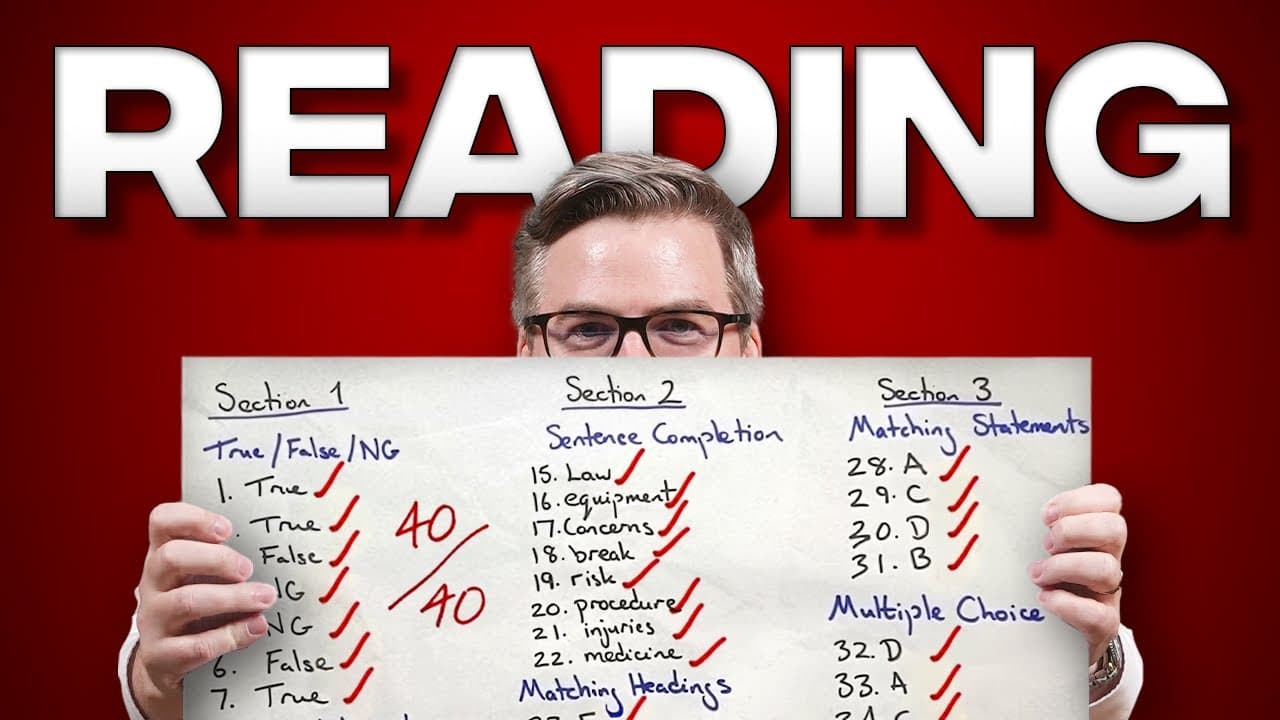
At IELTS Advantage, we've [music] helped hundreds of students get a band nine in their IELTS reading test. And what I thought [music] I would do today is show you a simple technique that we use to help students get a band nine in their IELTS reading test. As you can probably see, the clue to improving to a band N level is looking at your answers. U... Read More
Key Insights
- Wrong answers are the main diagnostic evidence for improvement because their patterns can reveal whether a learner struggles with certain question types, difficult passages, reading subskills, timing, or spelling. Reviewing only the total score or correct responses can conceal the precise weakness that needs attention.
- Official practice tests are required for this diagnostic technique, and each test should be unused and completed under exam conditions. The presenter recommends analyzing at least one test and says that completing two or three provides a better basis for identifying recurring patterns rather than isolated mistakes.
- Question-type patterns are evidence of strategy gaps when errors repeatedly occur in categories such as true, false, not given or matching headings. A learner with strong results elsewhere should focus on strategies for those weak categories instead of studying every IELTS Reading question type again.
- Section three errors can indicate weaknesses in vocabulary, reading skills, or timing because it is the most difficult section and contains harder text. Learners who perform well in sections one and two but make most mistakes in section three should investigate all three possible causes.
- Timing improves through gradual speed building after accuracy has been established. A learner who cannot finish should first attempt the test carefully in 90 minutes, then reduce the time to 80 minutes, 70 minutes, and finally 60 minutes while applying familiar question strategies.
- Spelling is the real weakness when a learner locates the correct answer but writes the required word incorrectly. In that case, extra work on reading strategies, vocabulary, speed, sentence completion, or summary completion does not address the source of the lost marks.
- Matching-question mistakes can reveal a scanning weakness because scanning helps locate the correct answer within a text. Similar analysis may identify weak skimming, while mistakes on questions requiring careful thought can show that the learner needs to develop stronger close-reading skills.
- Targeted practice works by turning an identified weakness into a strength rather than treating the learner as generally bad at reading. The presenter argues that persistent low scores have an underlying reason, which can be pinpointed by analyzing mistakes across official tests completed under exam conditions.
Install to Summarize YouTube Videos and Get Transcripts
Explore YouTube Video Summarizer or Get YouTube Transcript Extractor
Questions & Answers
Q: How can I identify my IELTS Reading weaknesses?
Complete at least one unused official practice test under exam conditions, although two or three tests are preferable. Review the questions you answered incorrectly rather than focusing only on your score or correct answers. Group the mistakes by question type, section, reading subskill, timing, and spelling. Recurring patterns will show which specific weakness should become the focus of your practice.
Q: Why should I use official IELTS Reading practice tests?
The technique depends on official practice tests because the mistake patterns must reflect the structure and demands of the real IELTS Reading test. The presenter explicitly states that the method will not work with other practice tests. Use an official test you have never completed before, follow exam conditions, and analyze two or three tests when possible for stronger evidence.
Q: What should I do if I keep missing the same question types?
Repeated mistakes in the same categories indicate that your main problem may be the strategy required for those question types. For example, a learner who consistently misses true, false, not given and matching headings questions, while answering other categories correctly, should study and practice strategies for those two types rather than trying to improve every aspect of reading.
Q: Why do I make most mistakes in IELTS Reading section three?
Mistakes concentrated in section three may point to weak vocabulary, insufficient reading skills, or a timing problem. Section three is described as the most difficult part, with harder words and greater demands on skimming, scanning, and close reading. If earlier sections are mostly correct, determine whether difficult language, reading processes, or running out of time explains the decline.
Q: How can I improve my IELTS Reading speed?
Build speed gradually instead of immediately forcing yourself to finish within the final time limit. Start by taking 90 minutes and completing everything properly. If you can answer nearly everything correctly, try again with 80 minutes, then 70 minutes, and finally 60 minutes. Familiarity with question types and their strategies should accompany this progressive reduction in time.
Q: What should I practice if spelling causes my wrong answers?
Practice spelling when you can locate the correct word in the passage but write it incorrectly on the answer sheet. That pattern shows that sentence completion, summary completion, strategy, reading ability, vocabulary, and speed are not necessarily the problem. A broad reading course would miss the actual cause, so spelling practice should receive your direct attention instead.
Q: What do matching-question errors reveal about reading skills?
Mistakes across matching information, matching headings, and matching statements can indicate difficulty with scanning, which is used to locate the correct answer. The pattern may also expose weak skimming. If errors occur when a question demands careful interpretation and deeper thought, close reading may be the relevant weakness. The exact error pattern determines which subskill needs practice.
Q: Why is targeted IELTS Reading practice more effective?
Targeted practice concentrates effort on the recurring weakness revealed by wrong answers. One learner may need question-type strategies, another may need vocabulary and reading skills, another may need gradual timing work, and another may only need spelling practice. Because these problems require different responses, analyzing mistakes prevents learners from spending time studying skills they already perform successfully.
Summary & Key Takeaways
-
The technique begins with completing an unused official IELTS practice test under exam conditions, preferably repeating the process with two or three tests. Instead of concentrating on the total score or correctly answered questions, examine every mistake and look for patterns that reveal the particular question types, reading skills, or practical issues limiting performance.
-
Mistakes concentrated in particular question types call for targeted strategies, while errors concentrated in section three may indicate weak vocabulary, reading skills, or time management. Matching-question errors can expose problems with scanning or skimming, and mistakes on questions requiring careful interpretation may reveal a need to strengthen close reading.
-
Timing should be improved gradually by first completing questions accurately with more time, then reducing the allowance from 90 minutes to 80, 70, and finally 60. Spelling errors require a different response: if the correct words were located but written incorrectly, the learner should practice spelling rather than reading strategies, vocabulary, or speed.
Read in Other Languages (beta)
Share This Summary 📚
Summarize YouTube Videos and Get Video Transcripts with 1-Click
Try YouTube Summary with ChatGPT & Claude or YouTube Transcript Generator
Explore More Summaries from IELTS Advantage 📚
Summarize YouTube Videos and Get Video Transcripts with 1-Click
Try YouTube Summary with ChatGPT & Claude or YouTube Transcript Generator