How Do Hierarchical AI Agents Solve Task Challenges?
TL;DR
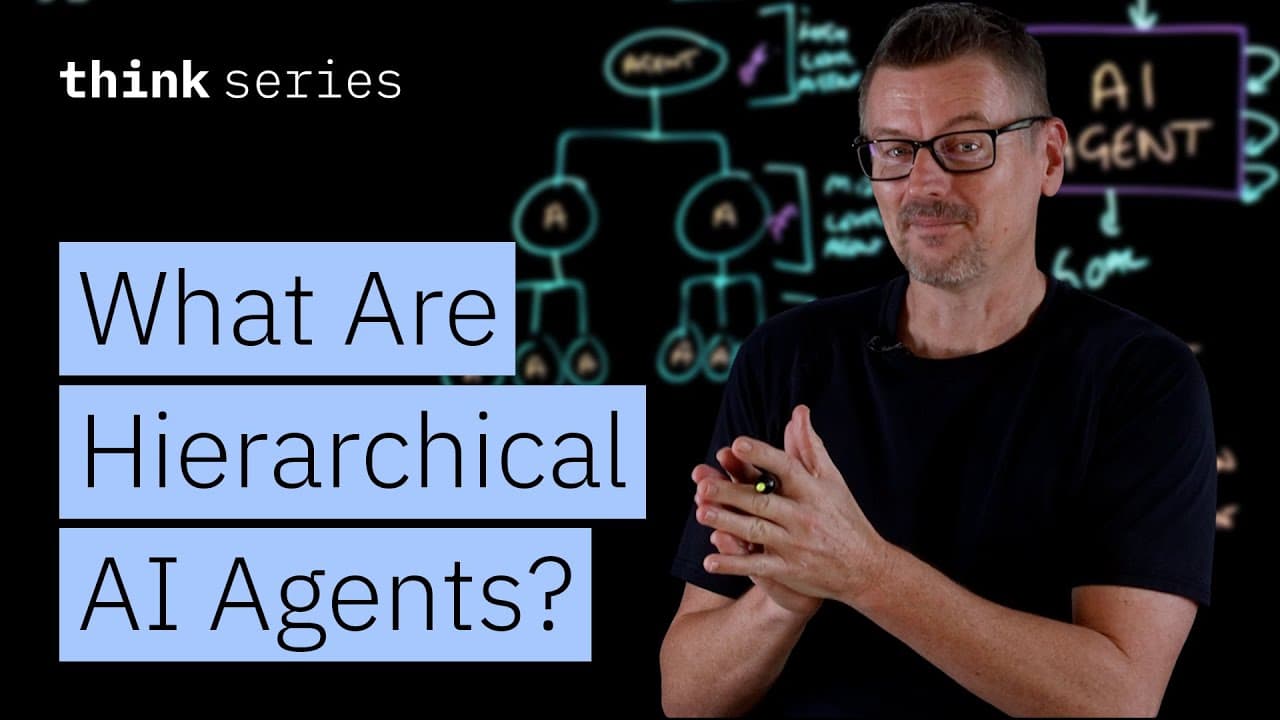
Hierarchical AI agents address issues like context dilution and tool saturation by organizing tasks into a multi-layered system. High-level agents manage strategic planning, mid-level agents handle task implementation, and low-level agents execute specific tasks. This separation enhances efficiency but requires careful planning to avoid errors in task decomposition and communication.
Transcript
AI agents have a problem. They take in a request and then they work autonomously to achieve a goal. But in long-horizon tasks, it can be tricky to keep the agent focused across all of the different steps that the agent needs to execute. Because you see, in a single-agent architecture, you might well hit a few predictable failure modes. Like, for ex... Read More
Key Insights
- Hierarchical AI agents solve context dilution by using contextual packets, maintaining a high signal-to-noise ratio.
- Tool saturation is mitigated through tool specialization, limiting agents to specific tools for their tasks.
- Model flexibility allows different AI models to be used for tasks based on complexity, optimizing computational resources.
- The hierarchy enables parallelism, allowing multiple agents to work on different tasks simultaneously.
- Recursive feedback loops in the hierarchy ensure quality control by allowing supervisors to monitor and correct outputs.
- Task decomposition is critical but challenging, as errors can propagate downstream if initial planning is flawed.
- Orchestration overhead involves designing state management and handoff logic, requiring robust system architecture.
- Miscommunication risks exist, similar to the 'telephone game', where task instructions can become distorted through layers.
Install to Summarize YouTube Videos and Get Transcripts
Explore YouTube Video Summarizer or Get YouTube Transcript Extractor
Questions & Answers
Q: How do hierarchical AI agents prevent context dilution?
Hierarchical AI agents prevent context dilution by using a system of contextual packets. High-level agents maintain the global state and delegate tasks to lower-level agents with only the relevant slice of context needed for the task. This approach keeps the signal-to-noise ratio high, ensuring that agents focus on pertinent information without being overwhelmed by unnecessary details.
Q: What is tool saturation and how is it addressed in hierarchical AI systems?
Tool saturation occurs when an AI agent has access to too many tools, complicating tool selection and increasing chances of errors. Hierarchical AI systems address this by implementing tool specialization, where low-level agents are limited to specific tools relevant to their tasks. This reduces decision complexity and enhances efficiency by providing agents with a narrow, purpose-built toolbox.
Q: Why is model flexibility important in hierarchical AI agents?
Model flexibility allows hierarchical AI systems to assign different AI models to tasks based on their complexity. High-level agents may use sophisticated models for strategic planning, while low-level agents use lighter models for simpler tasks. This optimizes computational resources by avoiding unnecessary use of high-cost models for straightforward tasks, enhancing overall system efficiency.
Q: What are the advantages of parallelism in hierarchical AI systems?
Parallelism in hierarchical AI systems allows multiple agents to work on different parts of a problem simultaneously, increasing efficiency and reducing time to completion. By distributing tasks across various agents, the system can handle complex workflows more effectively, with each agent focusing on specific tasks without waiting for others to complete their work.
Q: How do recursive feedback loops enhance quality control in hierarchical AI systems?
Recursive feedback loops enhance quality control by allowing agents to report back their results to higher-level agents. This feedback acts as a quality gate, enabling supervisors to monitor outputs and initiate retries or adjustments if necessary. Such loops ensure that errors are caught early, maintaining the integrity and accuracy of the overall task execution process.
Q: What challenges are associated with task decomposition in hierarchical AI systems?
Task decomposition involves breaking down complex goals into manageable subtasks, a critical but challenging aspect of hierarchical AI systems. Errors in decomposition, such as missing steps or incorrect sequencing, can propagate downstream, affecting the entire system. Effective task decomposition requires careful planning and a thorough understanding of dependencies and task requirements.
Q: What is orchestration overhead in hierarchical AI systems?
Orchestration overhead refers to the complexity involved in designing the state management and handoff logic between agents in hierarchical AI systems. It includes building retry loops for error handling and ensuring seamless communication between agents. A robust system architecture is essential to prevent issues like recursive loops, where agents repeatedly pass errors without resolution.
Q: How can miscommunication occur in hierarchical AI systems, and what are its effects?
Miscommunication in hierarchical AI systems can occur due to errors in task decomposition or context pruning, leading to the 'telephone game' effect. Instructions may become distorted as they pass through different layers, resulting in agents executing incorrect tasks. Such miscommunications can compromise task accuracy and efficiency, highlighting the need for clear communication and validation processes.
Summary & Key Takeaways
-
Hierarchical AI agents improve task management by organizing tasks into layers with high, mid, and low-level agents. This structure prevents context dilution and tool saturation by maintaining focus and specialization. However, successful implementation requires careful task decomposition and clear communication to avoid errors.
-
The hierarchical approach allows for model flexibility, using different AI models based on task complexity, and enables parallel processing of tasks. This enhances efficiency and scalability in AI systems but demands robust system architecture to manage interactions and prevent recursive errors.
-
Challenges in hierarchical AI agents include task decomposition errors and potential communication issues. Effective planning and validation are crucial to ensure that each layer performs its role accurately and that the overall system functions smoothly without misinterpretations or inefficiencies.
Read in Other Languages (beta)
Share This Summary 📚
Summarize YouTube Videos and Get Video Transcripts with 1-Click
Try YouTube Summary with ChatGPT & Claude or YouTube Transcript Generator
Explore More Summaries from IBM Technology 📚





Summarize YouTube Videos and Get Video Transcripts with 1-Click
Try YouTube Summary with ChatGPT & Claude or YouTube Transcript Generator