How to Create Mind Maps and Flowcharts in ChatGPT
TL;DR
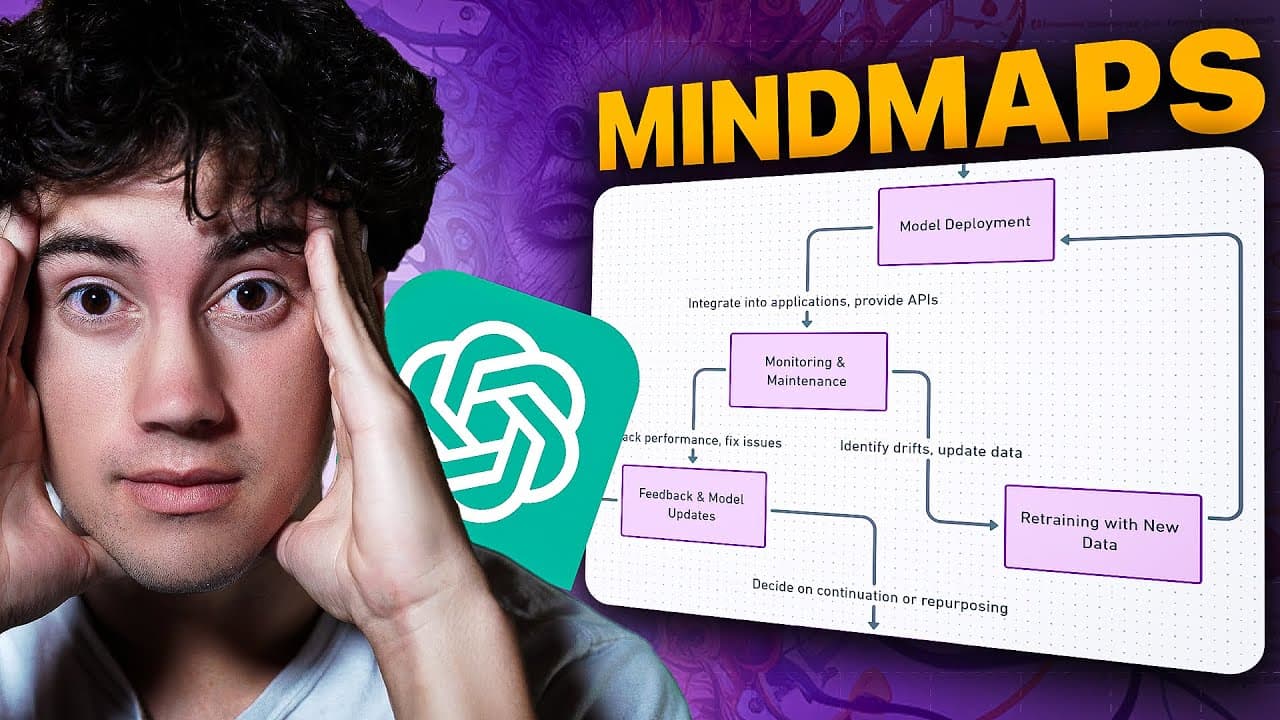
Enable the AI Diagrams plugin in ChatGPT, define a clear goal and relevant context, then request a specific mind map, flowchart, or sequence diagram. The plugin creates a Whimsical diagram that you can open, edit, save, and reuse for brainstorming, prioritizing ideas, understanding complex systems, or developing more cohesive plans.
Transcript
in this chat GPT tutorial I'm going to show you how to create mind maps and flowcharts and diagrams within chat GPT now this can all be done in a matter of about 15 seconds and this is super powerful stuff because it's not only going to help you learn things better it's going to help you see how systems are running it's going to help give you ideas... Read More
Key Insights
- The AI Diagrams plugin creates flowcharts, mind maps, and sequence diagrams from prompts inside ChatGPT. It uses Whimsical and returns a link that lets users view, edit, change, and save the generated diagram on a computer or phone.
- The plugin installation process starts in ChatGPT's plugin menu. If AI Diagrams is unavailable, users can open the plugin store, search for AI Diagrams, install the purple Whimsical flowchart plugin, and enable it by selecting its checkbox.
- A productive diagram workflow starts by identifying the exact problem that needs visualization. The tutorial demonstrates this approach with YouTube content ideation, while also noting that diagrams can represent complex processes and explain how systems operate.
- Custom instructions can make ChatGPT think and respond from a specialized professional perspective. The demonstrated workflow inserts a content strategist persona into both custom instruction fields before requesting YouTube ideas, although the presenter states that this step is optional.
- The GCA prompt sequence consists of a goal, context, and action. The goal defines the desired outcome, the context narrows the subject using relevant details, and the action specifies exactly what ChatGPT and the diagram plugin should produce.
- Visual connections can support more cohesive and strategic planning because related ideas appear together rather than as isolated list entries. Seeing branches and relationships also encourages the mind to explore multiple paths and connect concepts during brainstorming.
- Mind maps allow flexible organization and prioritization that a linear list does not provide. Categories, branches, and connected ideas make it easier to compare possible tasks or content topics and decide which areas deserve further development.
- The generated Whimsical diagram remains editable after ChatGPT creates it. In the demonstrated example, the plugin produces a tree containing 30 AI YouTube ideas, and those ideas can become starting points for later script requests or more detailed video planning.
Install to Summarize YouTube Videos and Get Transcripts
Explore YouTube Video Summarizer or Get YouTube Transcript Extractor
Questions & Answers
Q: How do you create a mind map in ChatGPT?
Open ChatGPT's plugin menu, activate the AI Diagrams plugin, and submit a prompt describing the mind map you need. The tutorial recommends stating a goal, adding enough context to narrow the topic, and specifying the requested action and structure. After generation, follow the provided Whimsical link to view, edit, change, or save the mind map.
Q: How do you install the AI Diagrams plugin in ChatGPT?
Select the plugins area in ChatGPT and check whether AI Diagrams is available. If it is missing, open the plugin store from the bottom of the plugin box and search for AI Diagrams. The tutorial identifies it as a purple plugin powered by Whimsical. Select install, then enable the installed plugin by choosing its checkbox in the plugin menu.
Q: What types of diagrams can the AI Diagrams plugin create?
The AI Diagrams plugin can create flowcharts, mind maps, and sequence diagrams from a ChatGPT prompt. The tutorial uses it to build a large tree diagram containing categorized YouTube ideas and proposes using it to visualize how a complex system, such as a large language model, operates. Generated diagrams can be opened and edited in Whimsical.
Q: How should you prompt ChatGPT to generate a useful diagram?
Use the GCA prompt sequence described in the tutorial: provide a goal, relevant context, and a specific action. For example, state that you need YouTube ideas, explain that the channel covers artificial intelligence and performs well with application topics such as ChatGPT and Midjourney, then request a 30-idea tree organized into categories with unique concepts for growth and audience retention.
Q: Why use a mind map instead of a traditional list?
A mind map displays relationships among ideas through branches and connecting lines, which can support visual processing and more cohesive planning. The tutorial argues that branching also facilitates creativity by encouraging thought in multiple directions. Unlike a linear list, a mind map allows concepts to be grouped, reorganized, compared, and prioritized in a more flexible visual structure.
Q: How do custom instructions improve diagram results in ChatGPT?
Custom instructions can assign ChatGPT a specialized professional role and define how it should respond. In the tutorial, a content strategist persona is pasted into the two custom instruction fields before generating YouTube ideas. This specialization is presented as a way to tailor the response to the task, although the presenter explicitly says it is optional for producing useful diagrams.
Q: Can ChatGPT-generated diagrams be edited and saved?
Yes. The AI Diagrams plugin returns a link labeled for viewing or editing the result in Whimsical. Opening that link provides access to the complete generated tree or flowchart, where its contents can be changed and saved. The tutorial also states that users can save diagrams to a computer or phone rather than being limited to the initial ChatGPT preview.
Q: How can mind maps help with YouTube content planning?
A mind map can organize video ideas into related categories and reveal connections that are less obvious in a flat list. The tutorial requests a tree containing 30 ideas for an artificial intelligence channel, informed by successful topics such as ChatGPT and Midjourney. Those ideas can then be taken back into ChatGPT for scripts or more detailed guidance on producing each video.
Summary & Key Takeaways
-
The workflow begins by enabling the AI Diagrams plugin from ChatGPT's plugin menu. If it is not already available, search the plugin store for AI Diagrams, identified in the tutorial as the purple Whimsical flowchart plugin, install it, and select its checkbox before submitting a diagram request.
-
The recommended prompting method uses the GCA sequence: state a goal, supply context, and specify an action. In the content example, the goal is generating YouTube ideas, the context identifies artificial intelligence and successful application topics, and the action requests a tree diagram containing 30 categorized ideas designed for growth and audience retention.
-
Mind maps provide advantages over ordinary lists because they visually connect related concepts, encourage branching thought, and make flexible organization easier. The generated Whimsical result can be opened through a link, edited, saved, or expanded through additional ChatGPT requests, including requests for scripts and more detailed content plans.
Read in Other Languages (beta)
Share This Summary 📚
Summarize YouTube Videos and Get Video Transcripts with 1-Click
Try YouTube Summary with ChatGPT & Claude or YouTube Transcript Generator
Explore More Summaries from AI Foundations 📚





Summarize YouTube Videos and Get Video Transcripts with 1-Click
Try YouTube Summary with ChatGPT & Claude or YouTube Transcript Generator