How Did Steve Jobs Bring Apple Back From Crisis?
TL;DR
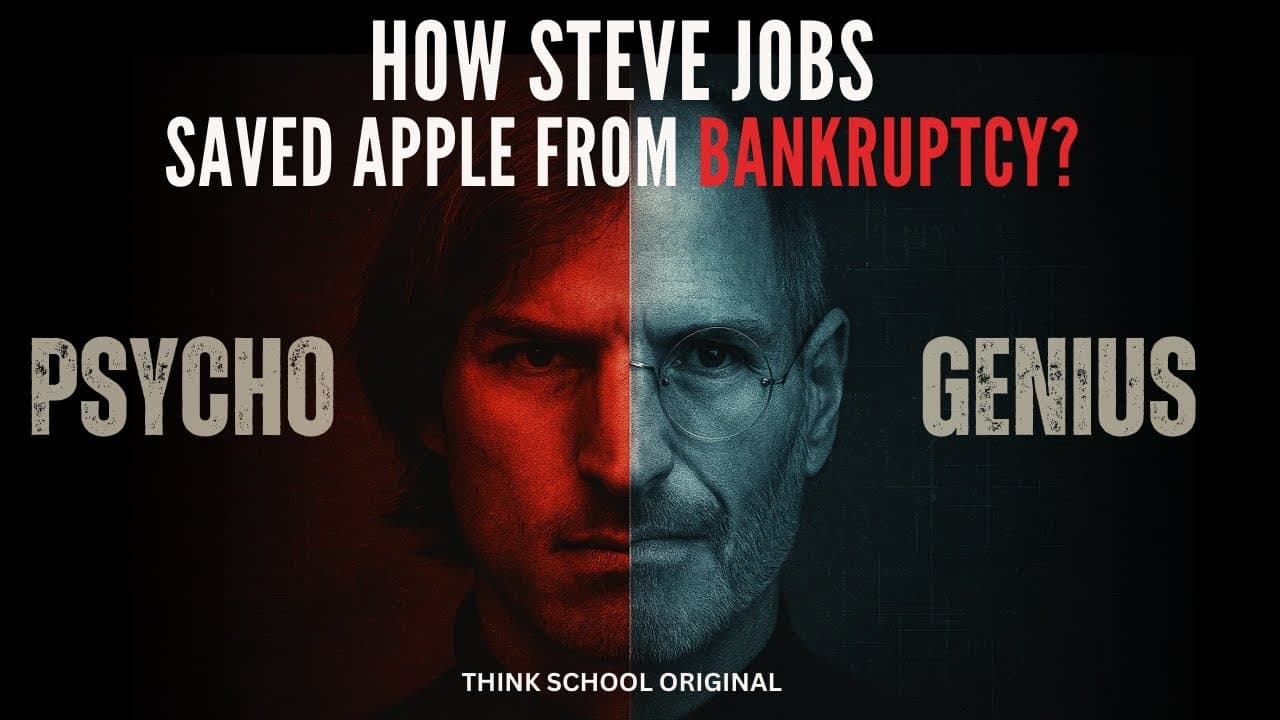
Steve Jobs returned to Apple in 1997 after the company’s market value had fallen 80 percent from early 1992 and annual losses had surpassed $1 billion. The account presents Apple’s recovery as the result of its founder returning during a leadership vacuum, reviving its focus on innovative personal computers, and introducing products such as the iMac after years of financial, operational, and product problems.
Transcript
you can't connect the dots looking forward You can only connect them looking backwards Great You've got to be uh willing to um fail You've got to be willing to crash and burn starting a company with whatever If you're afraid of failing uh you won't get very far The year is 1997 and Apple is dying The company is hurting laying off workers One of Sil... Read More
Key Insights
- Apple was close to bankruptcy in 1997, with losses surpassing $1 billion that year, layoffs, executive departures, weak retail shelf space, and computers collecting dust in stores. These combined problems reflected a financial crisis, a leadership vacuum, and declining customer demand.
- Apple’s market value fell by 80 percent between early 1992 and the end of 1997. The decline showed how far confidence had deteriorated after Apple’s earlier reputation as a personal-computing pioneer and left investors with little hope for the company’s future.
- Steve Jobs returned to Apple in 1997 after being away from the company he helped create for 12 years. The account frames his return as the pivotal event that began Apple’s recovery from severe losses and eventual transformation into a company valued above $3 trillion.
- Apple’s early growth was exceptionally rapid, rising from $775,000 in revenue in 1977 to $7.9 million in the second year, $47 million in the third, and $117 million in the fourth. By its fifth year, revenue had reached a reported $334 million.
- The personal-computer opportunity emerged as microchips compressed capabilities once associated with room-sized machines into small components. Jobs and Steve Wozniak used that technological shift to challenge IBM by developing an accessible personal computer through their young company.
- John Sculley was hired because Jobs wanted an orthodox executive who could manage Apple and sell to corporate America while Jobs concentrated on the Macintosh. The arrangement exposed a conflict between Jobs’s product-centered intensity and the requirements of conventional corporate management.
- Apple’s Lisa was priced at $10,000 while an IBM PC was offered for $1,565. The account attributes this gap to costly, overengineered features and Apple’s insistence on developing software internally instead of licensing software and encouraging outside developers.
- Jobs’s design priorities sometimes created operational costs and product problems. His opposition to noisy cooling fans reportedly contributed to Macintosh computers overheating and crashing, while his demand for dramatic packaging caused Apple to spend heavily on a box customers would quickly discard.
Install to Summarize YouTube Videos and Get Transcripts
Explore YouTube Video Summarizer or Get YouTube Transcript Extractor
Questions & Answers
Q: How close was Apple to bankruptcy in 1997?
Apple was presented as being on the brink of bankruptcy in 1997. Its losses surpassed $1 billion that year, its market value had fallen 80 percent between early 1992 and the end of 1997, and it was laying off workers. Executives and employees were leaving, retailers gave its computers little shelf space, inventory was collecting dust, and investors had largely lost hope.
Q: How did Steve Jobs begin Apple’s comeback?
Steve Jobs began Apple’s comeback by returning in 1997, 12 years after leaving the company he had helped create. His arrival addressed a widening leadership vacuum at a time of severe losses, weak sales, and a bloated product line. The account identifies his return as the decisive turning point and connects the renewed company with the introduction of the iMac and a restored emphasis on innovative products.
Q: Why was Apple struggling before Steve Jobs returned?
Apple was struggling because several problems had accumulated at once. Its product line was bloated, executives were departing, workers were being laid off, and leadership was weakening. Customers were not buying enough Apple computers, retailers devoted little shelf space to them, and unsold machines accumulated. These operational problems accompanied annual losses above $1 billion and an 80 percent decline in market value from early 1992 through 1997.
Q: How quickly did Apple grow during its early years?
Apple generated $775,000 from computer sales in 1977, then increased revenue roughly tenfold to $7.9 million in its second year. Revenue reached $47 million in the third year and $117 million in the fourth. By the fifth year, Apple had gone public, produced a reported $334 million in revenue, reached a valuation of $1.7 billion, and made Jobs a millionaire.
Q: Why did Steve Jobs hire John Sculley as Apple’s CEO?
Jobs hired John Sculley because Apple’s growth required a more conventional executive to handle corporate management and present a respectable face to business customers. Sculley, who came from Pepsi, could focus on running the organization and selling to corporate America while Jobs pursued his Macintosh mission. The arrangement was intended to free Jobs from meetings, accounting procedures, and management work that kept him away from designing and innovating.
Q: Why was the Apple Lisa commercially problematic?
The Lisa was commercially problematic because it cost $10,000 while IBM offered its PC for $1,565. The account says Jobs filled the Lisa with expensive, overengineered features that customers did not need. Apple also insisted on developing software internally, spending millions and taking longer, while IBM licensed PC DOS from Microsoft and encouraged third-party developers to supply programs such as Word and Excel.
Q: How did Steve Jobs’s design decisions hurt early Apple products?
Jobs’s design decisions sometimes placed appearance and experience ahead of cost and practical engineering. He reportedly rejected cooling fans because they were noisy and unattractive, leading Macintosh computers to overheat and crash within two days of purchase. He also demanded elaborate Macintosh packaging to create a dramatic opening experience, causing Apple to spend heavily on an item customers would soon throw away.
Q: What role did microchips play in Apple’s founding?
Microchips helped make personal computers possible by compressing functions that once required giant, expensive machines into small components. Earlier computers were mainly used by governments, research institutions, and large corporations because they were costly and required trained operators. Jobs and Wozniak recognized that this technological shift could bring computing to individuals, leading them to develop circuit boards and personal computers through Apple beginning in 1976.
Summary & Key Takeaways
-
Apple entered 1997 in severe distress, with annual losses surpassing $1 billion, departing executives, layoffs, weak retail demand, and a product line described as bloated. Its market value had fallen 80 percent between early 1992 and the end of 1997, leaving investors doubtful and the company near bankruptcy.
-
Apple began in 1976 when Steve Jobs and Steve Wozniak pursued personal computers as microchips made smaller machines possible. Apple’s revenue grew from $775,000 in 1977 to $117 million in its fourth year, followed by $334 million by its fifth year and a reported valuation of $1.7 billion.
-
Jobs hired Pepsi executive John Sculley to handle conventional corporate leadership while he pursued the Macintosh. Their relationship deteriorated as Jobs became associated with harsh management, expensive engineering decisions, and products such as the $10,000 Lisa. Twelve years after leaving, Jobs returned in 1997 and introduced the iMac as Apple began its comeback.
Read in Other Languages (beta)
Share This Summary 📚
Summarize YouTube Videos and Get Video Transcripts with 1-Click
Try YouTube Summary with ChatGPT & Claude or YouTube Transcript Generator
Explore More Summaries from Think School 📚






Summarize YouTube Videos and Get Video Transcripts with 1-Click
Try YouTube Summary with ChatGPT & Claude or YouTube Transcript Generator