What Is Python? Definition and Key Language Features
TL;DR
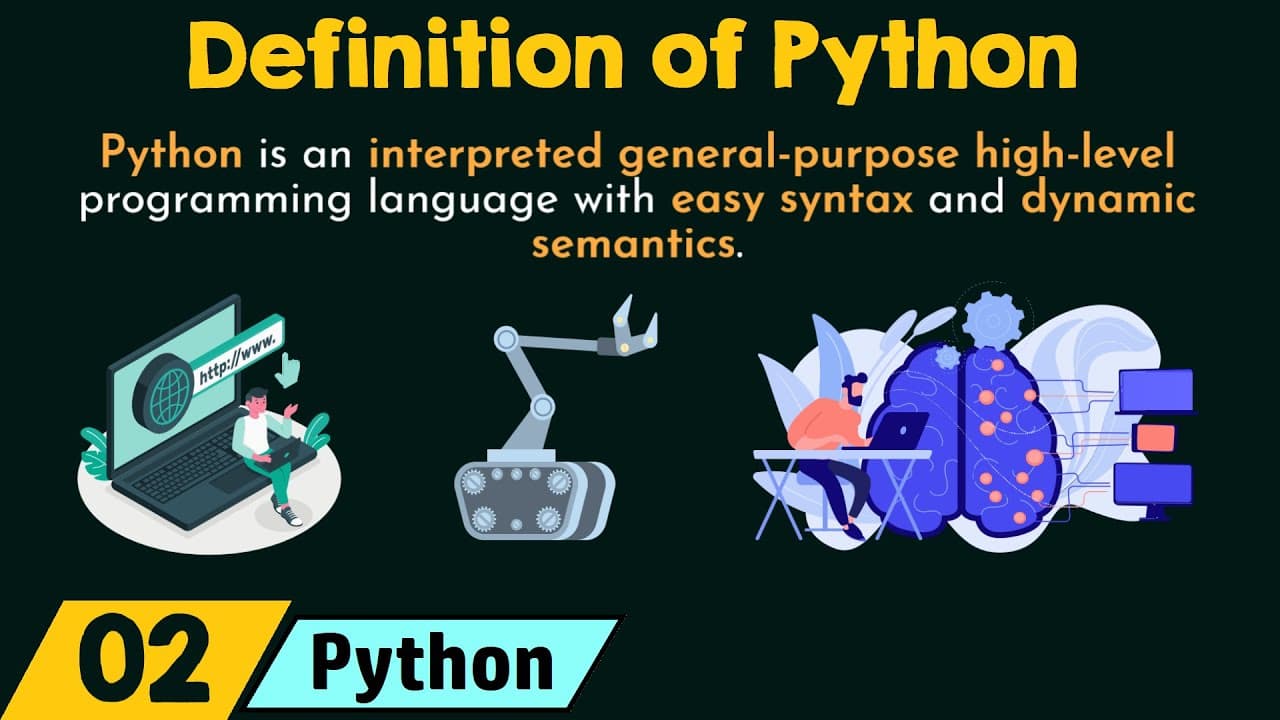
Python is an interpreted, general-purpose, high-level programming language with easy syntax and dynamic semantics. It uses an interpreter to translate human-readable source code into machine code and supports areas including web development, robotics, artificial intelligence, mobile applications, and desktop applications. Its variables can hold different types of values without type declarations, making the explanations below useful for understanding each part of Python’s definition.
Transcript
foreign we saw the introduction to Python Programming now we are ready to understand the definition of python so without any further delay let's get started and let's see all the topics of this presentation one by one there is only one topic we need to cover in this presentation and that is python definition now we will try to understand the defini... Read More
Key Insights
- Python is an interpreted, general-purpose (multi-purpose), high-level programming language with easy syntax and dynamic semantics. Understanding each of these words is the key to understanding the full definition of the language.
- Python was created by Guido van Rossum during the period of 1985 to 1990. He named it after the British comedy series Monty Python's Flying Circus, not after the snake, because he is a big fan of the show.
- An interpreted language uses an interpreter for translation, while a compiled language uses a compiler. Both compiler and interpreter are translators that convert code from one programming language into another.
- Translation is needed because humans understand languages like Python, C, C++, and Java, but computers cannot. A translator takes human-readable source code as input and generates machine code as output.
- Python is general-purpose because it is not specialized to a specific domain. It can be used across web development, robotics, artificial intelligence, mobile applications, and desktop applications rather than serving one special purpose.
- A high-level language is one humans can understand without problems, while a low-level language of zeros and ones is understood only by machines. Python code like 'area = length * breadth' is high-level and human-readable.
- Python has easy syntax because it removes overhead required in languages like C: no need to specify a variable's type, no semicolon after every statement, no placeholder in the print function, and 'print' is clearer than 'printf'.
- Python has dynamic semantics because variables are dynamic objects. Since you never specify a type, Python is dynamically typed, and a variable holding an integer can later hold a floating point value without any problem.
Install to Summarize YouTube Videos and Get Transcripts
Explore YouTube Video Summarizer or Get YouTube Transcript Extractor
Questions & Answers
Q: What is the definition of Python?
Python is an interpreted, general-purpose or multi-purpose, high-level programming language with easy syntax and dynamic semantics. These terms describe how Python code is translated, where the language can be used, how readable it is, and how its variables behave.
Q: Who created Python, and why is it called Python?
Guido van Rossum created Python during the period from 1985 to 1990. He named it after the British comedy series Monty Python's Flying Circus, not after a snake.
Q: What does it mean that Python is interpreted?
Python uses an interpreter for translation, while a compiled language uses a compiler. The interpreter translates Python source code into machine code that a computer can understand.
Q: Why does Python code need to be translated?
Humans can understand languages such as Python, C, C++, and Java, but computers cannot directly understand them. Translation converts human-readable source code into machine code that computers can understand.
Q: Why is Python a general-purpose programming language?
Python is general-purpose because it is not specialized for one domain. It can be used for web development, robotics, artificial intelligence, mobile applications, and desktop applications.
Q: Why is Python considered a high-level programming language?
Python is high-level because its code is readable and understandable to humans. For example, statements such as “length = 50,” “breadth = 20,” and “area = length * breadth” clearly express how to calculate a rectangle’s area, unlike low-level code made for machines.
Q: Why is Python syntax considered easy?
Python removes several requirements found in languages such as C. It does not require a variable type declaration, a semicolon after every statement, or a placeholder such as “%d” in the print function, and “print” is clearer than “printf.”
Q: What do dynamic semantics mean in Python?
Dynamic semantics mean Python variables are dynamic objects, and their types do not need to be declared. A variable holding an integer can later be assigned a floating-point value without a problem.
Summary & Key Takeaways
-
Python is defined as an interpreted, general-purpose (or multi-purpose), high-level programming language with easy syntax and dynamic semantics. It was created by Guido van Rossum between 1985 and 1990, and named after the comedy series Monty Python's Flying Circus rather than the snake.
-
Being interpreted means Python uses an interpreter, rather than a compiler, to translate its code into machine code. Translation is required because humans understand languages like Python, C, C++, and Java, but computers cannot, so source code must be converted into machine-understandable code.
-
Python is general-purpose because it works across many domains such as web, robotics, AI, mobile, and desktop apps. It is high-level and human-readable, has easy syntax with no type declarations or semicolons, and has dynamic semantics because variables are dynamic objects that can hold any type of value.
Read in Other Languages (beta)
Share This Summary 📚
Summarize YouTube Videos and Get Video Transcripts with 1-Click
Try YouTube Summary with ChatGPT & Claude or YouTube Transcript Generator
Explore More Summaries from Neso Academy 📚
Summarize YouTube Videos and Get Video Transcripts with 1-Click
Try YouTube Summary with ChatGPT & Claude or YouTube Transcript Generator