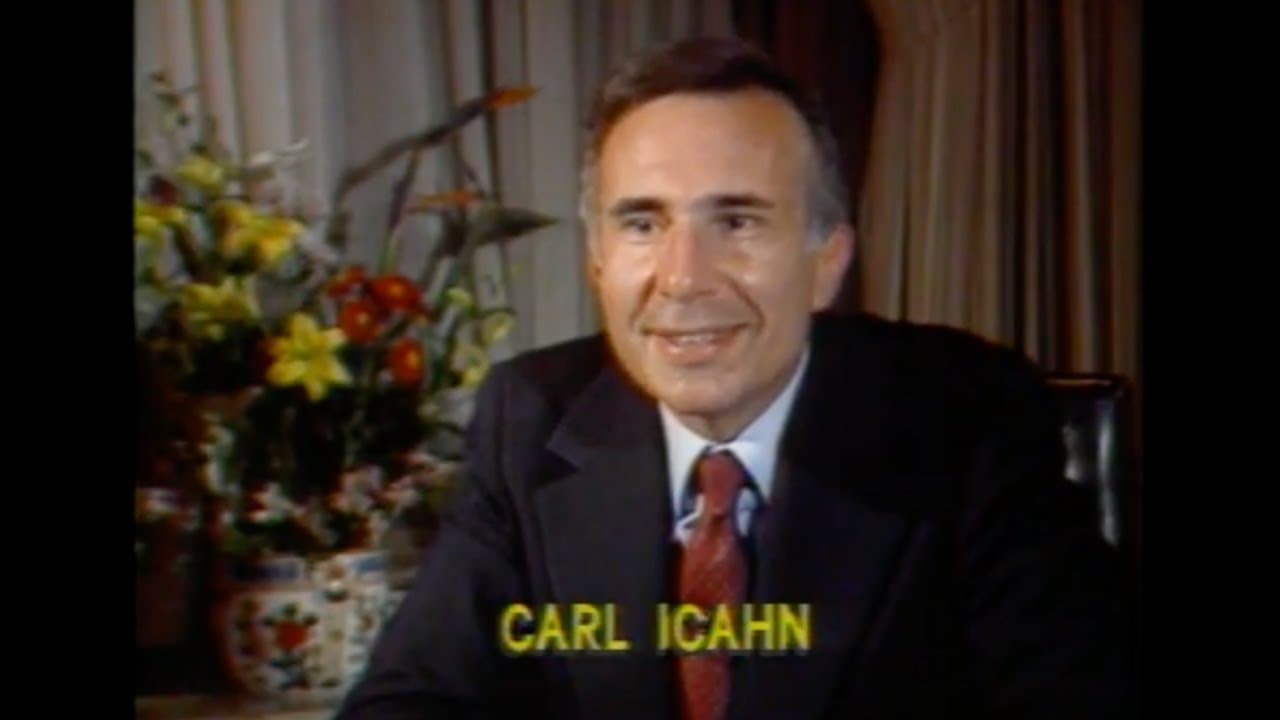
Carl Icahn's First Ever Interview | 1985
TL;DR
Carl Icahn’s strategy was to buy shares in companies trading below the value of their assets, then pursue changes that could raise shareholder value. In 1985, his TWA agreement strengthened his reputation as a credible acquirer, while his critics argued that hostile campaigns disrupted companies and primarily served his goal of making money.
Transcript
robin and now we have a profile about business carl icahn is back in the news icon is the man who's been changing the face of american business with his threatened or actual takeovers of dozens of companies recently he arranged a blockbuster deal to take over transworld airlines the price is now close to a billion dollars which he's still raising t... Read More
Key Insights
- Icahn’s investment strategy was to buy shares only when their market price appeared low relative to company assets. He described such stocks as bargains and said that once a stock rose enough to eliminate the bargain, it no longer interested him.
- Icahn began pursuing takeovers in 1979 after building his career in options and arbitrage. His uncle initially considered the idea too risky, but later invested alongside him after Icahn’s approach began producing results.
- Greenmail was the practice of a target company buying back Icahn’s shares at a premium so he would leave. Icahn said he had not requested such payments, maintained that management offered them, and argued that other shareholders sometimes benefited too.
- Icahn’s takeover record combined frequent battles with relatively few completed acquisitions. By 1985, he had taken control only three times, including Bayswater Realty, ACF, and the TWA merger agreement, but his company had made money in every cited case.
- TWA’s unions supported Icahn because the airline had announced a merger with Texas Air, whose president was viewed as tough on unions. Pilots and machinists accepted approximately 20 percent salary cuts for a small piece of the company if Icahn gained control.
- Icahn’s role in the TWA negotiations was direct and persistent. He spent much of the summer negotiating, often on weekends and until six in the morning, and said his personal intervention kept lawyers, employees, and pilots talking when disputes became emotional.
- Icahn’s corporate philosophy was that bureaucracy, executive privileges, and ineffective management could cause companies to trade far below their underlying value. He argued that hostile takeover pressure could expose this gap and force changes that benefited shareholders.
- Icahn’s critics said takeover campaigns were emotional, time-consuming distractions for executives trying to operate companies. Former TWA president Ed Meyer also argued that Icahn was motivated by profit rather than an interest in managing businesses or reforming managers.
Install to Summarize YouTube Videos and Get Transcripts
Explore YouTube Video Summarizer or Get YouTube Transcript Extractor
Questions & Answers
Q: How did Carl Icahn identify takeover targets?
Carl Icahn looked for stocks trading below what he considered the true value of the company, particularly when the share price was low relative to company assets. He described his purchases as bargains and said he would not pursue a stock after its price rose enough to remove that bargain. Annual reports of potential target companies covered a wall in his office.
Q: When did Carl Icahn begin pursuing corporate takeovers?
Carl Icahn began pursuing takeovers in 1979 after previously working in options and arbitrage. He told his uncle, Elliot Schnall, that he intended to target undervalued companies. Schnall initially thought the plan was too risky, but Icahn responded that risk brought reward. His uncle later changed his view and continued investing with him.
Q: What was greenmail in Carl Icahn’s takeover campaigns?
Greenmail referred to a target company buying back Icahn’s stock at a premium to persuade him to abandon a takeover effort. The practice attracted substantial criticism. Icahn maintained that he never requested such payments and that corporate management offered them. He also argued that other shareholders sometimes benefited when these contests increased the value of their holdings.
Q: Why was the TWA deal important to Carl Icahn’s reputation?
The TWA agreement was Icahn’s largest acquisition effort and involved an international airline serving the North Atlantic. It helped shift his image from someone seen primarily as a company speculator to a credible acquirer capable of taking control. An investment banker who had represented TWA’s management said Icahn had become a genuine takeover threat and was increasingly viewed as a man of his word.
Q: How did Carl Icahn obtain labor concessions at TWA?
Icahn negotiated directly and persistently with TWA’s unions, investment bankers, and lawyers, frequently working on weekends and until six in the morning. Pilots and machinists accepted approximately 20 percent salary cuts in exchange for a small piece of the company if he took over. Icahn believed senior managers needed to engage personally with workers during difficult negotiations.
Q: Why did TWA’s unions prefer Carl Icahn’s takeover bid?
TWA’s unions supported Icahn after the airline announced a merger with Texas Air, whose president, Frank Lorenzo, was known for being tough on unions. A union representative said Icahn had done everything he promised and had not reneged on his commitments. The pilots and machinists consequently agreed to salary reductions tied to receiving a small ownership interest.
Q: What did Carl Icahn believe was wrong with corporate management?
Icahn believed many American companies were poorly managed, burdened by bureaucracy, and weakened by a corporate culture of executive privileges, high salaries, jet planes, and golf courses. He argued that these conditions could create a large gap between a company’s underlying value and its stock price. Takeover pressure, in his view, could challenge entrenched management and improve shareholder value.
Q: How did critics respond to Carl Icahn’s takeover philosophy?
Critics rejected Icahn’s broad attacks on corporate executives and questioned whether investors without operating experience were qualified to judge company management. Former TWA president Ed Meyer described a takeover battle as unsettling, emotional, and time-consuming while executives were still trying to run the business. Meyer also argued that Icahn’s fundamental motivation was making money, not reforming management.
Summary
This video provides a profile of business mogul Carl Icahn, who has gained a reputation for his takeovers of numerous companies. He has recently made headlines for his billion-dollar deal to acquire Trans World Airlines (TWA) and his search for additional financing for future acquisitions. Despite rarely giving interviews, Icahn agreed to speak with correspondent June Masel for this profile.
Questions & Answers
Q: Who is Carl Icahn and what is he known for?
Carl Icahn is a prominent figure in American business known for his threatened or actual takeovers of numerous companies. He recently arranged a billion-dollar deal to take over TWA and is seeking additional funding for future acquisitions.
Q: What was Icahn's first major takeover and when did it occur?
Icahn's first major takeover was in 1979 when he bought the company Tap and Stove. This marked the beginning of his ventures into the world of takeovers.
Q: How did Icahn's journey as a takeover specialist begin?
Icahn got started in business with the help of Elliot Schnall, known as Uncle Elliot, who loaned him $400,000 in 1968 to buy a seat on the New York Stock Exchange. Initially focusing on options and arbitrage, Icahn later turned to takeovers, despite skepticism from Uncle Elliot and others.
Q: How has Icahn's approach to takeovers been received?
Icahn has faced criticism for his tactics, particularly for his use of greenmail, where a company buys back Icahn's stock at a premium. While Icahn and others argue that he hasn't accepted greenmail in a while, his actions have still garnered negative attention.
Q: How does Icahn choose which stocks to buy?
Icahn's strategy is to look for undervalued stocks, particularly those with prices below the true value of the company. He believes in only buying stocks that are bargains, as opposed to those whose prices have already increased.
Q: How successful has Icahn been at taking control of companies?
While Icahn has engaged in numerous hostile takeover battles, he has only actually taken control of three companies. However, in all cases, his company has made significant profits, with some deals earning as much as $25 million.
Q: How did Icahn secure labor concessions during the TWA takeover?
Icahn successfully negotiated labor concessions during the TWA takeover, something the airline's management had been unable to achieve. The pilots and machinists agreed to salary cuts in exchange for a small ownership stake in the company if Icahn took over.
Q: How does Icahn view the role of management in corporations?
Icahn believes that many companies are poorly managed and hindered by excessive bureaucracy, which leads to lower stock prices. He argues that the real value of a company is often higher without its management.
Q: What does Icahn consider the biggest problem in corporate America?
Icahn criticizes what he calls the "corporate culture" with its extravagances such as private jets, golf courses, and high salaries. He believes this aristocratic culture is prevalent in the corporate world, hindering effective management.
Q: What motivates Icahn in his pursuit of takeovers?
Icahn's primary motivation is making money, and he acknowledges that this is a fundamental part of his value system. However, he also believes that he is doing the right thing by driving up stock prices and benefiting shareholders.
Takeaways
Carl Icahn is a renowned figure in American business, known for his aggressive approach to takeovers and for reshaping companies. Despite criticism for his tactics and the use of greenmail, Icahn has achieved significant success in his career. His strategy involves identifying undervalued stocks and acquiring them at bargain prices. He also believes that many companies suffer from poor management and an aristocratic corporate culture, which leads to lower stock prices. Ultimately, Icahn's primary motivation is making money, but he also believes he is serving the best interests of shareholders.
Summary & Key Takeaways
-
Carl Icahn entered Wall Street with a $400,000 loan from his uncle in 1968, using it to buy a New York Stock Exchange seat. After working in options and arbitrage, he began targeting undervalued companies in 1979, despite warnings that the strategy involved excessive risk.
-
Icahn searched for stocks priced below the underlying value of company assets. Although he fought many hostile takeover battles, he had taken control only three times by 1985. His company nevertheless made money in every cited case, sometimes earning as much as $25 million from a single deal.
-
The TWA agreement became Icahn’s largest acquisition effort and helped recast him as a credible buyer rather than merely a speculator. He secured approximately 20 percent salary cuts from pilots and machinists in exchange for a small ownership stake, while arguing that active negotiation and management reform could benefit shareholders.
Read in Other Languages (beta)
Share This Summary 📚
Summarize YouTube Videos and Get Video Transcripts with 1-Click
Try YouTube Summary with ChatGPT & Claude or YouTube Transcript Generator
Explore More Summaries from Investor Archive 📚
Summarize YouTube Videos and Get Video Transcripts with 1-Click
Try YouTube Summary with ChatGPT & Claude or YouTube Transcript Generator