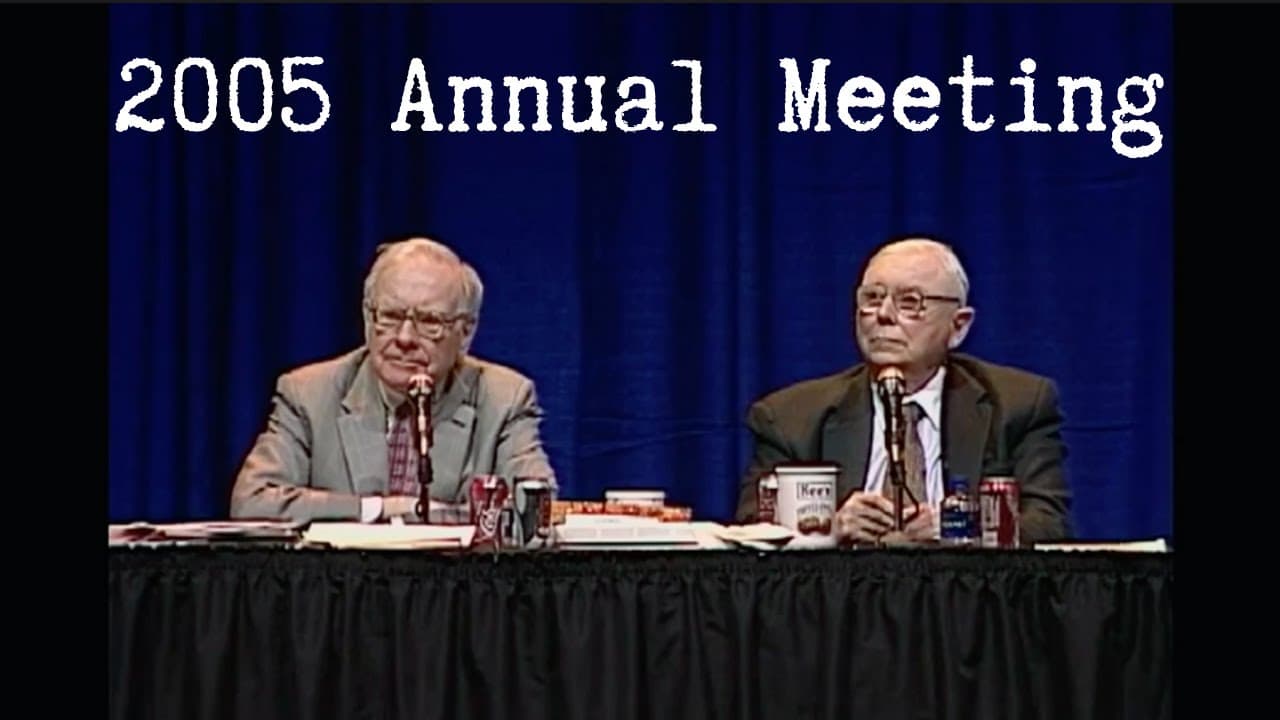
2005 Berkshire Hathaway Annual Meeting (Full Version)
TL;DR
Berkshire judged operating performance before investment gains and losses, because quarterly market movements and accounting classifications could obscure underlying economics. In the first quarter, pre-tax earnings before investment gains increased by slightly more than $400 million, while insurance underwriting produced almost $500 million and GEICO added 245,000 policyholders.
Transcript
morning i'm warren he's charlie we work together we really don't have any choice because he can hear and i can see i want to first thank a few people that cartoon was done by andy hayward who has done done them now for a number of years and he writes them he goes around the country and gets voices dubbed in it's a labor of love we don't pay him a d... Read More
Key Insights
- Berkshire's pre-tax earnings before investment gains increased by slightly more than $400 million in the first quarter. Buffett emphasized this operating measure because investment gains and losses depended on market fluctuations and accounting treatment rather than the timing or quality of Berkshire's economic decisions.
- Insurance underwriting income was almost $500 million before tax in the first quarter, about $200 million better than one year earlier. Buffett nevertheless described the quarter as considerably better than normally anticipated and warned that catastrophe insurance has seasonal exposure that can make early results appear unusually favorable.
- Catastrophe insurance risk was concentrated heavily in the third quarter because roughly 50 percent of hurricanes occurred in September. Approximately 17.5 percent occurred in October and another 17.5 percent in August, with the remaining exposure associated with November and July, according to Buffett's explanation.
- Berkshire's insurance float was approximately $45 billion, and Buffett believed it had a decent chance of costing zero or less for the year if no truly large catastrophes occurred. In that outcome, the float would effectively provide Berkshire with roughly $45 billion of free money.
- GEICO added 245,000 policyholders during the first quarter, an increase of almost 4 percent from its existing base. Much of the boost came from a strong reception in New Jersey, where GEICO had not been operating one year earlier, rather than equal growth throughout the country.
- GEICO produced a 13 percent underwriting profit during the first quarter, which was considerably better than Berkshire expected for the full year. Buffett noted that rates had been reduced in some locations and characterized the broader period as extraordinary for automobile insurers generally.
- Foreign exchange contracts totaling slightly more than $21 billion generated a first-quarter mark-to-market loss of just over $300 million. Those contracts could fluctuate by $200 million or more in a single day, and their market changes passed through Berkshire's profit and loss statement.
- Accounting gains did not necessarily represent economic realization in Berkshire's view. If the Procter & Gamble and Gillette merger occurred, exchanging Gillette shares for Procter & Gamble shares could require a reported gain exceeding $4 billion even though Berkshire expected to continue holding the replacement shares for a long time.
Install to Summarize YouTube Videos and Get Transcripts
Explore YouTube Video Summarizer or Get YouTube Transcript Extractor
Questions & Answers
Q: How did Berkshire's operating businesses perform in the first quarter?
Berkshire's businesses produced a broad increase in first-quarter operating earnings before investment gains and losses. Total pre-tax earnings on that basis rose by slightly more than $400 million. Insurance underwriting led the improvement, while investment income increased by more than $100 million, finance business income rose by about $50 million, and the other businesses collectively added close to $50 million.
Q: Why were Berkshire's first-quarter insurance results unusually strong?
The insurance results benefited partly from the seasonal structure of catastrophe coverage. Berkshire could recognize hurricane-related premiums monthly even though it had no hurricane exposure in the first quarter and much of the actual risk arrived later in the year. Buffett said the quarter remained unusually good even after allowing for seasonality, so he cautioned against treating it as a normal result.
Q: How does hurricane season affect catastrophe insurance earnings?
Hurricane risk was concentrated late in the year, especially during the third quarter. Buffett said roughly 50 percent of hurricanes occurred in September, while approximately 17.5 percent occurred in October and another 17.5 percent in August. The remaining share was associated with November and July. Consequently, premiums could be earned before the period containing most of the related loss exposure.
Q: What did Buffett say about Berkshire's insurance float?
Buffett said Berkshire had approximately $45 billion of insurance float. He believed there was a decent chance that the float would cost the company zero or less for the year, provided that no truly large catastrophes occurred. If that expectation held, Berkshire would effectively have access to roughly $45 billion of free money generated through its insurance operations.
Q: How quickly was GEICO growing in early 2005?
GEICO added 245,000 policyholders in the first quarter, representing almost 4 percent growth from its existing policyholder base in a single quarter. Buffett explained that the strong reception in New Jersey provided an important boost because GEICO had not been operating there one year earlier. He cautioned that the company was not achieving the same quarterly growth rate throughout the country.
Q: Why did Buffett disregard quarterly investment gains and losses?
Buffett said Berkshire made investment decisions according to what created the most economic sense, not according to whether a transaction produced an accounting gain or loss in a particular quarter. He therefore considered quarterly timing meaningless. The interpretation was further complicated because some unrealized changes passed through the income statement while changes in other investments, including Coca-Cola shares, did not.
Q: How did foreign exchange contracts affect Berkshire's reported earnings?
Berkshire held foreign exchange contracts totaling slightly more than $21 billion. Their daily market valuation produced a first-quarter mark-to-market loss of just over $300 million, including a cited figure of $310 million. Buffett noted that the contracts could fluctuate by $200 million or more in one day and that these changes flowed through the profit and loss statement despite not representing a completed investment outcome.
Q: Why would the Gillette transaction create a misleading accounting gain?
If the Procter & Gamble and Gillette merger proceeded, Berkshire would exchange its Gillette shares for Procter & Gamble shares. Accounting rules would require Berkshire to report the exchange as a realized gain, potentially exceeding $4 billion. Buffett considered that gain meaningless because Berkshire would merely replace one long-term shareholding with another and expected to hold the Procter & Gamble stock for a very long time.
Summary
In this video, Warren Buffett and Charlie Munger discuss various topics including their gratitude towards the creators of the cartoon, Liberty's Kids, and poor Charlie's almanac. They also express their thanks to Kelly Muchmore for organizing the event and mention the upcoming marriage of Kelly. Additionally, they talk about their interest in investing in businesses and the current market conditions that make it challenging. They touch upon the importance of selecting terrific managers when buying businesses and the passion they look for in those managers. Warren also discusses their investment in Anheuser-Busch and the beer industry, as well as the impact of increased competition from private equity funds and hedge funds. They discuss the importance of starting investing at a young age and recommend reading extensively on the subject. They also mention their concerns about the increasing amount of money being spent on money management and the need for corporate managers to better understand investments.
Questions & Answers
Q: What do Warren Buffett and Charlie Munger express their gratitude for?
Warren and Charlie express their gratitude towards the creators of the cartoon Liberty's Kids and Andy Hayward for his work on it. They also thank the author of Charlie's Almanac, Peter Kaufman, and Kelly Muchmore for organizing the event. They mention the upcoming marriage of Kelly.
Q: What do Warren and Charlie look for when buying businesses?
When buying businesses, Warren and Charlie look for terrific managers with a passion for their business. They want managers who love their business beyond their paycheck and have a genuine interest in running the business even after selling it. They believe that the success of a business often depends on the passion and dedication of its managers.
Q: What is Warren's view on the beer industry and their investment in Anheuser-Busch?
Warren mentions that the beer industry is not growing significantly in the U.S. and that Anheuser-Busch is experiencing flat earnings due to increased competition and promotional pricing. He acknowledges the strong consumer position of Anheuser-Busch and the absence of private labels or generic products in the beer industry, which is a plus. However, he doesn't expect significant future growth in the industry.
Q: How do Warren and Charlie feel about the increased competition from private equity funds and hedge funds in buying businesses?
Warren and Charlie acknowledge that there is more money looking to buy businesses now compared to five years ago. They mention the increased presence of private equity firms and hedge funds in the market and the willingness to pay higher prices for businesses. They also highlight that many businesses are being sold to companies planning to resell them in a short period of time. Warren and Charlie mention that this increased competition makes it difficult for Berkshire Hathaway to find good investment opportunities.
Q: What advice do Warren and Charlie give to younger people wanting to invest in the stock market?
Warren and Charlie advise young people to start investing early and read everything they can on the subject. They emphasize the importance of developing a framework, understanding business fundamentals, and having a genuine interest in the subject. Warren suggests reading Benjamin Graham's "The Intelligent Investor," as it had a significant impact on his own investing approach. They also mention that investing requires more qualities of temperament than intellect and that starting early can be a significant advantage.
Q: What are Warren and Charlie's concerns about the current state of money management?
Warren and Charlie express their concerns about the increasing amount of money going into money management and the concentration of brainpower in the field. They believe there is too much emphasis on buying pieces of paper and trying to get rich quickly. They highlight the high percentage of GDP and national brainpower being dedicated to money management, which they see as a negative for the country. However, they acknowledge their own contribution to this phenomenon and express their reservations about it.
Q: How did Warren become interested in investing and what sparked his interest at a young age?
Warren became interested in investing at a young age, possibly around seven years old. His father was in the business, and Warren would visit his office and read interesting books on investing. He also observed the stock market ticker tape at a local company's board. Warren's interest grew as he read extensively on the subject and studied the New York Stock Exchange and different investment strategies.
Q: What do Warren and Charlie advise younger people about investing?
Warren and Charlie advise younger people to start investing early, read extensively on the subject matter, and develop a framework or investment philosophy that works for them. They emphasize the importance of learning from books and studying successful investors like Benjamin Graham. They also mention the need to think for oneself and have a strong temperament for investing. Warren emphasizes that investing requires qualities of temperament more than intellect.
Q: How does Warren describe the current state of investing and competition for good investment opportunities?
Warren describes the current state of investing as challenging, primarily due to increased competition for good investment opportunities. He mentions that there is more money looking for deals now compared to five years ago, and private equity firms and hedge funds are willing to pay higher prices for businesses. Warren acknowledges that this makes it difficult for Berkshire Hathaway to find good investments and that they are at a disadvantage in the current market conditions.
Q: What are Warren and Charlie's thoughts on the concentration of intelligent classes in money management?
Warren and Charlie express their concerns about the high concentration of the intelligent classes in money management and the increasing amount of brainpower dedicated to this field. They believe it is not a positive development for the country and express their dislike for the current state of money management, which they see as a low calling compared to other professions. They also mention that they have contributed to this phenomenon through their own investing strategies.
Takeaways
In this video, Warren Buffett and Charlie Munger discuss various topics related to investing and business. They express their gratitude towards the creators of Liberty's Kids and Charlie's Almanac, as well as the organizers of the event. They highlight the importance of selecting passionate and dedicated managers when buying businesses. They also discuss their investment in Anheuser-Busch and acknowledge the challenges posed by increased competition from private equity funds and hedge funds. Both Warren and Charlie emphasize the need for young people to start investing early and read extensively on the subject. They also express concerns about the growing amount of money and brainpower dedicated to money management. Overall, they provide valuable insights into their investment philosophy and the current state of the market.
Summary & Key Takeaways
-
Berkshire's first-quarter operating businesses improved before investment gains and losses. Pre-tax insurance underwriting income reached almost $500 million, approximately $200 million above the prior year. Investment income increased by more than $100 million, finance business income rose by about $50 million, and the other businesses collectively gained close to $50 million.
-
Insurance results required seasonal context because catastrophe exposure was unevenly distributed throughout the year. Hurricane risk was concentrated largely in September, while the company earned some related premiums during the first quarter without hurricane loss exposure. Buffett therefore cautioned that the unusually strong quarter should not be treated as a normal annual run rate.
-
Quarterly investment gains and losses were described as economically meaningless for evaluating Berkshire's decisions. More than $21 billion of foreign exchange contracts produced a mark-to-market loss slightly above $300 million, while changes in Coca-Cola shares did not enter income. A potential Gillette exchange could create a reported gain exceeding $4 billion without changing Berkshire's economic view.
Read in Other Languages (beta)
Share This Summary 📚
Summarize YouTube Videos and Get Video Transcripts with 1-Click
Try YouTube Summary with ChatGPT & Claude or YouTube Transcript Generator
Explore More Summaries from Investor Archive 📚

Summarize YouTube Videos and Get Video Transcripts with 1-Click
Try YouTube Summary with ChatGPT & Claude or YouTube Transcript Generator