What Are SQL Command Types and Their Uses in DBMS
TL;DR
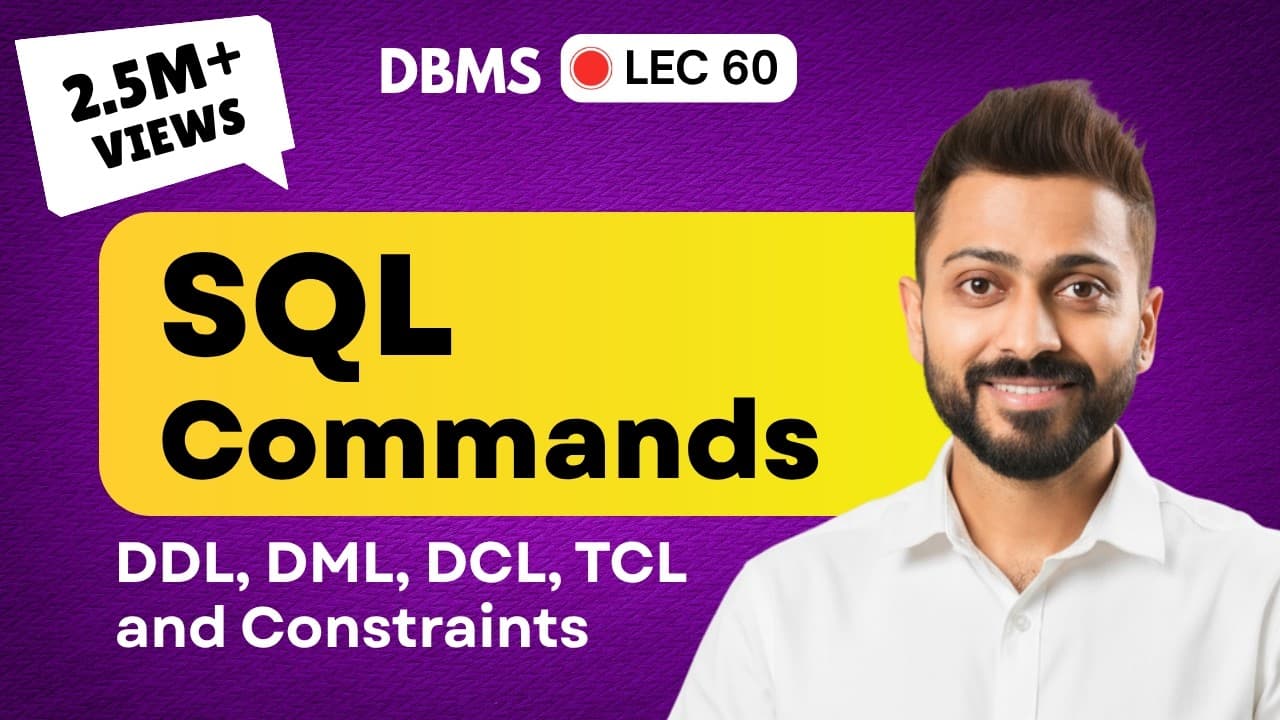
SQL commands are grouped into DDL, DML, DCL, TCL and constraints. DDL commands create and modify schema using create, alter, drop, truncate and rename; DML commands insert, update, delete and select data; DCL commands grant and revoke access; TCL commands manage transactions with commit, rollback and savepoints. Constraints enforce data rules during data entry.
Transcript
Hello Friends, Welcome to Gate Smashers In today's video we are going to discuss about types of SQL commands, SQL Is What? Structured query language, so we use structure query language to deal with structure data, structure data meaning structure data means data that we normally store in the form of tables or you can say in the form of relations So... Read More
Key Insights
- DDL commands define and modify the schema, including creating, altering, dropping, truncating, and renaming database objects such as tables and views, which sets up the structure in which data lives.
- DML commands manipulate the actual data, allowing inserts, updates, deletes, and retrievals, which are essential for maintaining current information and supporting application needs.
- DCL commands control who can access which data, enabling grant and revoke of privileges to users or roles, thus enforcing security and proper authorization.
- TCL commands govern transactions, enabling commit, rollback, and savepoints to ensure ACID properties during multi-step operations.
- Constraints provide rules for data entry, such as primary keys, foreign keys, and not null, helping maintain data integrity and relationships across tables.
- The practical workflow described emphasizes using DDL to define tables first, then DML to populate and modify data, followed by DCL and TCL to secure and manage transactions.
- The lecture highlights that all commands have specific syntax and use cases, and mastering them is essential for competitive exams and real-world DBMS work.
- The overview approach is designed for quick comprehension of what each command type covers and how they relate to schema, data manipulation, access control, and transactions
- More videos from this channel:
- More from this channel: Gate Smashers
Install to Summarize YouTube Videos and Get Transcripts
Explore YouTube Video Summarizer or Get YouTube Transcript Extractor
Questions & Answers
Q: What is the role of DDL in SQL and which commands are included?
DDL, or Data Definition Language, is the set of SQL commands that define and modify the database schema. It includes create to build new objects like tables, alter to change structures, drop to remove objects, truncate to remove data from tables efficiently, and rename to change identifiers. These commands operate on the schema level, setting up the structure where data will reside and be managed.
Q: How do DML commands differ from DDL commands?
DML, or Data Manipulation Language, deals with the data stored in the schema rather than the structure itself. It includes insert to add new rows, update to modify existing data, delete to remove data, and select to retrieve information. DML is used after the schema is defined by DDL to manage the actual records in tables.
Q: What is the purpose of DCL in SQL and what commands are used?
DCL, Data Control Language, manages access and permissions to data within the database. The primary commands are grant to give specific privileges to users or roles and revoke to remove those privileges. DCL helps enforce security by controlling who can perform actions such as select, insert, update, delete, or create objects.
Q: Why are TCL commands important and what do they do?
TCL, Transaction Control Language, is crucial for ensuring data integrity during complex operations. It includes commit to save all changes made in a transaction, rollback to undo changes if something goes wrong, and savepoints to define intermediate points within a transaction. TCL helps apply ACID properties in practice.
Q: What are constraints and why are they used in SQL?
Constraints are rules applied to tables to enforce data integrity and validity during data modification. They include primary keys to ensure unique row identification, foreign keys to enforce referential integrity, not null to require a value, unique to prevent duplicates, and check and default to enforce data quality and sensible defaults.
Q: How does a typical workflow use DDL and DML together?
A typical workflow starts with DDL to create and tailor the schema, for example creating tables with the correct columns and data types. Once the structure exists, DML commands populate and modify the data inside those tables. This sequence ensures data is stored in a well-defined structure and remains queryable and consistent.
Q: What is the difference between commit and rollback in TCL?
Commit finalizes all changes made in the current transaction, making them permanent in the database. Rollback undoes all changes since the start of the transaction or up to a defined savepoint, restoring the previous state. This distinction allows safe error handling and consistent data states during multi-step operations.
Q: When would you use a savepoint in a transaction?
A savepoint marks an intermediate position within a transaction so that you can rollback to that point without aborting the entire transaction. This is useful for long or multi-step operations where you want to recover from a partial failure without losing all progress, improving reliability and control.
Summary & Key Takeaways
-
DDL commands define and modify the database schema, including creating tables and altering their structure. They establish how data is stored at the metadata level, shaping the overall database design.
-
DML commands operate on the data stored in tables, enabling insertion, retrieval, updating and deletion of records to reflect current information and business processes.
-
Constraints and transaction control add data integrity and reliability, ensuring valid state changes, enforcing rules, and allowing safe rollback or commit of complex operations.
Read in Other Languages (beta)
Share This Summary 📚
Summarize YouTube Videos and Get Video Transcripts with 1-Click
Try YouTube Summary with ChatGPT & Claude or YouTube Transcript Generator
Explore More Summaries from Gate Smashers 📚





Summarize YouTube Videos and Get Video Transcripts with 1-Click
Try YouTube Summary with ChatGPT & Claude or YouTube Transcript Generator