What Is Manchester Encoding and How Does It Work?
TL;DR
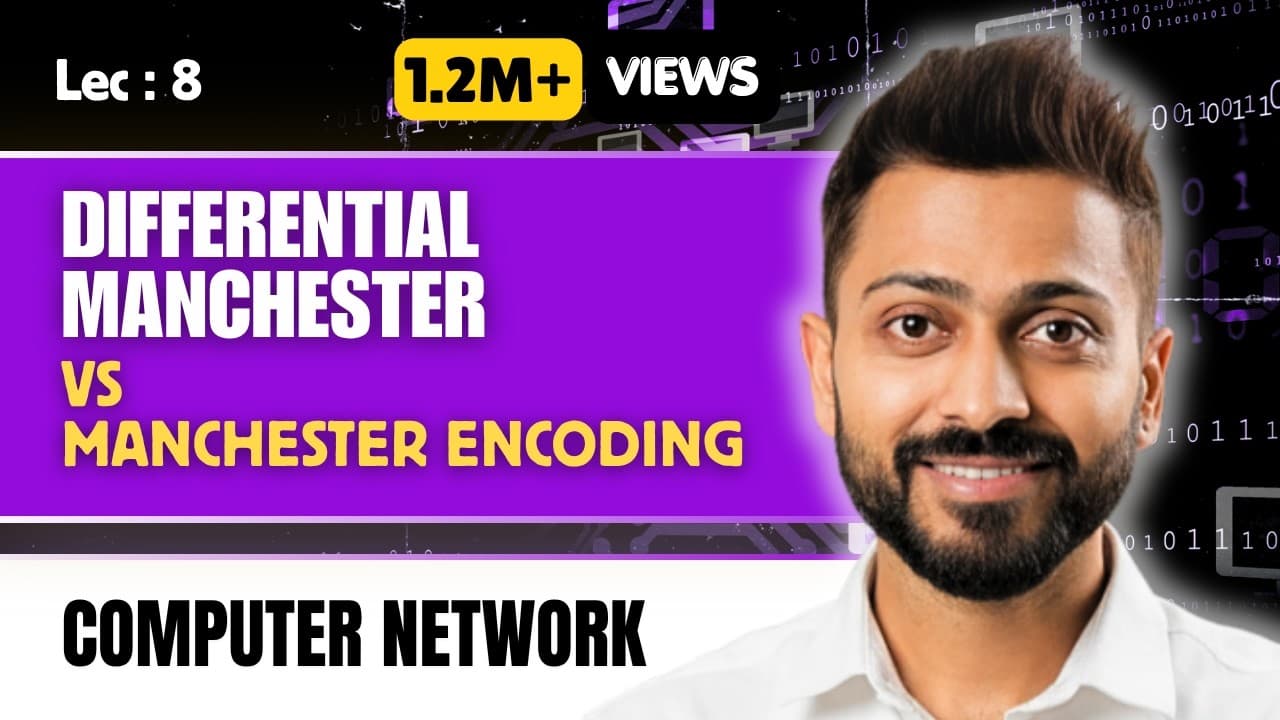
Manchester encoding represents binary data using signal transitions, with '1' indicated by a high-to-low transition and '0' by a low-to-high transition. Differential Manchester encoding signifies '0' through a transition and '1' by maintaining continuity, ensuring synchronization and minimizing transmission errors. Both methods are essential for data representation in the physical layer of digital communication.
Transcript
Read and summarize the transcript of this video on Glasp Reader (beta).
Key Insights
- Manchester encoding involves representing binary data using specific signal transitions, with two main conventions: Dr. Thomas and IEEE802.3.
- In Manchester encoding, '1' is represented by a transition from low to high and '0' by a transition from high to low, or vice versa depending on the convention used.
- Differential Manchester encoding uses transitions to encode data, where '0' is indicated by a transition and '1' by continuity.
- The physical layer of a network uses encoding techniques like Manchester and Differential Manchester to transmit data as digital or analog signals.
- Understanding the conventions and rules for drawing transitions is crucial for correctly applying Manchester and Differential Manchester encoding.
- Competitive exams like GATE and UGC NET often include questions on Manchester and Differential Manchester encoding.
- Differential Manchester encoding ensures synchronization by using transitions to signify bits, reducing errors in data transmission.
- Practical examples and diagrams help in grasping the concept of encoding techniques, making it easier to solve related problems.
Install to Summarize YouTube Videos and Get Transcripts
Explore YouTube Video Summarizer or Get YouTube Transcript Extractor
Questions & Answers
Q: How is '1' represented in Manchester encoding according to Dr. Thomas?
In Manchester encoding according to Dr. Thomas, a '1' is represented by a transition from a lower to an upper signal, typically from low to high. This representation is part of the convention where each bit is indicated by a specific change in the signal, ensuring clear differentiation between '1' and '0'.
Q: What is the main difference between Manchester and Differential Manchester encoding?
The main difference between Manchester and Differential Manchester encoding lies in the use of transitions. Manchester encoding uses specific transitions to represent '1' and '0', while Differential Manchester encoding uses transitions to indicate '0' and continuity to represent '1'. This makes Differential Manchester more robust in terms of synchronization.
Q: Why is understanding conventions important in Manchester encoding?
Understanding conventions in Manchester encoding is crucial because different conventions, like Dr. Thomas and IEEE802.3, use different signal transition rules to represent binary data. Knowing which convention to apply ensures accurate data encoding and transmission, especially in environments where specific standards are required.
Q: How does Differential Manchester encoding ensure synchronization?
Differential Manchester encoding ensures synchronization by using transitions to signify '0', which creates a consistent timing pattern. This pattern helps receivers maintain synchronization with the sender, reducing errors in data transmission and making it more reliable compared to methods without such built-in synchronization.
Q: What is the significance of edges in Differential Manchester encoding?
Edges in Differential Manchester encoding are significant because they represent '0'. An edge indicates a transition, which is crucial for maintaining synchronization and ensuring that the receiver correctly interprets the incoming data. This method helps in reducing errors and improving the reliability of data transmission.
Q: How does the physical layer use encoding techniques in data transmission?
The physical layer uses encoding techniques like Manchester and Differential Manchester to convert digital data into signals suitable for transmission over a network. These techniques translate binary data into specific signal patterns, ensuring that data is accurately transmitted and received across different media types, whether digital or analog.
Q: What role do practical examples play in understanding encoding techniques?
Practical examples play a crucial role in understanding encoding techniques by providing visual and hands-on illustrations of how data is encoded. They help learners visualize the process, understand the rules of signal transitions, and apply these concepts to solve problems, making the learning process more effective and engaging.
Q: Why are Manchester and Differential Manchester encoding important for competitive exams?
Manchester and Differential Manchester encoding are important for competitive exams like GATE and UGC NET because they are fundamental concepts in networking and digital communication. Understanding these encoding techniques is essential for solving related problems, as they often appear in exam questions testing knowledge of data transmission and encoding methods.
Summary & Key Takeaways
-
The video explains the difference between Manchester and Differential Manchester encoding in digital communication, focusing on how data is represented using signal transitions. It covers the conventions used in Manchester encoding and the concept of edges in Differential Manchester encoding.
-
Manchester encoding uses signal transitions to represent binary data, with two conventions: Dr. Thomas and IEEE802.3. Differential Manchester encoding involves using edges to indicate '0' and continuity for '1', ensuring synchronization and reducing transmission errors.
-
The video is a useful resource for students preparing for competitive exams like GATE and UGC NET, offering practical examples and diagrams to illustrate the encoding techniques. It emphasizes the importance of understanding conventions and transition rules in data transmission.
Read in Other Languages (beta)
Share This Summary 📚
Summarize YouTube Videos and Get Video Transcripts with 1-Click
Try YouTube Summary with ChatGPT & Claude or YouTube Transcript Generator
Explore More Summaries from Gate Smashers 📚



Summarize YouTube Videos and Get Video Transcripts with 1-Click
Try YouTube Summary with ChatGPT & Claude or YouTube Transcript Generator