What Is the Difference Between Multiprogramming and Multitasking?
TL;DR
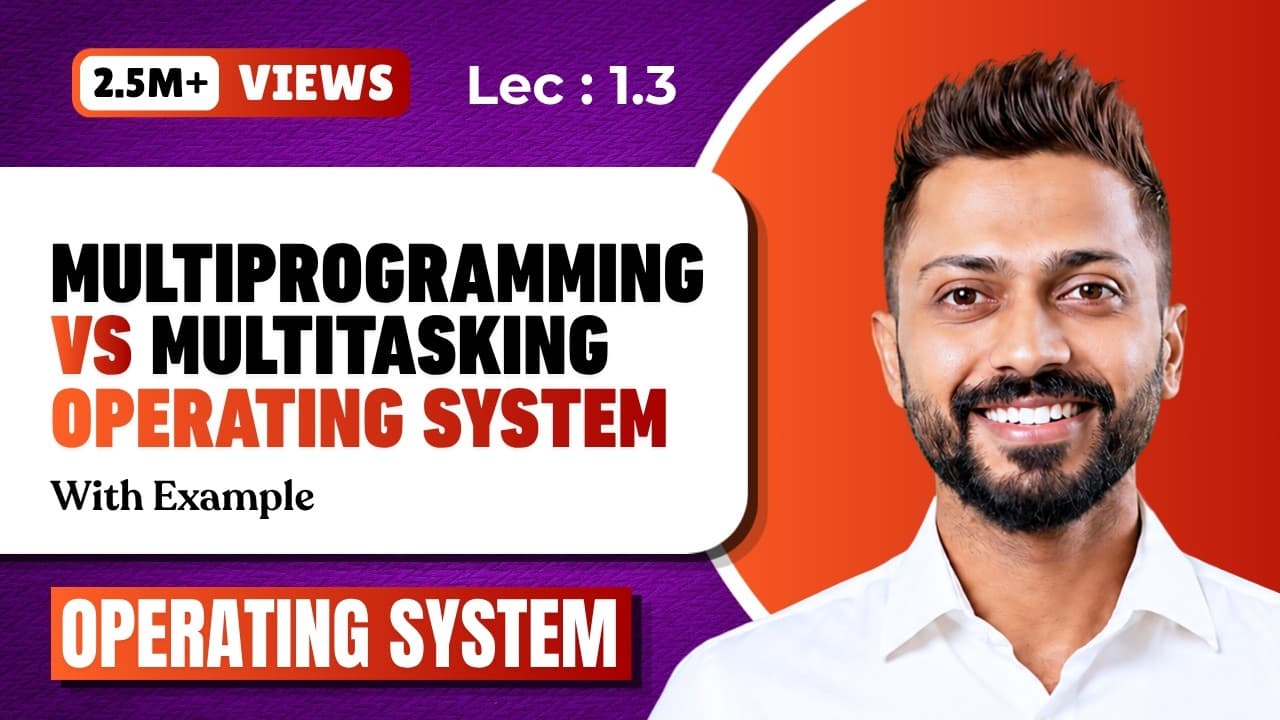
Multiprogramming runs one process to completion before moving to the next, optimizing CPU usage but potentially delaying responses. In contrast, multitasking switches between processes frequently, enhancing responsiveness and reducing idle time—a method used in most modern operating systems.
Transcript
Hello friends, Welcome to Gate Smashers In types of operating system These two types are very important That's multi-tasking, multi-program or time-sharing operating system Here, students get confused many times that what is actually multi-programmed and what is multitasking, also, what's the difference between both of them So first I'm telling abo... Read More
Key Insights
- ⌛ Multi-programmed operating systems optimize CPU time by allowing multiple processes to reside in memory but execute one at a time.
- 🥺 Non-preemptive scheduling in multi-programming ensures that processes run to completion, increasing CPU utilization but possibly leading to delays in response times.
- ✖️ Multi-tasking systems enhance responsiveness by using preemptive tactics, enabling the CPU to rapidly switch between processes.
- 👤 In a multi-tasking setup, processes are allotted a limited time period for execution, creating a more dynamic and interactive user experience.
- 😒 Real-time operating systems commonly use multi-tasking for their efficiency in handling multiple simultaneous operations.
- 🧑🦯 Round-robin is a common algorithm used in multi-tasking systems to evenly distribute CPU time among processes.
- 👤 Understanding these operating system types helps users and developers make informed decisions regarding system design and resource allocation.
Install to Summarize YouTube Videos and Get Transcripts
Explore YouTube Video Summarizer or Get YouTube Transcript Extractor
Questions & Answers
Q: What is the primary characteristic of a multi-programmed operating system?
A multi-programmed operating system is defined by its ability to manage multiple processes in RAM simultaneously but can only execute them one at a time through a non-preemptive model. This means the CPU will complete the execution of the current process before moving to the next one, thus minimizing idle CPU time by overlapping processes that require input/output operations.
Q: How does multi-tasking differ from multi-programming in terms of process execution?
Multi-tasking differs from multi-programming primarily in its approach to process execution. Multi-tasking employs a preemptive scheduling strategy, allowing the CPU to execute portions of multiple processes before moving on. This enhances responsiveness as it allocates CPU time more fairly amongst processes, allowing faster completion of tasks from several processes rather than waiting for one to finish entirely.
Q: What are the benefits of time-sharing in multi-tasking systems?
Time-sharing in multi-tasking systems leads to reduced response times for users because processes are executed in small time slices. This prevents a single process from monopolizing CPU time, thereby improving the responsiveness of applications and ensuring that all users have quicker access to resources. As a result, users experience more efficient multitasking across applications.
Q: Why is idle CPU time significant in operating systems?
Idle CPU time is significant as it represents inefficiency in process execution. In operating systems, particularly multi-programmed ones, minimizing this idle time is crucial for optimizing performance. A CPU that remains idle signifies that processes are waiting unnecessarily, leading to delays and poorer overall system responsiveness. Reducing idle time is a key goal in both multi-programmed and multi-tasking systems.
Summary & Key Takeaways
-
The video explains two key types of operating systems: multi-programming and multi-tasking, focusing on their definitions and functionalities.
-
Multi-programmed systems utilize a non-preemptive strategy, where a process runs to completion before the next one starts, optimizing CPU utilization.
-
In contrast, multi-tasking systems employ a preemptive method, enabling quicker responses as the CPU switches between processes frequently, enhancing responsiveness.
Read in Other Languages (beta)
Share This Summary 📚
Summarize YouTube Videos and Get Video Transcripts with 1-Click
Try YouTube Summary with ChatGPT & Claude or YouTube Transcript Generator
Explore More Summaries from Gate Smashers 📚





Summarize YouTube Videos and Get Video Transcripts with 1-Click
Try YouTube Summary with ChatGPT & Claude or YouTube Transcript Generator