How Do the Three Main Machine Learning Types Differ?
TL;DR
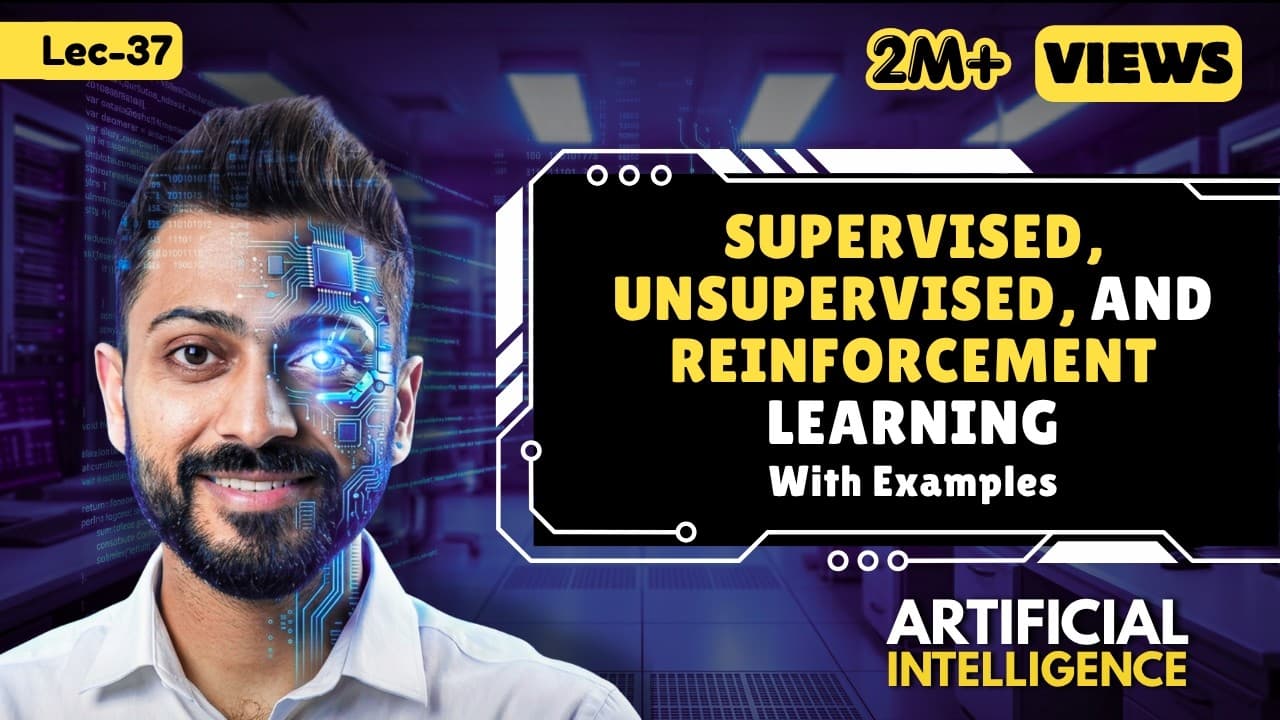
Supervised learning trains on labeled inputs and outputs, unsupervised learning discovers clusters from inputs without known outputs, and reinforcement learning improves policies through rewards and penalties. Exit polls illustrate supervised classification, observations in the film PK illustrate unsupervised clustering, and actions followed by favorable or unfavorable consequences illustrate reinforcement learning.
Transcript
Hello friends! Welcome to Gate Smashers. In this video, we are going to discuss various types of learnings in AI. You can also say it various types of machine learning. The different types of learning we have in machine learning are supervised, unsupervised, and reinforcement. The difference between the three is asked many times. In this video, I w... Read More
Key Insights
- Supervised learning is based on labeled training data in which both the input and the expected output are already available. A model is created from these examples and then tested by supplying new input to determine whether it produces a valid output.
- Training data acts as the supervisor in supervised learning because it provides the instructions needed to construct the model. The quality and refinement of this data affect whether the model's later output agrees with the observed result.
- Exit polling is presented as an example of supervised learning because feedback from many categories of people supplies input, while predicted winners, losers, and seat totals supply outputs. Actual voting data can then be entered into the resulting model.
- Classification is the process of assigning data to defined outcomes, such as identifying a candidate as a likely winner or loser. The lecture associates this supervised task with the Naive Bayes algorithm and evaluates it using new data.
- Unsupervised learning is performed with input data but without known outputs or predefined labels. The learner independently observes characteristics and forms clusters, even though the first categories it creates are not guaranteed to be correct.
- K-means clustering is described as an unsupervised method that creates groups and attempts to place similar kinds of observations together. Possible grouping features include physical structure, color, appearance, clothing, and patterns of movement.
- Reinforcement learning is driven by an agent's actions, resulting state changes, and positive rewards or negative penalties. The agent uses these consequences to create or revise a policy that guides which actions it should perform next.
- Learning can progress from unsupervised clustering toward supervised classification as categories become refined. Once a learner has formed and understood a cluster, it can use that acquired category to classify a newly observed example.
Install to Summarize YouTube Videos and Get Transcripts
Explore YouTube Video Summarizer or Get YouTube Transcript Extractor
Questions & Answers
Q: What is the difference between supervised, unsupervised, and reinforcement learning?
Supervised learning uses training data that already contains inputs and corresponding outputs, allowing a model to learn classifications from labeled examples. Unsupervised learning receives inputs without known outputs and independently organizes similar observations into clusters. Reinforcement learning involves an agent taking actions, receiving positive rewards or negative penalties, and revising a policy according to the consequences and state changes produced by those actions.
Q: How does supervised learning use labeled training data?
Supervised learning treats labeled training data as a teacher or supervisor. Each training example provides an input together with its expected output, and a learning algorithm uses those paired examples to create a model. New input is later supplied to the model, which generates an output. Comparing that result with the observed outcome helps indicate whether the training data was accurate and refined.
Q: How do exit polls illustrate supervised learning?
Exit polls provide feedback gathered from many categories of people as input data, while predicted seat totals, winners, losers, or winning probabilities serve as outputs. These input-output pairs form training data for a prototype model. When actual voting data becomes available, it can be entered as new input, and the model's result can be compared with the final election outcome to assess the training data.
Q: What is classification in supervised machine learning?
Classification assigns input data to an established category or outcome. In the election example, a model can classify a candidate as a winner or loser, or indicate that one candidate has a greater probability of winning than another. Because these outcome labels are already represented in the training data, the model learns from labeled examples before it processes new input and produces a classification.
Q: How does unsupervised learning create clusters?
Unsupervised learning examines input without receiving a correct output or predefined category. It searches for similarities in observable features, including physical structure, color, appearance, clothing, or movement, and places similar observations into groups called clusters. The first clusters may not be correct. As more observations or feedback become available, the learner can gradually refine the groups and move closer to useful categories.
Q: Why is the PK movie used to explain unsupervised learning?
The character from PK arrives without prior knowledge of categories such as male, female, child, or adult. He receives visual input through observation and groups people according to characteristics such as height, mustaches, clothing, physical appearance, and walking style. Because no known output tells him the correct category initially, his attempt to form and refine groups illustrates unsupervised clustering.
Q: How does reinforcement learning use rewards and penalties?
Reinforcement learning places an agent in an environment where it performs an action and experiences a consequence. A favorable consequence acts as a positive reward, while an unfavorable one acts as a penalty. The action can also change the state or environment. The agent uses this result to form or revise a policy, which then influences whether it performs a similar action in the future.
Q: Which algorithms are associated with the three learning types?
The lecture associates Naive Bayes with supervised learning, particularly when inputs and outputs are already provided for classification. It presents K-means as an unsupervised clustering method that attempts to keep similar observations in the same group. For reinforcement learning, it identifies Q-learning as a generally used method for learning policies from actions, rewards, penalties, and resulting changes in state.
Summary & Key Takeaways
-
Supervised learning uses training data containing both inputs and outputs. A learning algorithm builds a model from this labeled data, then processes new input and produces a classification or prediction. The exit poll example shows how feedback and expected election outcomes can form a prototype model that is later tested against actual voting data.
-
Unsupervised learning begins with input data but no known output or teacher-provided labels. The learner examines characteristics such as physical structure, color, appearance, clothing, or movement and places similar observations into clusters. These initial groups may be inaccurate, but additional observations and feedback can gradually refine how items are grouped and recognized.
-
Reinforcement learning involves an agent acting within an environment and receiving either a positive reward or a negative penalty. Each action can change the agent's state or environment, and the result helps form or revise a policy for future behavior. The lecture connects this process with games and identifies Q-learning as a commonly used method.
Read in Other Languages (beta)
Share This Summary 📚
Summarize YouTube Videos and Get Video Transcripts with 1-Click
Try YouTube Summary with ChatGPT & Claude or YouTube Transcript Generator
Explore More Summaries from Gate Smashers 📚


Summarize YouTube Videos and Get Video Transcripts with 1-Click
Try YouTube Summary with ChatGPT & Claude or YouTube Transcript Generator