What is cloud computing and why use it today?
TL;DR
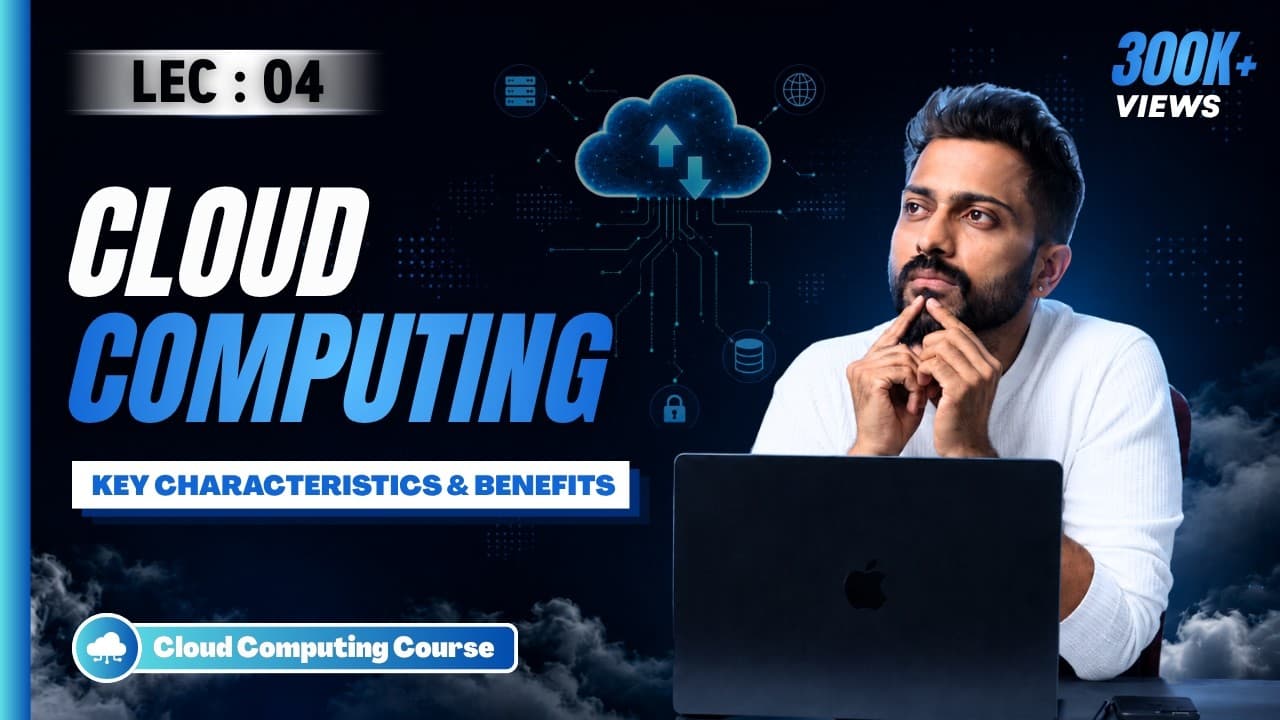
Cloud computing delivers computing services over the internet, including storage, servers, databases, networking, software, and more. It enables on demand self service, pay as you go, broad network access, resource pooling, and scalability. Real life examples include Google Drive, Netflix, and Spotify which rely on cloud infrastructure for access from anywhere.
Transcript
Dear students, welcome to Gate Smashers In today's video, I am going to explain Basic introduction of cloud computing And I will explain things to you with real life example First of all, if I read the definition What is a cloud computing? Cloud computing means delivering the computing services Like storage, servers, databases networking, software ... Read More
Key Insights
- Cloud computing is defined as delivering computing services over the internet including storage, servers, databases, networking, software, and runtime.
- On demand self service means users can obtain computing resources as needed without direct human interaction with the service provider.
- Pay as you go pricing lets users pay only for the resources they actually use, similar to utility services like electricity or ride sharing.
- Broad network access ensures cloud services are accessible from any device with internet connectivity.
- Resource pooling uses virtualization to share physical resources among multiple users.
- Scalability and elasticity allow services to scale up or down quickly in response to demand.
- Major cloud providers control large market segments and offer a variety of services to meet different needs.
- Examples like Google Drive, Netflix, and Spotify illustrate cloud based storage and streaming in everyday life.
- More videos from this channel:
- More from this channel: Gate Smashers
Install to Summarize YouTube Videos and Get Transcripts
Explore YouTube Video Summarizer or Get YouTube Transcript Extractor
Questions & Answers
Q: What is cloud computing in simple terms?
Cloud computing is a way to deliver computing services over the internet. It means you can use storage, servers, databases, networking, software, and other resources without owning and managing physical hardware. You pay for what you use, access services from anywhere, and rely on providers to manage the infrastructure while you focus on your applications and data.
Q: Why do businesses use cloud computing?
Businesses use cloud computing to avoid large upfront hardware costs and complex setup. It provides on demand self service, pay as you go pricing, global access through the internet, and the ability to scale resources quickly as demand changes. This leads to faster deployment, flexibility, and the capacity to innovate without heavy capital investment.
Q: Who are the major cloud providers?
The major cloud providers are AWS, Microsoft Azure, and Google Cloud. They lead the market with extensive infrastructure, broad service offerings, and global data center networks. These providers supply computing power, storage, databases, and many specialized services that support a wide range of applications from simple websites to complex analytics.
Q: What is meant by on demand self service?
On demand self service means users can provision computing resources themselves without human intervention. They can request storage, compute power, or software, and the system automatically allocates and configures what is needed. This accelerates deployment, reduces wait times, and improves operational efficiency for teams.
Q: How does pay as you go work in cloud services?
Pay as you go means you are charged based on usage rather than a fixed upfront cost. As you consume more resources, your charges increase proportionally, and when consumption drops, costs decrease. This model aligns expenses with actual demand and helps manage budgets more predictably.
Q: What is resource pooling in cloud computing?
Resource pooling happens when a cloud provider uses virtualization to share physical resources like servers and storage among multiple tenants. Resources are allocated logically to each user, appearing as a dedicated service while the underlying hardware is shared. It enables efficient utilization and cost savings.
Q: What is elasticity in cloud computing?
Elasticity refers to the ability of cloud services to scale resources up or down quickly in response to demand. If traffic spikes, more compute and storage can be provisioned; if demand falls, resources can be reduced. This helps maintain performance while controlling costs.
Q: Can you name everyday examples of cloud usage?
Everyday examples include Google Drive for storage, Netflix and Spotify for streaming media, and various apps that rely on cloud infrastructure for data access. These services run in the cloud so users can access content and files from any device with internet connectivity, without local installations.
Summary & Key Takeaways
-
Cloud computing is defined as delivering computing services over the internet including storage, servers, databases, networking, software, and runtime. Its core idea is to provide access to resources without on premises infrastructure and to enable easy, scalable, and elastic use of IT resources.
-
Major cloud providers like AWS, Azure, and Google Cloud lead the market, offering vast infrastructure that powers services used daily. These providers offer on demand resources, payment models, and global reach, making it feasible for businesses of all sizes to deploy cloud based solutions.
-
Key characteristics and benefits include on demand self service, pay as you go, broad network access, resource pooling, scalability, and elasticity. Cloud services allow rapid provisioning, reduced upfront costs, and the ability to scale resources to match demand while maintaining performance.
Read in Other Languages (beta)
Share This Summary 📚
Summarize YouTube Videos and Get Video Transcripts with 1-Click
Try YouTube Summary with ChatGPT & Claude or YouTube Transcript Generator
Explore More Summaries from Gate Smashers 📚





Summarize YouTube Videos and Get Video Transcripts with 1-Click
Try YouTube Summary with ChatGPT & Claude or YouTube Transcript Generator