How AI Humanoid Robots Transform Workplaces
TL;DR
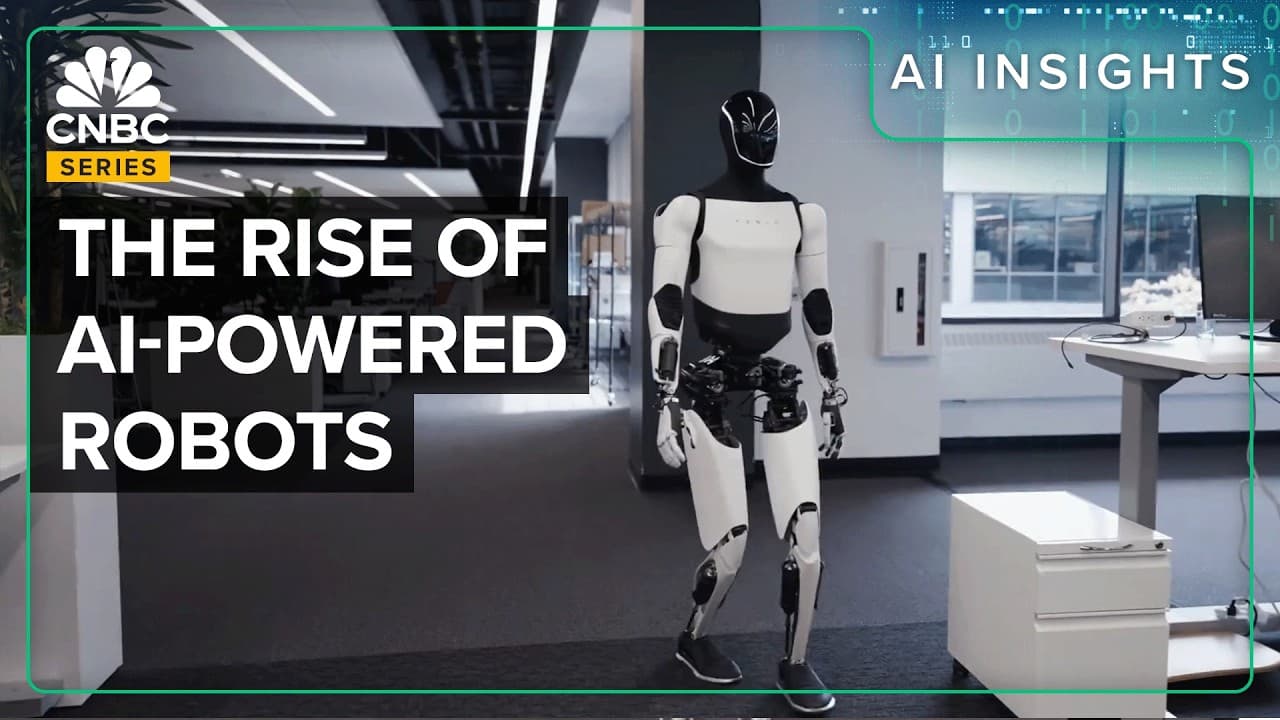
AI powered humanoid robots are attracting billions in investment from big tech and are seen as a way to fill labor shortages in factories and warehouses. The video explains how advancements in AI and training data enable these robots to interpret human language, perform tasks, and potentially operate autonomously, while noting hurdles like safety, trust, and deployment scale.
Transcript
Hey, digit, take the box with the heaviest animal and move it to tower four. This is digit, a robot who sort of looks like a person, hence the name Humanoid Robot. Technically, these are called bipedal humanoid robots. Using semantic intelligence, it's able to interpret commands from people and then make its own decisions about how to act. So the g... Read More
Key Insights
- AI driven humanoid robots interpret human language and autonomously decide actions based on real world data
- Investors and tech giants are funneling billions into humanoid robotics for potential widespread deployment
- Major partners like Nvidia and Microsoft provide hardware, software and foundation models to accelerate robotics development
- Humanoids are positioned to tackle dangerous, repetitive, and physically demanding tasks
- Autonomy in robots grows through data collection, teleoperation and training on numerous trajectories
- Different companies pursue varied designs, including legged and wheeled platforms, to optimize dexterity and mobility
- Labor shortages in manufacturing and logistics are a primary market driver for humanoid robotics
- Public concerns center on safety, trust and the ethical implications of robots in daily life and work environments
- More videos from this channel:
- More from this channel: CNBC
Install to Summarize YouTube Videos and Get Transcripts
Explore YouTube Video Summarizer or Get YouTube Transcript Extractor
Questions & Answers
Q: How do AI humanoid robots learn tasks for real world environments
AI humanoid robots learn tasks by collecting data from real world scenarios through teleoperation, where a human performs the task many times and the data is used to train the model. The system then replicates the demonstrated trajectories to perform the task autonomously in new spaces, reducing the need for extensive manual coding and enabling flexible responses to new objects and environments.
Q: Why are major tech companies investing in humanoid robots
Major tech companies invest because humanoid robots could transform labor across industries by handling dangerous or repetitive work and alleviating labor shortages in manufacturing and logistics. The investment is driven by the potential to create scalable, semi autonomous systems that work alongside humans and can be deployed in a variety of settings, supported by powerful AI foundations and hardware from leading firms.
Q: What is the perceived market potential for humanoid robots according to the video
The video notes that investors expect substantial growth in the humanoid robotics market, with projections of huge long term market value and the potential for robots to become a significant part of the economy. Analysts describe the sector as one of the biggest opportunities for automation alongside existing tech industries, though practical deployment hinges on safety, reliability and cost effectiveness.
Q: What challenges are associated with deploying humanoid robots in households or care settings
Challenges include ensuring safety and reliability, forming trust with users, managing safety risks in homes and care facilities, and determining appropriate levels of autonomy. The video discusses how such robots must be friendly and capable of operating in environments built for humans, while addressing ethical questions about safety, privacy and impact on care work.
Q: Which companies are mentioned as partners or competitors in humanoid robotics
Companies mentioned include Agility Robotics, Sanctuary AI, Optronics, and Apptronik as contributors to humanoid development. Nvidia, Microsoft and Google are cited as key partners for hardware, software, and foundation models, with Tesla’s Optimus and other robots used as examples of industry ambition and competition among large tech players.
Q: What applications are envisioned for humanoid robots in industry
Applications include logistics and warehousing tasks like moving boxes and handling totes, manufacturing support, retail assistance, and eventual roles in automotive, healthcare and other sectors. The goal is to deploy robots to perform end to end tasks, improve efficiency and safety, and support an aging workforce as job markets evolve.
Q: How does the video describe the role of AI in advancing robotics
AI is described as the key unlock for advancing robotics by enabling robots to learn from data, understand complex tasks, and generalize to new situations. Generative AI models help train robots by processing large datasets of trajectories, allowing robots to infer how to perform tasks without coding every step from scratch.
Q: What concerns are raised about the pace of robot deployment and public acceptance
Concerns include whether robots can be trusted to operate safely in daily life and work settings, if the deployment pace is realistic, and how to handle potential job displacement. The video frames these as broader questions about whether humanoids will become commonplace tools, remain PR spectacles, or deliver real economic value.
Summary & Key Takeaways
-
Humanoid robots are being developed to interpret natural language and make autonomous decisions, aiming to handle dangerous or repetitive tasks in real world workplaces.
-
Big tech and investors are driving rapid funding and partnerships to accelerate robot development, with firms like Nvidia, Microsoft, and Tesla playing key roles.
-
The path to widespread adoption includes proving reliability, safety, and cost effectiveness, while addressing concerns about job displacement and the pace of deployment in industries such as logistics and manufacturing.
Read in Other Languages (beta)
Share This Summary 📚
Summarize YouTube Videos and Get Video Transcripts with 1-Click
Try YouTube Summary with ChatGPT & Claude or YouTube Transcript Generator
Explore More Summaries from CNBC 📚





Summarize YouTube Videos and Get Video Transcripts with 1-Click
Try YouTube Summary with ChatGPT & Claude or YouTube Transcript Generator