How BYD Overtook Tesla in Global EV Sales and Growth
TL;DR
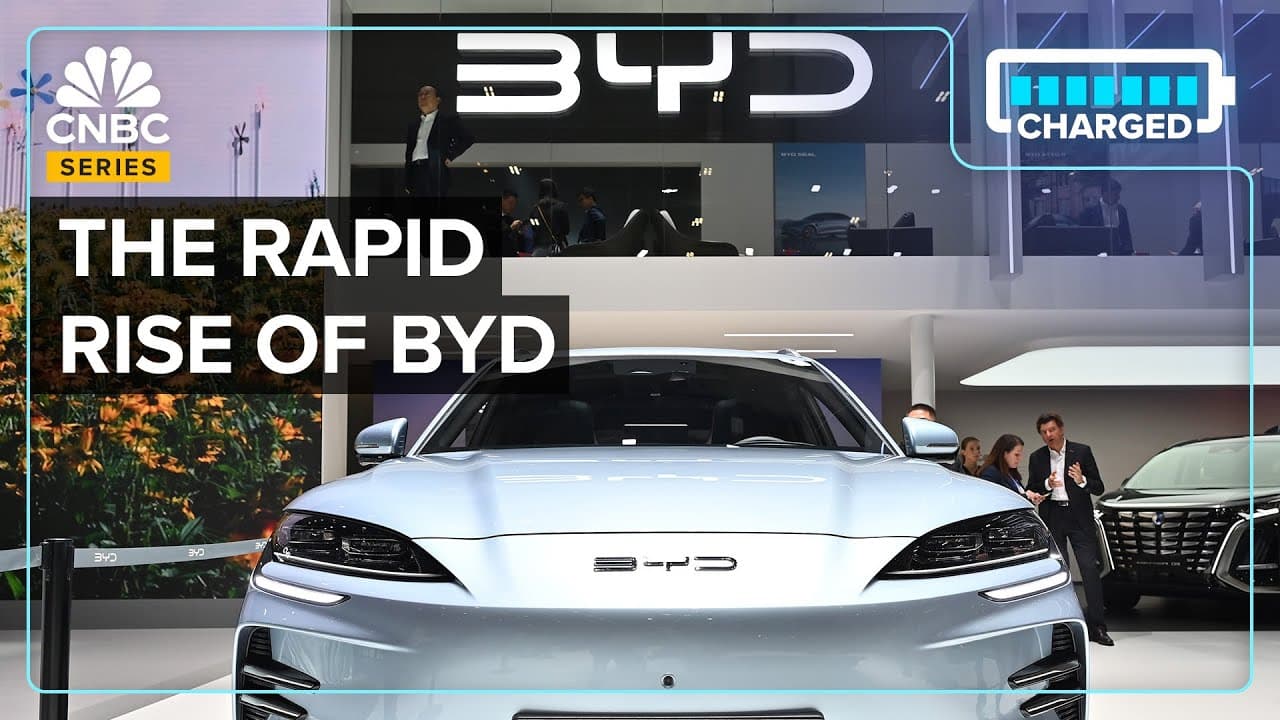
BYD built momentum through aggressive price strategies and strong in house battery tech, propelling rapid growth in China and expanding exports. The company dominates around 40 percent of China’s EV market, outsells rivals with a wide model lineup, and is pushing into Europe, Asia, and the Americas with reduced costs and integrated battery production.
Transcript
In the world of electric vehicles, Tesla has reigned supreme. But its days as top dog may be numbered. In China, the world's largest EV market, it's been losing ground to domestic automakers as a ruthless price war has inflamed an already competitive market. If Tesla had not had price cuts of 20 to 30%, they probably would have actually had sales d... Read More
Key Insights
- BYD is the top EV brand in China with an 11 percent market share and 2.4 million new car insurance registrations in 2023.
- BYD produced over 3 million new energy vehicles in 2023, surpassing Tesla in global production within the same period.
- BYD undercuts competitors through price strategy and controls its battery supply chain to reduce costs and improve margins.
- BYD designs and manufactures its own batteries at scale, including the Blade and LFP technologies, which lowers costs and increases safety.
- BYD exports grew 334 percent in 2023 to 242,765 vehicles across 70 countries, signaling rapid international expansion.
- BYD has built a diversified portfolio including Dynasty, Ocean, Denza, Yangwang, and Fang Cheng Bao to cover multiple market segments.
- BYD uses in house production for cost control and is expanding overseas with ships capable of carrying thousands of cars for Europe and beyond.
- The EU is scrutinizing Chinese EV subsidies, presenting a potential obstacle to BYD’s European growth strategy.
- More videos from this channel:
- More from this channel: CNBC
Install to Summarize YouTube Videos and Get Transcripts
Explore YouTube Video Summarizer or Get YouTube Transcript Extractor
Questions & Answers
Q: What is BYD's main strategy to compete with Tesla in EVs?
BYD relies on a price driven strategy combined with its own battery technology to keep costs low and margins sustainable. By undercutting competition in price, offering a broad model range from entry level to high end, and using its own batteries such as the Blade and LFP variants, BYD maintains a competitive edge. This integrated approach enables scale, export growth, and resilience in the face of price wars that have affected other manufacturers.
Q: How did BYD grow to become a leading Chinese EV brand?
BYD began as a battery maker and transitioned into autos, undercutting competition through low cost manufacturing and rapid product development. Its 2010s shift toward NEVs with mass market appeal, the Tang and Han models, and a focus on battery innovation helped it dominate the Chinese EV landscape. The company’s concentration on affordable mass market vehicles with a broad price range cemented its top market position.
Q: What role does battery technology play in BYD's success?
Battery technology is central to BYD’s success. BYD designs and manufactures its own batteries at scale, including the Blade and LFP chemistry, which reduces cost per kilowatt hour and enhances safety. This vertical integration allows BYD to offer competitive pricing, secure supply for its models, and even supply batteries to other car makers, reinforcing its competitive position.
Q: What is the scope of BYD’s global expansion and export growth?
BYD has expanded exports to 70 countries with 242,765 vehicles in 2023, signaling strong global growth. The company has delivered thousands of cars to Germany on its own ship and aims to enter additional markets such as Japan, Mexico, Southeast Asia, and parts of Europe. Its strategy includes setting up European plants and leveraging in house production to sustain low costs.
Q: Why did Warren Buffett invest in BYD and how did it affect the company?
Buffett invested in BYD due to the company’s battery business potential and strong leadership, recognizing an opportunity beyond the vehicle market. His backing provided credibility and capital, contributing to BYD’s growth story and stock appreciation. The investment highlighted the importance of battery technology in BYD’s overall strategy and international expansion.
Q: How has BYD impacted the European EV market and regulatory environment?
BYD is expanding into Europe with large exports and local plans, while facing regulatory scrutiny over subsidies. The EU Commission has questioned Chinese EV subsidies, accusing potential dumping or over subsidization. This regulatory environment could influence BYD’s pricing and market access in Europe, shaping its strategic moves and investments there.
Q: What makes BYD’s product lineup appealing across segments?
BYD offers a broad lineup from affordable mass market models like the Dolphin and Seal to larger vehicles such as the Han and Tang, and luxury subbrands like Denza and Yangwang. This mix targets different customer segments, supports high volumes, and strengthens brand appeal, enabling BYD to compete across price points and vehicle types while expanding globally.
Q: What challenges does BYD face as it expands internationally?
As BYD expands internationally, it faces competition, regulatory scrutiny in regions like the EU, and potential geopolitical considerations. Balancing price competitiveness with compliance and local market requirements will be key. The company also needs to manage logistics and service networks to support growing international sales and maintain customer trust.
Summary & Key Takeaways
-
BYD rose to the top of the EV market by undercutting competition and expanding battery technology, which allowed for cost efficiency and broader model availability. The result is rapid scale in China and increasing overseas exports.
-
BYD expanded beyond passenger cars to buses and commercial fleets while maintaining a mass market focus with affordable models like the Dolphin and Sea series. This mix supports high volumes and global reach.
-
BYD confronts regulatory scrutiny in Europe while pursuing strategic markets worldwide, including Europe, Southeast Asia, and potentially the United States, leveraging in house battery production and a diversified product lineup to sustain growth.
Read in Other Languages (beta)
Share This Summary 📚
Summarize YouTube Videos and Get Video Transcripts with 1-Click
Try YouTube Summary with ChatGPT & Claude or YouTube Transcript Generator
Explore More Summaries from CNBC 📚




Summarize YouTube Videos and Get Video Transcripts with 1-Click
Try YouTube Summary with ChatGPT & Claude or YouTube Transcript Generator