How Close Are Home Robots to Doing Your Chores?
TL;DR
Home robots remain years away from mainstream use, and the humanoids sold today still lean on human teleoperators. Weave Robotics' Treadle folds laundry in Bay Area businesses now, with home shipments planned for 2026, while 1X's $20,000 NEO is remote-operated by a person in a headset. Vacuum cleaners are still the only home robots that have truly succeeded.
Transcript
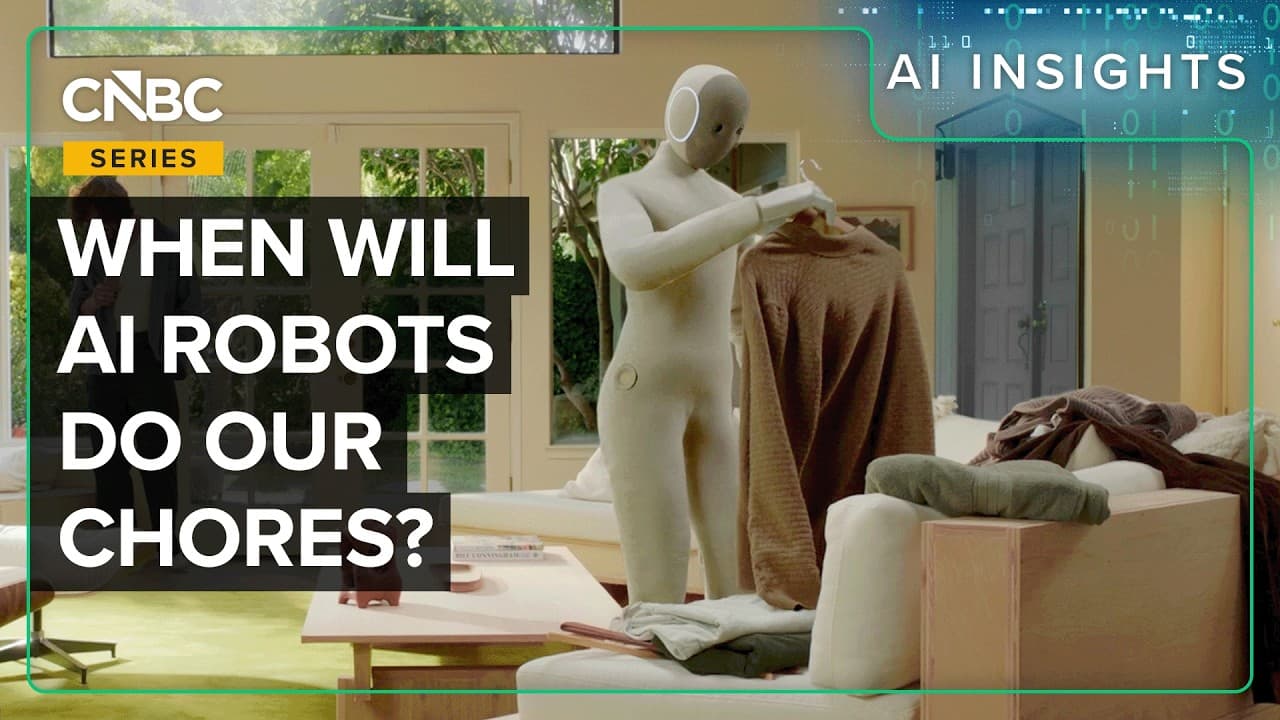
This is Treadle the Humanoid by Weave Robotics that's folding laundry for businesses in the Bay Area now, and has plans to tidy up for some hotels soon, too. We're shipping to our first home customers in 2026, and we are live in businesses now in 2025. There's no doubt that AI robots are here, in Amazon warehouses, car factories, even farms.... Read More
Key Insights
- Vacuum cleaners are the only home robots that have really been successful, because limited purpose machines suit a world so dynamic and complex that it helps to be the master of one trade rather than an all purpose Rosie from The Jetsons.
- Weave Robotics' Treadle folds laundry for Bay Area businesses in 2025, with first home customer shipments planned for 2026, talks underway with hotels for a coming model that also tidies floors and surfaces, and a consumer model named Isaac reservable now.
- 1X's NEO costs $20,000 and is available for pre-sale, but it must be teleoperated by a human wearing a headset, meaning a person is watching the robot's and the owner's every move inside the home.
- Both Weave's and LG's home humanoids ride on wheels instead of legs, which cuts component count, speeds up building, and lets the machines balance passively so they stay upright when first-of-their-kind products inevitably struggle or collide with something.
- Teleoperation functions as the bridge from no autonomy to full autonomy, filling the gap while companies collect real-world home data, and experts interviewed say it is going to be here for a while rather than disappearing soon.
- The home is unstructured in ways factories are not: you cannot plan for a child running into the robot or the robot running over a pet, whereas warehouse environments are confined and structured enough for current deployments.
- Humanoid form has advocates because the world is built for humans, with ladders, stages, and stairs suited to human shapes, and because existing human motion data can be retargeted to human-shaped robots for training.
- China's strategy is to deploy humanoids widely to collect as much real-world data as possible and get the population excited about them, a push the United States is not matching, leaving it unclear which country will win the open space.
Install to Summarize YouTube Videos and Get Transcripts
Explore YouTube Video Summarizer or Get YouTube Transcript Extractor
Questions & Answers
Q: How close are home robots to actually doing chores?
Not close for general-purpose chores. Three years into the generative AI era, the most common AI-powered home robots are still simple, and vacuum cleaners are the only home robots that have really been successful. At the second annual Humanoid Summit, only two or three of roughly 60 exhibitors focused on the home, and experts interviewed called in-home humanoids a far away dream with questionable capabilities. Task-specific machines like Weave's laundry-folding Treadle are shipping first, but even those are not yet fully autonomous.
Q: What is the 1X NEO robot and how much does it cost?
NEO is a humanoid home robot from Palo Alto based 1X, the only U.S. company with a humanoid on the market today. It is available for pre-sale at $20,000. Users describe asking NEO to answer the door, walk over, open it, let people in, and greet them. The major caveat is that NEO is operated by a human being wearing a headset, so a person behind the scenes is watching the robot and the household. 1X's apparent aim is to collect home data so future versions no longer require teleoperation.
Q: Why are home robots harder to build than factory robots?
Factories and warehouses are confined, structured environments that can be planned for. Homes are unstructured: every home is different, and kids and pets introduce unpredictability that cannot be scripted, such as a child running into the robot or the robot running over a pet. Homes also raise privacy and safety stakes. A robot can fall over, lose power, or have its battery die, and many bad things can happen. That risk profile is why no humanoid robots work side by side with people in U.S. factories yet, let alone in living rooms.
Q: What is Weave Robotics' Treadle robot and where is it deployed?
Treadle is a humanoid robot by Weave Robotics that folds laundry. It is deployed in some Bay Area laundromats and businesses in 2025, and the company says it is shipping to its first home customers in 2026. Weave is also in talks with hotels for a coming model that will tidy up floors and surfaces, and a consumer-level model called Isaac can be reserved now. Founders Kaan Dogrusoz and Evan Wineland started the company after seeing, around the end of 2023 and start of 2024, no product they would want in their own living room.
Q: Why do some home humanoid robots use wheels instead of legs?
Both Weave's Treadle and LG's ServeBot CLOiD are humanoid but ride on wheels rather than legs. Wheels mean fewer components, which makes the robots faster to build. They also let the machine balance passively, so the company does not have to worry about actively balancing to stay upright when a first-of-its-kind product inevitably bumps into something or struggles with a task. As the video notes, there is a reason robot vacuums are not bipedal, though some argue the human form will eventually dominate in-home robotics.
Q: What is teleoperation in robotics and why is it used?
Teleoperation means a human remotely controls the robot, often while wearing a headset. Experts describe it as the bridge from no autonomy to full autonomy, filling the gap that still needs to be closed, and say it is going to be here for a while. It also serves data collection: companies like 1X and Weave build their own foundational models trained on data gathered while the robots work, so systems can iterate toward autonomy. Unitree's G1 is remote-controlled today, and Tesla's Optimus has reportedly had help from a human remote assisting.
Q: What privacy concerns do teleoperated home robots raise?
When teleoperators are involved, a human is watching everything the robot sees inside the home, which experts in the video call a potentially huge issue. One interviewee said they would not want to share everything going on in their home with a robot that might be sharing it with somebody else. Company representatives frame it around transparency, arguing the product cannot be made good without a lot of user data. Others counter that homes already contain listening devices, from phones to smart speakers, so robots are just an extension of those machines.
Q: Which companies are leading the humanoid robot market?
In the U.S., Agility Robotics says its Digit robot has moved more than 100,000 totes for GXO, though it has been in testing at Amazon warehouses for over two years. Tesla's Optimus targets industrial uses but failed to launch as planned in 2025. Boston Dynamics' Atlas trains at a Hyundai factory and will integrate Google's Gemini models. Figure AI humanoids helped assemble about 30,000 BMW X3s in a 2025 trial, and Apptronik's Apollo runs pilots at Mercedes Benz and GXO. In China, Unitree is generally considered the leader, with its $70,000 G1 sold in the U.S. by Robo Store.
Summary & Key Takeaways
-
Humanoid robots dominated CES and shared stages with Elon Musk and Jensen Huang, but at the second annual Humanoid Summit in Silicon Valley, only two or three of roughly 60 exhibitors focused on the home. Developers and industry experts interviewed there described in-home deployment as still a far away dream with questionable capabilities.
-
Weave Robotics, founded by Kaan Dogrusoz and Evan Wineland after they saw no product in 2023-2024 they would want in their own living room, has its Treadle robot folding laundry in Bay Area laundromats, is in talks with hotels for a model that tidies floors and surfaces, and takes reservations for a consumer model called Isaac.
-
The home is far harder than the factory because every home differs and adds unpredictability from kids and pets, plus privacy and safety risks when a robot falls over or loses power. Factories and warehouses are confined, structured environments, which is why humanoids have been deployed there quietly instead of in living rooms.
-
Teleoperation is the current bridge from no autonomy to full autonomy, and experts say it will be here for a while. 1X's NEO, Unitree's $70,000 G1, and reportedly Tesla's Optimus all rely on human remote assistance, which lets companies gather the home data needed to train models toward real autonomy.
-
China is pushing humanoid deployment to gather as much real-world data as possible and to build public enthusiasm, an approach the U.S. is not matching. UBTech says hundreds of its Walker S2 humanoids are deployed, including on production lines of Chinese carmakers like BYD, and Unitree is generally considered the market leader.
Read in Other Languages (beta)
Share This Summary 📚
Summarize YouTube Videos and Get Video Transcripts with 1-Click
Try YouTube Summary with ChatGPT & Claude or YouTube Transcript Generator
Explore More Summaries from CNBC 📚






Summarize YouTube Videos and Get Video Transcripts with 1-Click
Try YouTube Summary with ChatGPT & Claude or YouTube Transcript Generator