Understanding Short-Run Costs in Economics
TL;DR
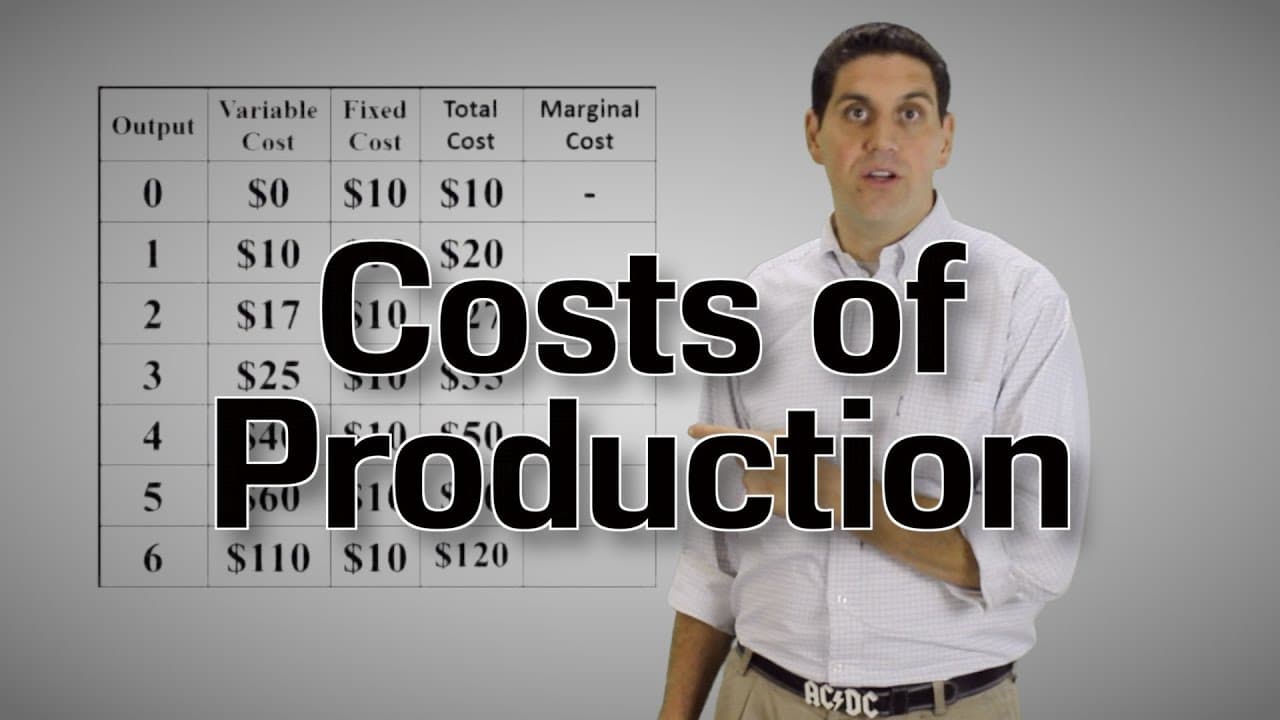
Short-run costs in economics consist of fixed and variable costs that impact production decisions. Fixed costs remain constant regardless of output, while variable costs change with production levels. Total cost combines both types, and marginal cost represents the cost of producing one additional unit.
Transcript
hey how you doing ecal students this is mr clifford welcome to acdc econ right now i'm going to talk about cost curves if there's one complaint about learning microeconomics it's cost curves i mean no one gets excited about cost curves they might not be exciting but cost curves are super essential now someday you might own a business and it's impor... Read More
Key Insights
- 🇨🇷 Cost curves are important in understanding the cost of production and calculating profit.
- 🇨🇷 Fixed costs remain constant regardless of the amount produced, while variable costs change with the output.
- 🇨🇷 Total cost is the sum of fixed and variable costs, while marginal cost represents the additional cost of producing one more output.
- 🇨🇷 Average variable cost, average fixed cost, and average total cost provide insights into per unit costs.
- 🇨🇷 The average variable cost plus the average fixed cost equals the average total cost.
- 💄 Cost calculations are essential for determining profit and making production decisions.
- 🧑🎓 Understanding cost curves is crucial for business owners and microeconomics students.
Install to Summarize YouTube Videos and Get Transcripts
Explore YouTube Video Summarizer or Get YouTube Transcript Extractor
Questions & Answers
Q: What are fixed costs?
Fixed costs are costs that remain constant regardless of the amount produced, such as rent or manager's salary.
Q: How do variable costs differ from fixed costs?
Variable costs change with the amount produced, such as raw materials or labor expenses.
Q: How is total cost calculated?
Total cost is calculated by adding fixed costs to variable costs.
Q: What is marginal cost?
Marginal cost is the additional cost of producing one more output and is calculated by dividing the change in total cost by the change in output.
Q: What is the average variable cost?
Average variable cost is the total variable cost divided by the quantity produced.
Q: How is average fixed cost calculated?
Average fixed cost is the fixed cost divided by the quantity produced.
Q: How can average total cost be determined?
Average total cost is calculated by dividing the total cost by the quantity produced.
Summary & Key Takeaways
-
Cost curves are essential in understanding the cost of production and calculating profit for businesses.
-
Fixed costs are costs that do not change with the amount produced, while variable costs do.
-
Total cost is the sum of fixed and variable costs, while marginal cost is the additional cost of producing one more output.
Read in Other Languages (beta)
Share This Summary 📚
Summarize YouTube Videos and Get Video Transcripts with 1-Click
Try YouTube Summary with ChatGPT & Claude or YouTube Transcript Generator
Explore More Summaries from Jacob Clifford 📚





Summarize YouTube Videos and Get Video Transcripts with 1-Click
Try YouTube Summary with ChatGPT & Claude or YouTube Transcript Generator