How to Master Supply and Demand in Economics

TL;DR
Understanding supply and demand is crucial for economic analysis. The law of demand indicates a negative relationship between price and quantity demanded, while supply shows a positive correlation. Key concepts include elasticity, consumer and producer surplus, and the impact of government interventions like taxes and price controls. Mastering these concepts helps predict market changes and identify efficiency and welfare effects.
Transcript
Hey Econ students, this is Jacob Clifford. Welcome to the Microeconomics Unit 2 summary video. In these summary videos, I explain all the concepts that you need to know for your next quiz, unit exam, or final exam, basically everything you need to get an A in the class. But remember this is a summary video so I'm going pretty quick. If you need... Read More
Key Insights
- The law of demand shows a negative relationship between price and quantity demanded, while the law of supply shows a positive relationship.
- Elasticity measures the responsiveness of one economic variable to a change in another, crucial for understanding market dynamics.
- Consumer surplus, producer surplus, and deadweight loss are used to analyze the efficiency and welfare effects of a market.
- A demand and supply graph shows equilibrium price and quantity, useful for predicting and analyzing market changes.
- Government interventions like taxes, subsidies, tariffs, and price controls can significantly alter supply and demand dynamics.
- Price elasticity of demand is calculated as the percent change in quantity demanded divided by the percent change in price.
- Cross-price elasticity of demand indicates if goods are substitutes or complements, while income elasticity distinguishes normal from inferior goods.
- The impact of international trade on domestic markets can be analyzed using supply and demand, highlighting changes in consumer and producer surplus.
Install to Summarize YouTube Videos and Get Transcripts
Explore YouTube Video Summarizer or Get YouTube Transcript Extractor
Questions & Answers
Q: How does the law of demand affect consumer behavior?
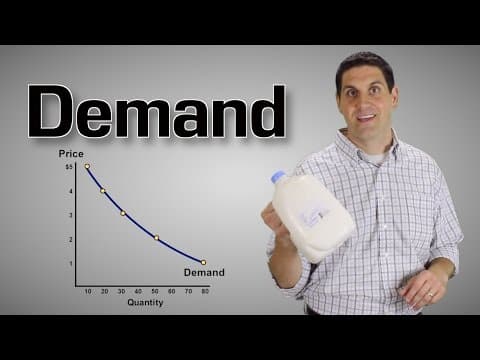
The law of demand suggests that as prices decrease, the quantity demanded by consumers increases, and vice versa. This inverse relationship is due to factors like the substitution effect, where consumers opt for cheaper alternatives, and the income effect, where lower prices increase purchasing power, allowing consumers to buy more.
Q: What factors can shift the demand curve?
The demand curve can shift due to changes in consumer preferences, the number of consumers, prices of related goods (substitutes and complements), consumer income, and future expectations. For instance, an increase in consumer income generally shifts the demand curve for normal goods to the right, indicating higher demand at each price level.
Q: What are the determinants of supply?
Supply is influenced by factors such as the price of resources, the number of producers, technology, government interventions (like taxes and subsidies), and expectations of future profits. For example, an advancement in technology can increase supply by making production more efficient, shifting the supply curve to the right.
Q: How is price elasticity of demand calculated?
Price elasticity of demand is calculated by dividing the percentage change in quantity demanded by the percentage change in price. If the absolute value of the elasticity is greater than one, demand is elastic, meaning quantity is sensitive to price changes. If it's less than one, demand is inelastic, indicating less sensitivity.
Q: What is the significance of consumer and producer surplus?
Consumer surplus represents the difference between what consumers are willing to pay and what they actually pay, while producer surplus is the difference between what producers receive and their minimum acceptable price. Together, they indicate the total benefits to market participants and are used to assess market efficiency.
Q: How do taxes affect market equilibrium?
Taxes on producers shift the supply curve to the left, increasing the price consumers pay and reducing the price producers receive. This creates a deadweight loss, representing lost efficiency in the market. The tax burden is shared between consumers and producers, depending on the relative elasticities of supply and demand.
Q: What is the impact of international trade on domestic markets?
International trade allows consumers to access goods at lower world prices, increasing consumer surplus and total market efficiency. However, it reduces domestic producer surplus, as local producers face competition from cheaper imports. Tariffs can mitigate this by raising import prices, but they also create deadweight loss.
Q: What are the effects of price controls like ceilings and floors?
Price ceilings, set below equilibrium, lead to shortages as demand exceeds supply, while price floors, set above equilibrium, cause surpluses as supply exceeds demand. Both result in market inefficiencies and deadweight loss, reducing total welfare. Understanding these effects helps evaluate policy impacts on market dynamics.
Summary & Key Takeaways
-
Supply and demand are fundamental concepts in economics, with demand showing an inverse relationship between price and quantity demanded, and supply showing a direct relationship. Elasticity is key to understanding how sensitive quantity is to price changes.
-
Consumer and producer surplus measure the benefits to buyers and sellers, respectively. Government interventions like taxes and price controls can create deadweight loss, indicating market inefficiency.
-
International trade affects domestic markets by altering consumer and producer surplus. Understanding these dynamics helps predict market changes and assess economic welfare.
-
(Content reviewed on 2026-08-27.)
Read in Other Languages (beta)
Share This Summary 📚
Summarize YouTube Videos and Get Video Transcripts with 1-Click
Try YouTube Summary with ChatGPT & Claude or YouTube Transcript Generator
Explore More Summaries from Jacob Clifford 📚




Summarize YouTube Videos and Get Video Transcripts with 1-Click
Try YouTube Summary with ChatGPT & Claude or YouTube Transcript Generator