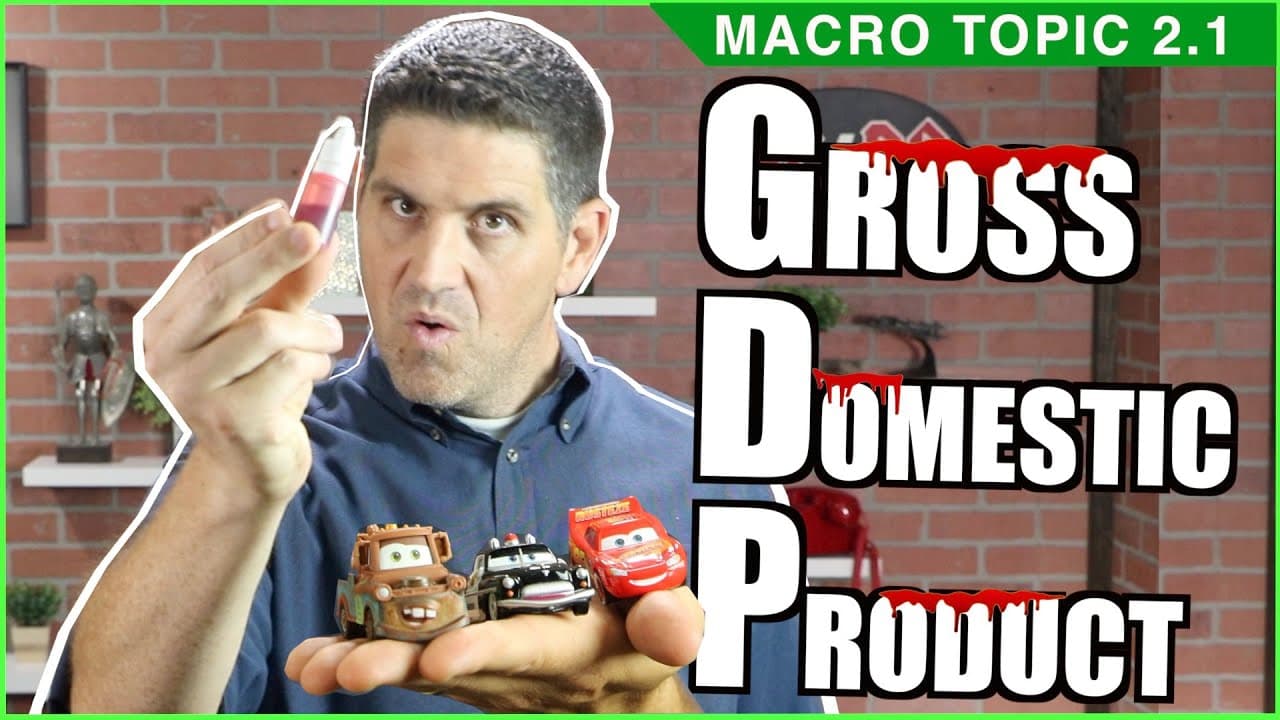
What Is GDP and the Circular Flow in Macro?
TL;DR
GDP is the dollar value of all final goods and services produced in a country in one year. It can be measured three ways: expenditures, income, and value added, all yielding the same number. The circular flow shows how money, saving, and spending connect the real economy to the financial sector.
Transcript
hey dad this is Jacob Clifford and welcome to my youtube channel now let's go back in time in December of 1799 in the first American president George Washington is sick you're the doctor and given the limited access you have to medical research you prescribed bloodletting so you confidently remove five pints of his blood five pints and the results ... Read More
Key Insights
- GDP is the dollar value of final goods and services produced in a country in a year.
- GDP counts production within the country regardless of ownership of the producing entities.
- Only final goods and services count toward GDP, intermediate goods are excluded.
- There are three ways to measure GDP: expenditures, income, and value added.
- The expenditures approach sums consumption, investment, government spending, and net exports.
- The income approach totals wages, rents, interest, and profits earned from production.
- The value added approach tallies the additional value created at each stage of production.
- The circular flow shows how money circulates between households, firms, and the financial sector, linking spending and saving to GDP.
Install to Summarize YouTube Videos and Get Transcripts
Explore YouTube Video Summarizer or Get YouTube Transcript Extractor
Questions & Answers
Q: What is GDP and why is it important for measuring the economy?
GDP is the dollar value of all final goods and services produced within a country in one year. It is important because it acts as a heartbeat for the economy, indicating overall growth or decline. By measuring production in a single metric, policymakers, students, and analysts can track economic health and compare periods or countries.
Q: What are the three ways to measure GDP and do they give the same result?
The three ways are the expenditures approach, the income approach, and the value-added approach. The expenditures method sums consumption, investment, government spending, and net exports. The income approach totals wages, rents, interest, and profits. The value-added method adds the value created at each production stage. All three should yield the same GDP figure for a given period.
Q: What counts as a final good and what does not count toward GDP?
Final goods and services are counted toward GDP because they are purchased for final use by consumers or businesses. Intermediate goods, used to produce final products, do not count to avoid double counting. The focus is on the value of what ends up being consumed in the economy in the reporting year.
Q: Why are intermediate goods excluded from GDP calculations?
Intermediate goods are excluded because they are inputs used to produce final goods. Counting them would double count the value of the final product. GDP aims to measure only the value of goods and services as they reach the end user in a given year.
Q: What is the circular flow model and what does it illustrate?
The circular flow model illustrates how money moves between households and firms and how the financial sector links saving to investment. It shows how consumption and investment finance production, and how government spending and net exports also play a role in the overall flow of money through the economy.
Q: How does the financial sector relate to GDP and the economy’s health?
The financial sector supports GDP by channeling saved resources into investments that fund production. When money stops flowing, spending and investment slow, causing a downturn. A healthy financial system ensures liquidity and credit availability, helping households and firms finance their activities and sustain GDP growth.
Q: What happens if the money supply contracts in the economy according to the video?
If the money supply contracts, savings and lending shrink, reducing spending and investment. This can lead to a decline in production and GDP as fewer resources are allocated to creating goods and services. The video uses the Great Depression analogy to emphasize money as the lifeblood of economic activity.
Q: Why is GDP measured in dollars and not in physical units like cars or pizzas?
GDP is measured in dollars to capture the market value of all final goods and services produced. Using dollar values standardizes diverse outputs into a single metric, enabling clear comparisons over time and across sectors, regardless of the physical units or types of goods produced.
Summary & Key Takeaways
-
GDP is the dollar value of all final goods and services produced within a country in one year, measured in dollars and excluding intermediate goods. It reflects production inside the country and is compared year over year to show growth or contraction.
-
The three measures of GDP are expenditures, income, and value added. Expenditures sum consumer, business, government, and net exports, while income adds up wages, rents, interest, and profits, and value added counts added value at each production stage.
-
The circular flow model links households and firms with the financial sector, showing how private and public savings are lent to finance spending, which drives the economy and GDP growth over time.
Read in Other Languages (beta)
Share This Summary 📚
Summarize YouTube Videos and Get Video Transcripts with 1-Click
Try YouTube Summary with ChatGPT & Claude or YouTube Transcript Generator
Explore More Summaries from Jacob Clifford 📚





Summarize YouTube Videos and Get Video Transcripts with 1-Click
Try YouTube Summary with ChatGPT & Claude or YouTube Transcript Generator