Circular Flow Matrix- How the economy works
TL;DR
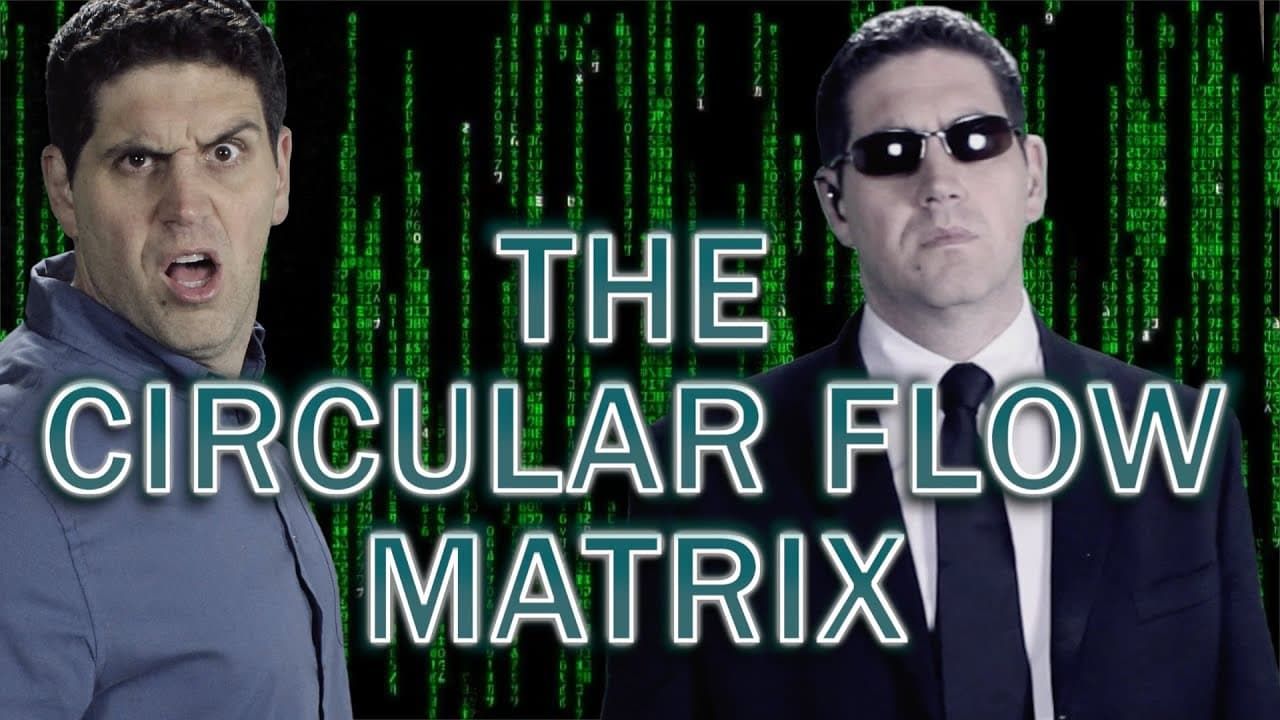
The video explains the Circular Flow Matrix in market economies.
Transcript
hey this is Jacob Clifford welcome to ac/dc econ today I'm going to show you something that's all around you that most people don't even see it's called the matrix and you're inside it right now the circular flow matrix or model shows how products resources and money flow in the economy now look at your surro... Read More
Key Insights
- The Circular Flow Matrix illustrates how products, resources, and money circulate within a market economy, involving households and businesses.
- Households supply resources and demand products, while businesses supply products and demand resources, creating a continuous economic exchange.
- The four factors of production include land, labor, capital, and entrepreneurship, each contributing differently to the production process.
- Factor payments are categorized as rent, wages, interest, and profit, corresponding to land, labor, capital, and entrepreneurship, respectively.
- Government plays a crucial role by purchasing goods and services in the product market and resources in the resource market, funded by taxes.
- Public goods and services, such as roads and education, are provided by the government, supported by government spending and transfer payments.
- The financial sector and international trade are additional components of the economy, involving savings, loans, exports, and imports.
- The video questions whether capitalism liberates or enslaves individuals, suggesting a trade-off between modern conveniences and self-sufficiency.
Install to Summarize YouTube Videos and Get Transcripts
Explore YouTube Video Summarizer or Get YouTube Transcript Extractor
Questions & Answers
Q: What is the Circular Flow Matrix?
The Circular Flow Matrix is a model that illustrates how products, resources, and money flow within a market economy. It shows the interactions between households and businesses, where households supply resources and demand products, and businesses supply products and demand resources, creating a continuous economic cycle.
Q: What are the four factors of production?
The four factors of production are land, labor, capital, and entrepreneurship. Land refers to natural resources, labor involves human effort, capital includes tools and machinery, and entrepreneurship is the initiative to combine these factors to produce goods and services. Each factor earns a specific type of income, contributing to economic activity.
Q: How does the government participate in the Circular Flow Matrix?
The government participates by purchasing goods and services in the product market and resources in the resource market. It provides public goods and services such as roads and education, funded by government spending. The government also makes transfer payments to businesses and households to meet specific social objectives.
Q: What are factor payments in the context of the Circular Flow Matrix?
Factor payments are the incomes earned by the owners of the factors of production. They include rent for land, wages for labor, interest for capital, and profit for entrepreneurship. These payments represent the compensation for contributing resources to the production process within a market economy.
Q: How do households and businesses interact in the Circular Flow Matrix?
Households and businesses interact by engaging in the exchange of goods, services, and resources. Households supply resources such as labor and capital to businesses in the resource market, while businesses supply goods and services to households in the product market. This interaction ensures the continuous flow of economic activity.
Q: What role does the financial sector play in the Circular Flow Matrix?
The financial sector facilitates the flow of money within the economy by providing a mechanism for savings and loans. It enables households and businesses to save money, which can then be loaned out to others, supporting investment and consumption, and contributing to the overall economic cycle.
Q: How do international trade and exports fit into the Circular Flow Matrix?
International trade introduces the flow of goods and services across borders, with exports and imports playing a significant role. Exports are goods and services sold to other countries, bringing money into the domestic economy, while imports are purchased from abroad, affecting the flow of money out of the economy.
Q: Does capitalism liberate or enslave individuals according to the video?
The video poses the question of whether capitalism liberates or enslaves individuals, highlighting the trade-off between enjoying modern conveniences and the potential constraints of constant economic activity. It suggests that while capitalism provides various benefits, it may also create a cycle of continuous spending and earning, prompting reflection on personal freedom.
Summary & Key Takeaways
-
The Circular Flow Matrix explains the interaction between households and businesses in a market economy, highlighting the flow of products, resources, and money. It describes how households demand products and supply resources, while businesses do the opposite, creating a continuous economic exchange.
-
Four factors of production—land, labor, capital, and entrepreneurship—are crucial in the economy. Each factor earns a different type of income: rent for land, wages for labor, interest for capital, and profit for entrepreneurship, illustrating the diverse contributions to production.
-
The government plays a significant role in the economy by purchasing goods and services and providing public goods like education and infrastructure. Funded by taxes, government spending supports the economy, while transfer payments address social objectives such as poverty alleviation.
Read in Other Languages (beta)
Share This Summary 📚
Summarize YouTube Videos and Get Video Transcripts with 1-Click
Try YouTube Summary with ChatGPT & Claude or YouTube Transcript Generator
Explore More Summaries from Jacob Clifford 📚

Summarize YouTube Videos and Get Video Transcripts with 1-Click
Try YouTube Summary with ChatGPT & Claude or YouTube Transcript Generator