How to choose single vs multi-agent AI architectures?
TL;DR
Single vs multi-agent choice depends on tokens and talent; multi-agent stacks win when large problem solving requires burn of tokens for correctness, but they add complexity. Memory and statefulness shape the context and downstream design. Ongoing evaluation and robust error handling separate durable agents from failed pilots, while hype and decks should be viewed skeptically.
Transcript
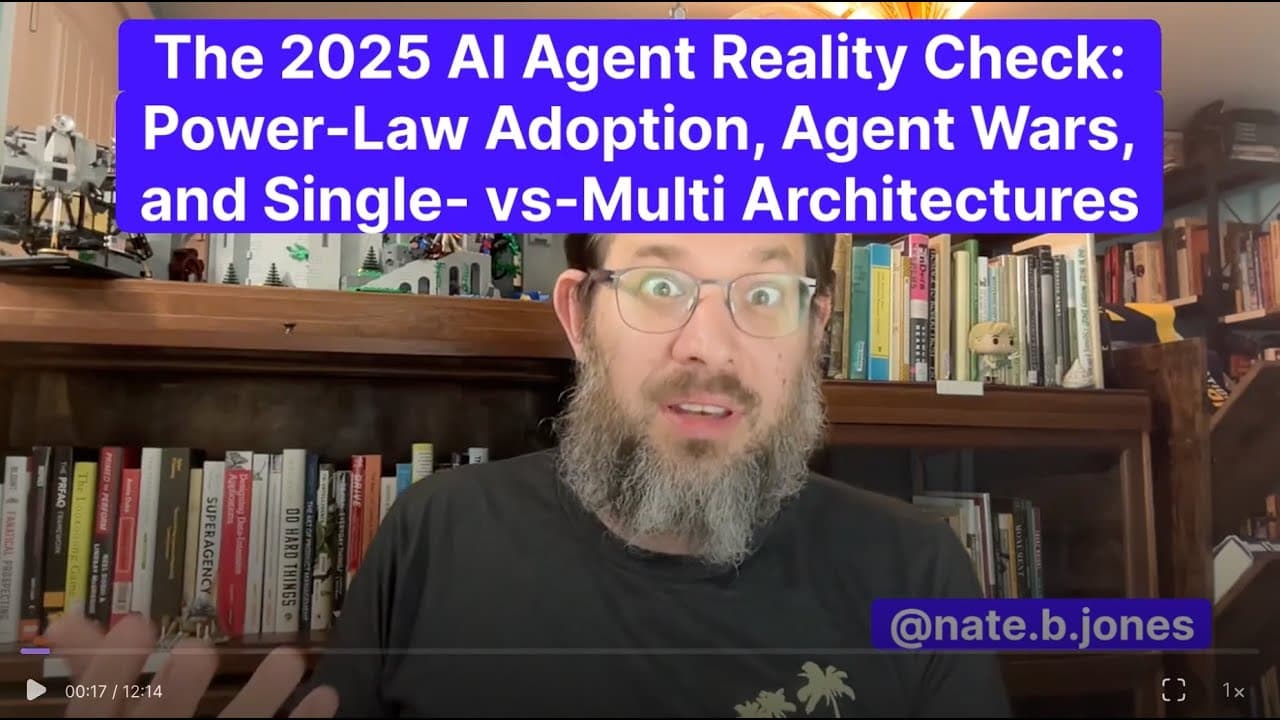
This video is for everyone who has wondered what is an AI agent and how do I get on track with AI agents in 2025. I'm going to unfold for you what I think are the most important strategic levers and then I've written about a 30-page Substack article that will sort of dive farther into it. We're obviously not going to just read 30 pages here. So, th... Read More
Key Insights
- Power-Law Adoption Gap: AI agent adoption follows a steep power-law curve where a small group debates architecture while most lag behind.
- Single vs Multi-Agent Stakes: Cognition’s Devon argues single-agent simplicity, while Anthropic shows multi-agent stacks win when talent and compute justify the added complexity.
- Token Burn Determines Correctness: Large problems require deliberate token expenditure; starving an LLM of output tokens impairs reasoning.
- Memory and Statefulness Matter: Designing memory architecture and state management is foundational and shapes all downstream decisions.
- Eval Discipline Is Essential: Continuous evaluation, drift monitoring, and robust error handling separate durable agents from abandoned pilots.
- Beware Consulting Hype: McKinsey decks recycle old models and buzzwords, risking costly missteps for CEOs.
- Build vs Buy Pragmatism: Off-the-shelf tools can outperform bespoke stacks when ROI justifies the choice.
- Context Engineering Is Key: Context design enables effective instructions, policies, and guidance for agent operation.
- More videos from this channel:
- More from this channel: AI News & Strategy Daily | Nate B Jones
Install to Summarize YouTube Videos and Get Transcripts
Explore YouTube Video Summarizer or Get YouTube Transcript Extractor
Questions & Answers
Q: What is the core distinction between single and multi-agent architectures in this video
The core distinction is that a single agent stack is simpler and easier to deploy, while multi-agent architectures are more complex but can be substantially more effective when there is enough talent and compute to justify the token burn needed for correctness. The discussion cites the debate between Anthropic and Cognition as a practical example of this trade off and emphasizes that the choice depends on balancing correctness, cost, and production complexity.
Q: Why does token burn matter in AI agent correctness
Token burn matters because long and complex problems require enough output tokens to compute a correct solution. Without sufficient tokens, the system may fail to reach a correct conclusion, which was highlighted by an Apple paper referenced in the video. The point is that deliberate expenditure of tokens enables deeper reasoning and better results over longer horizons.
Q: What role does memory architecture play in AI agents according to the talk
Memory architecture and statefulness are described as the critical levers that shape context engineering. Getting memory right affects how instructions, policies, and guidance are applied, influencing every subsequent design choice. The speaker emphasizes that this foundational layer determines how effectively agents access and use information over time.
Q: What is the speaker’s critique of the McKinsey deck on AI agents
The speaker criticizes the McKinsey deck for using outdated models and buzzwords, claiming it lacks technical substance and would mislead CEOs. The critique centers on the use of non current models and vague terms like agentic mesh, arguing that such material does not reflect real, actionable innovation and could lead to costly missteps in investments.
Q: How does the video describe the adoption dynamics of AI agents in organizations
The video describes adoption as a power-law phenomenon where a small elite group leads in debates about architecture while the majority of organizations are slow to move or adopt. This framing suggests that the most impactful decisions come from a niche segment with the capability to push for advanced agent architectures and rigorous evaluation.
Q: What is meant by evaluation discipline in AI agents
Evaluation discipline refers to ongoing testing, drift monitoring, and robust error handling that separate durable production agents from pilots that fail to scale. This discipline ensures that agents continue to perform reliably in changing conditions and helps organizations measure true performance beyond initial deployment.
Q: What guidance does the talk give about Build vs Buy decisions
The talk advises pragmatic Build vs Buy decisions, noting that off-the-shelf solutions can outperform bespoke stacks when ROI justifies the choice. It emphasizes evaluating available tools for their ability to meet business goals and reduce maintenance burden, rather than defaulting to custom architectures just because they are more technically interesting.
Q: Why is context engineering and the flow of memory crucial for agent success
Context engineering is crucial because it directly impacts how agents interpret tasks, apply policies, and access historical information. The flow of memory determines what information stays available and how it is recalled, enabling more accurate decision making, better guidance, and more reliable agent performance over long horizons. The talk frames this as a central strategic lever.
Summary & Key Takeaways
-
Power law adoption creates an elite debate on AI agents while most firms lag behind. The video argues that understanding memory architecture and context engineering is central to successful agent design.
-
The debate between single and multi-agent architectures hinges on token burn, talent, and production complexity, with multi-agent requiring deliberate token expenditure for correctness.
-
Pragmatic decisions like build versus buy and skepticism toward hype influence how organizations implement AI agents and measure success.
Read in Other Languages (beta)
Share This Summary 📚
Summarize YouTube Videos and Get Video Transcripts with 1-Click
Try YouTube Summary with ChatGPT & Claude or YouTube Transcript Generator
Explore More Summaries from AI News & Strategy Daily | Nate B Jones 📚






Summarize YouTube Videos and Get Video Transcripts with 1-Click
Try YouTube Summary with ChatGPT & Claude or YouTube Transcript Generator