What Are Network Topologies: Bus, Star, Ring, Mesh?
TL;DR
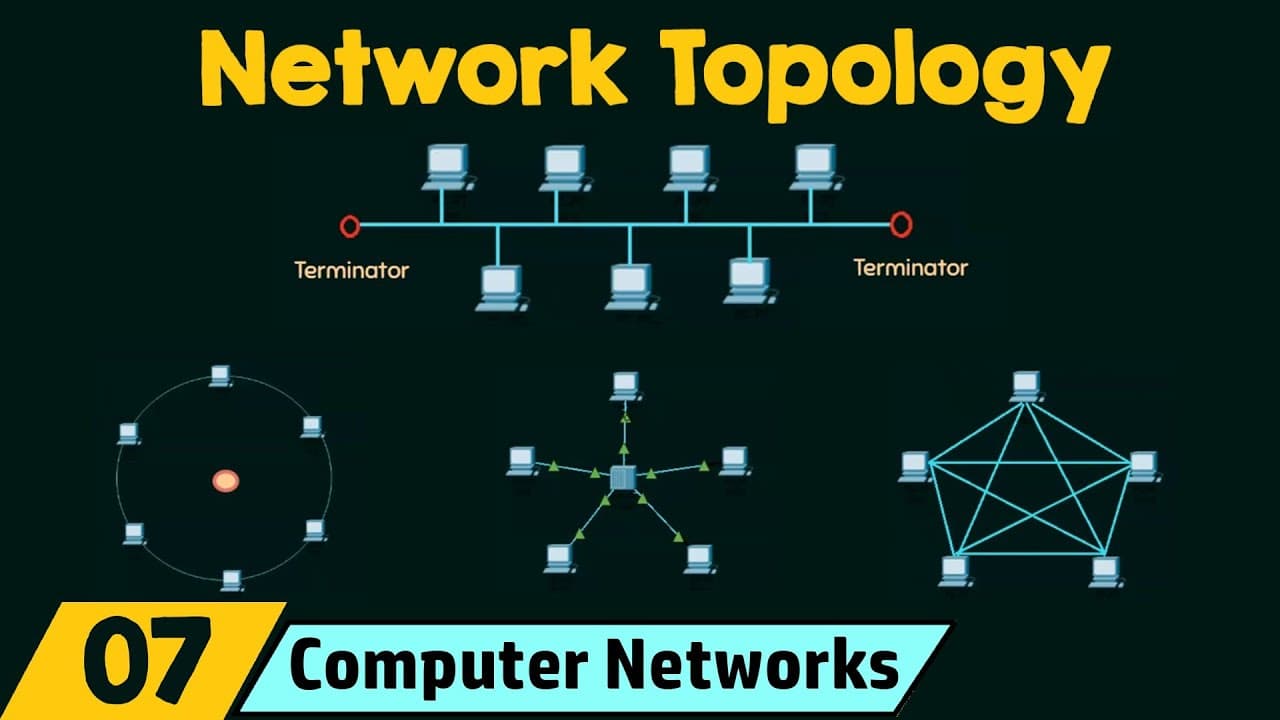
Network topology is the arrangement of nodes so communication can be established among them. It splits into physical topology (where nodes are placed) and logical topology (how data flows). The five main types are bus, ring, star, mesh, and hybrid, each with distinct trade-offs in cost, fault tolerance, and security.
Transcript
Today we will see, network topology. Upon the completion of this session, we will be able to understand, various network topologies like bus, star, ring, mesh and hybrid. We will also understand what are the advantages and disadvantages of bus, star, ring, mesh and hybrid topologies. Firstly, we will start with what is a network topology. We have s... Read More
Key Insights
- Network topology is the arrangement of nodes of a computer network so that communication can be established among all the nodes. It can be viewed as the layout of a computer network.
- Physical topology refers to where nodes are physically placed, such as some on the ground floor and others on the first floor, while logical topology refers to how data flows from one node to another.
- Bus topology uses a single common transmission medium to which all nodes connect, and the data flow is bi-directional, meaning data can travel in both directions along the cable.
- In bus topology every node receives a copy of the transmitted signal, so nodes not intended as the recipient reject the packet, which means there is no security in this approach.
- Ring topology is a bus topology arranged in a closed loop using peer-to-peer nodes with equal rights, where each node has two connections to its nearest neighbors and communication is unidirectional.
- Ring topology passes a token around the network, and whichever node holds the token gets its turn to send data, which is why it is called token ring topology.
- Star topology connects every node to a central node, a hub or switch, through which all traffic must pass, preventing other nodes from overhearing the communication and making it scalable by adding more switches.
- Mesh topology connects each node directly to every other node, providing one hundred percent fault tolerance and reliability because a failed link leaves alternative paths to reach the destination.
Install to Summarize YouTube Videos and Get Transcripts
Explore YouTube Video Summarizer or Get YouTube Transcript Extractor
Questions & Answers
Q: What is a network topology?
A network topology is the arrangement of nodes of a computer network in such a way that communication can be established among all the nodes. It can be viewed as the layout of a computer network. When you have several nodes, you must arrange them so every node can communicate with the others. Topology is further categorized into physical topology and logical topology, describing node placement and data flow respectively.
Q: What is the difference between physical and logical topology?
Physical topology refers to where you are going to place all the nodes physically. For example, you might place three nodes on the ground floor of a building and two nodes on the first floor, and that placement is the physical topology. Logical topology refers to how the data is going to flow from one node to another node, regardless of which floor the nodes sit on. It deals with the data flow pattern in the network.
Q: How does bus topology work?
In bus topology there is a common transmission medium, and all nodes are connected to this medium. When one node sends data, it travels over this shared medium and every node receives the signal simultaneously. The transmission medium is bi-directional, meaning data can flow in both directions. Only the intended recipient keeps the packet, while all other nodes deny or reject the data signal since it was not meant for them.
Q: What are the advantages and disadvantages of bus topology?
Bus topology is less expensive because only one wire or cable is involved, it suits temporary networks, and a single node failure does not affect other nodes. Its disadvantages are that it is not fault tolerant, since if the transmission medium fails the entire network goes down with no redundant line. Cable length is limited to a certain range, and because every node receives a copy of the signal, there is no security.
Q: Why is ring topology called token ring topology?
Ring topology is a bus topology in a closed loop, and it uses a token to control which node may transmit. Whichever node holds the token gets its turn to send data. After some time the token is passed to the next node, then circulated throughout the network so every node gets an opportunity to send or receive data. Because a token governs this process, the topology is called token ring topology, and communication is unidirectional.
Q: What are the disadvantages of ring topology?
Ring topology is unidirectional, so to reach a destination the data may have to cross many intermediary nodes rather than travel directly. It has a single point of failure: if a link fails, the entire network is disrupted, and a node failure or link failure affects the whole network. Under very high load the network performance degrades, and because data crosses so many nodes, there is no security for confidential data.
Q: How does star topology handle communication and scalability?
In star topology every node connects to a central node, a hub or switch, and all traffic must pass through it. When one node sends data, it goes to the central node, which is responsible for forwarding it to the destination, so other nodes cannot overhear the communication. It is scalable because if a switch's ports run out, for example 24 ports, you can add another switch, connect more computers, and link the two switches together.
Q: Why is mesh topology considered fault tolerant?
In mesh topology each node is directly connected to every other node in the network. Because of this full interconnection, it provides one hundred percent fault tolerance and reliability. If a link failure is encountered between two computers, that computer still has another way, in fact many ways, to reach the destination through other links. The failure of one link does not isolate any node, since alternative paths always remain available to route the data.
Summary & Key Takeaways
-
Topology means the arrangement of nodes in a computer network so communication can be established among all nodes. It is viewed as the network layout and divides into physical topology, meaning where nodes are placed, and logical topology, meaning how data flows between nodes.
-
Bus topology connects all nodes to one common bi-directional transmission medium, making it inexpensive and suitable for temporary networks, and a single node failure does not affect others. However, it is not fault tolerant, cable length is limited, and every node sees the data, so there is no security.
-
Ring topology is a closed-loop bus with peer-to-peer nodes and unidirectional token-based communication. Star topology routes all traffic through a central hub or switch, making it easy to design and scalable but vulnerable to central-node failure. Mesh topology links every node directly, giving full fault tolerance.
Read in Other Languages (beta)
Share This Summary 📚
Summarize YouTube Videos and Get Video Transcripts with 1-Click
Try YouTube Summary with ChatGPT & Claude or YouTube Transcript Generator
Explore More Summaries from Neso Academy 📚





Summarize YouTube Videos and Get Video Transcripts with 1-Click
Try YouTube Summary with ChatGPT & Claude or YouTube Transcript Generator