How to Stop Overthinking Everything: Therapy Skills
TL;DR
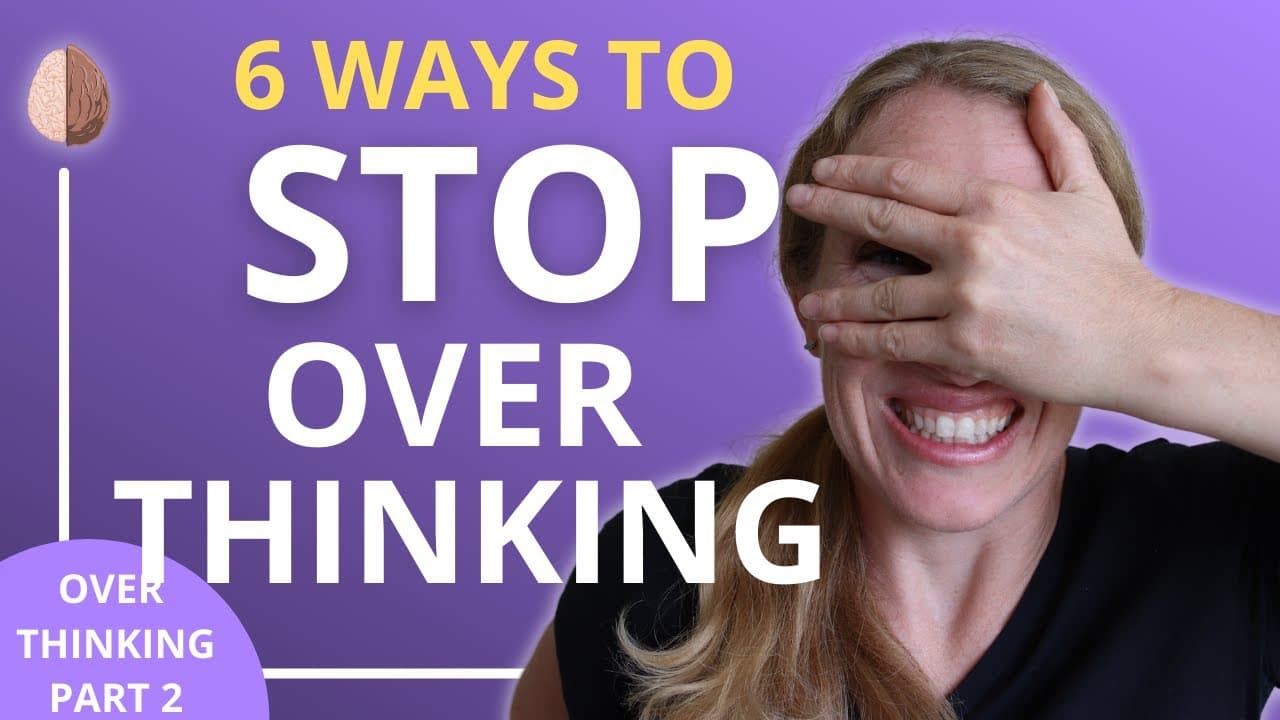
The fastest way out of overthinking is to notice and name it out loud by saying 'I'm overthinking,' then schedule a fixed daily worry time so your brain stops nagging. From there, shift attention to the present moment and swap vague 'why' questions for one small concrete action you can actually take.
Transcript
Hi, everyone. I'm Emma McAdam. I'm a licensed therapist. And in this video we're going to be talking about how to stop overthinking everything. Okay. Your boss emails you. He wants to meet with you in two days. He doesn't say why. Your heart drops. You feel sick. "What did I do wrong?" you think. Uh "He's gonna fire me," you think. You spend th... Read More
Key Insights
- Overthinking comes in at least four forms: rumination about the past, worry about the future, overanalyzing decisions, and social anxiety like 'Why did I say that?' Recognizing which type you are stuck in makes it easier to interrupt the cycle before it spirals.
- The first skill is noticing and naming, because rumination is a bad habit you often do without awareness. Saying 'I'm overthinking' out loud, or asking someone to point it out, separates you from the distress around the situation.
- Learning your triggers helps you predict overthinking. Ask what time of day, place, or situation you are most likely to ruminate in, such as right before bed or after a social event, so you can prepare to shift focus to something more helpful.
- Scheduling or postponing rumination is powerful because telling your brain 'I'll worry about this at 2 pm' signals that the issue will be addressed, so it stops nagging. Setting worry time daily for a month proves you are serious about it.
- The rule 'Never worry in your head, do it on paper' turns spinning thoughts into action. Methods include a free-write, a locus-of-control activity, a pros and cons list, or a brain dump, each giving worry a defined time and place.
- You do not have to believe everything you think, because a thought being loud, frequent, or intense does not make it true or helpful. You are the referee who chooses which thoughts to buy, a skill practiced through mindfulness or cognitive diffusion.
- Attention shifting works like changing the channel with a remote control for your thoughts, moving from what you can't control to what you can, from awful to a more helpful view, toward specific, action-oriented focus.
- Concrete thinking beats abstract thinking because vague overgeneralizations like 'Why can't I ever be happy?' lead to self-loathing and helplessness. 'Why' questions almost never lead to action, so ask 'What is one small thing I can do today?' instead.
Install to Summarize YouTube Videos and Get Transcripts
Explore YouTube Video Summarizer or Get YouTube Transcript Extractor
Questions & Answers
Q: How do you stop overthinking everything?
You stop overthinking by learning specific skills rather than trying to force the thoughts away. Start by noticing and naming it, saying 'I'm overthinking' out loud. Then set limits by scheduling a daily worry time, and redirect your thoughts through attention shifting, grounding in the present moment, and asking concrete action-oriented questions instead of vague 'why' questions. The more you practice these, the easier stopping the cycle becomes.
Q: What are the different types of overthinking?
There are at least four types of overthinking: rumination about the past, worry about the future, overanalyzing decisions, and social anxiety, which shows up as thoughts like 'Why did I say that?' Recognizing which type you are experiencing helps you apply the right skill. Overthinkers often cycle through several of these, and the video notes that people most commonly ruminate when they have nothing else to occupy their attention.
Q: What is the first skill to stop overthinking?
The first skill is noticing and naming. Because rumination is a bad habit people are often not aware they are doing, the goal is to get good at identifying it and simply say 'I'm overthinking' out loud. You can ask someone to point it out to you, and learn your triggers by asking what time of day, place, or situation you tend to ruminate in. You can even set an hourly phone alarm to check whether you are ruminating and track it for a week.
Q: How does scheduling worry time help reduce rumination?
Scheduling or postponing rumination sends a message to your brain to stop nagging you, because it knows the issue will be addressed. You tell yourself 'I'll worry about this at 2 pm' and put it on your calendar. A strong practice is scheduling worry time every day for one month with a set time limit, such as worrying for 35 minutes, to prove to your brain you are serious. This shows there is a time and place for worrying and not worrying, and the brain likes boundaries.
Q: Why should you write worries down instead of keeping them in your head?
The saying is 'Never worry in your head. Do it on paper. Write it down.' Writing worries down turns spinning mental wheels into something structured and actionable. There are several methods you can use, including a free-write, a locus-of-control activity, a pros and cons list, or a brain dump. Doing this during a scheduled worry time reinforces to your brain that worry has a defined time and place, making it easier to set it aside otherwise.
Q: What does 'changing the channel' mean for your thoughts?
Changing the channel is an attention-shifting technique where you imagine having a remote control for your thoughts and clicking a button to shift focus. You might shift from compulsive worry to what you are grateful for, from things you can't control to things you can, or from seeing everything as awful to a more helpful way of thinking. These channels are specific, within your locus of control, and action-oriented, making them a better use of energy than spinning your mental wheels.
Q: How does focusing on the present moment stop overthinking?
The present moment is an antidote to rumination that is always available. Because nature abhors a vacuum, simply trying to stop overthinking without redirecting focus can pull you back into the habit. Instead, turn attention away from your inner world of negative thinking toward the outer world, including the people you are with and activities you are doing. Use your senses by noticing what you can see, feel in your body, and your breathing, which moves you away from repetitive ruminative thoughts.
Q: Why are 'why' questions bad for overthinking?
'Why' questions almost always lead to a cycle of rumination because they focus on big, vague, abstract problems that lead to self-loathing and helplessness. Questions like 'Why am I such a failure?' or 'Why am I so depressed?' do not lead to any action. The video describes a client who treated 'why' as a swear word requiring money in a swear jar. Instead, shift to concrete questions like 'What is one small thing I can do today for my mental health?' which for him often meant going for a walk outside.
Summary & Key Takeaways
-
Overthinking traps people in an endless cycle, illustrated by worrying for two days about a boss meeting that turns out to be a promotion, then immediately worrying about the new job. There are at least four types: rumination, future worry, overanalyzing decisions, and social anxiety, but the skills to stop it can be learned.
-
The first skills set limits: notice and name overthinking by saying 'I'm overthinking' out loud and learning your triggers, then postpone or schedule rumination by assigning a fixed daily worry time. The brain likes boundaries, so writing worries on paper during that scheduled window shows there is a time and place for worrying.
-
The remaining skills redirect thoughts: practice attention shifting by acting as the referee of your thoughts and changing the channel toward what you can control, anchor in the present moment using your senses, and shift from abstract 'why' questions to concrete questions about one small action you can take today.
Read in Other Languages (beta)
Share This Summary 📚
Summarize YouTube Videos and Get Video Transcripts with 1-Click
Try YouTube Summary with ChatGPT & Claude or YouTube Transcript Generator
Explore More Summaries from Therapy in a Nutshell 📚



Summarize YouTube Videos and Get Video Transcripts with 1-Click
Try YouTube Summary with ChatGPT & Claude or YouTube Transcript Generator