What Makes BlackRock So Powerful in Global Markets
TL;DR
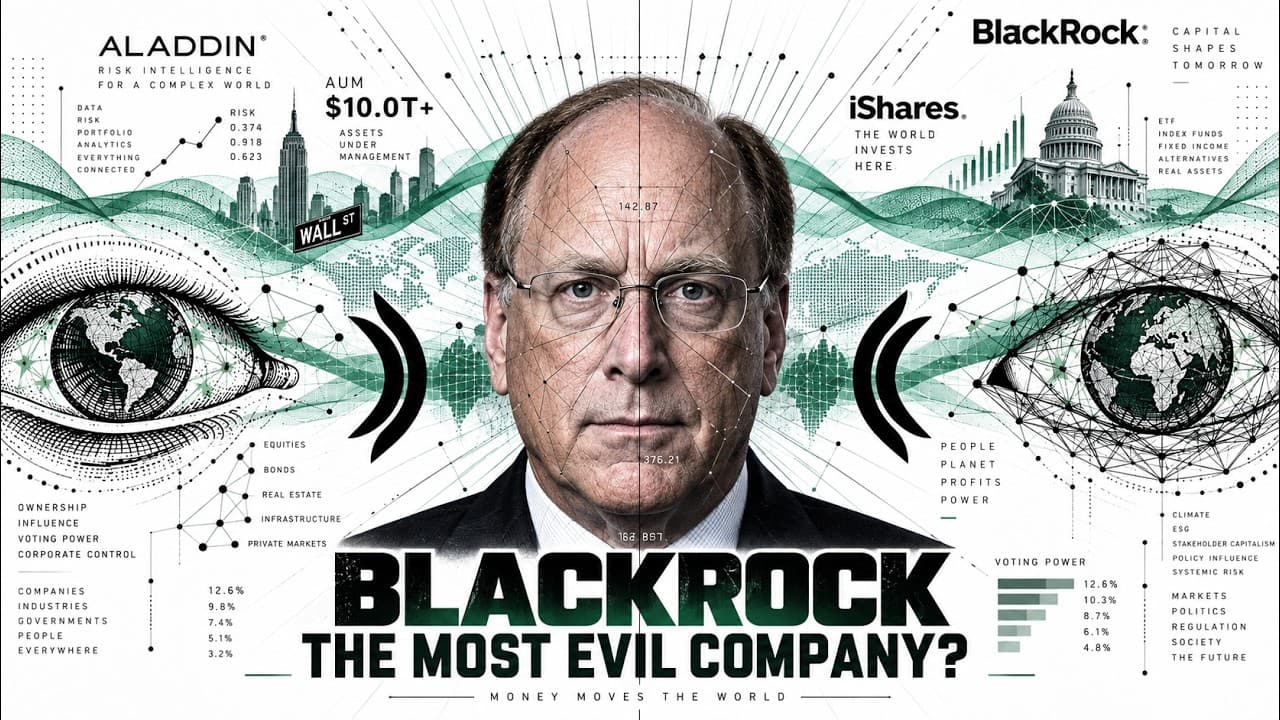
BlackRock wields unprecedented influence by controlling vast assets and owning stakes across major companies. Its Aladdin software acts as a central risk engine guiding investment decisions. The combination of deep equity positions, a trusted risk framework, and a triad of rival firms has reshaped modern finance.
Transcript
Larry Frink, the guy running Black Rockck, is really the president of the United States if we look at the kind of influence he's got. Wait a minute. These guys essentially have a monopoly. Well, how big is Black Rockck? Ladies and gentlemen, Black Rockck is the most powerful and according to US politicians, the most evil company in the world. >> Bl... Read More
Key Insights
- BlackRock controls over $15 trillion in assets, giving it outsized influence in global markets.
- BlackRock owns sizable percentages in major tech and consumer companies, including Nvidia, Apple, Microsoft, Google, and Coca Cola.
- The three firms BlackRock, Vanguard, and State Street together own stakes in many S&P 500 companies, forming a powerful triad.
- Aladin is BlackRock's proprietary risk management software that simulates market scenarios and guides investment decisions.
- BlackRock does not manufacture physical products yet wields power through ownership and sophisticated financial tools.
- The company originated from Blackstone Financial Management and evolved into a dominant asset manager with advanced analytics.
- A recession served as a proving ground for Aladin, validating its predictive capabilities to regulators and investors.
- Public and governmental fear around BlackRock stems from its ability to influence the economy without direct production.
Install to Summarize YouTube Videos and Get Transcripts
Explore YouTube Video Summarizer or Get YouTube Transcript Extractor
Questions & Answers
Q: What is the scale of BlackRock's assets under management as described in the video
BlackRock controls over $15 trillion in assets, making it the largest asset manager in the world. This scale enables it to influence corporate governance, invest across sectors, and affect market movements globally. The figure is presented as a central pillar of its power and reach, illustrating the magnitude of its influence.
Q: How does BlackRock own stakes in major companies without manufacturing products
The video explains that BlackRock owns substantial shares in many large companies, giving it governance influence and market leverage without physical production. This ownership model relies on financial stakes in publicly traded firms rather than manufacturing goods, highlighting the power of investment holdings in modern capitalism.
Q: Who are the so called big three in asset management mentioned in the video
The big three mentioned are BlackRock, State Street, and Vanguard. They are described as a trio that controls significant portions of many S&P 500 companies, collectively shaping investment trends, corporate governance, and market direction through their large asset bases and shareholdings.
Q: What is Aladdin and why is it important in the video
Aladdin is BlackRock’s risk management software, described as a comprehensive system that analyzes thousands of data points to predict how events affect portfolios. It is depicted as the brain of BlackRock’s operations, enabling precise risk assessment and informed decision making across markets and assets.
Q: How did the 2008 crisis influence perceptions of BlackRock and its tools
The 2008 crisis is presented as a proving ground for BlackRock’s Aladdin system. The meltdown showed investors and regulators the value of sophisticated risk modeling for predicting losses and managing risk in mortgage backed securities. This crisis reinforced BlackRock’s reputation as a crucial market risk manager.
Q: What role do the firms Vanguard and State Street play with BlackRock according to the video
Along with BlackRock, Vanguard and State Street form a powerful trio that together owns large stakes in many S&P 500 companies. This triad concentration amplifies their influence on corporate governance and market dynamics, creating a consolidated force in asset management and equity ownership across the U.S. market.
Q: Why is BlackRock described as powerful despite not making physical products
The video argues that BlackRock’s power comes from ownership and data-driven risk management rather than manufacturing. By controlling vast assets, owning significant shares, and using Aladdin to model outcomes, BlackRock can influence corporate strategy, investment flows, and market stability without producing tangible goods.
Q: What concerns does the video raise about government views on BlackRock
The video suggests that government entities fear or scrutinize BlackRock due to its enormous asset base, global reach, and ability to steer investment decisions across many sectors. This perceived influence raises questions about regulatory oversight, market fairness, and the resilience of financial systems reliant on a single dominant institution.
Summary & Key Takeaways
-
BlackRock controls about $15 trillion in assets and is central to global markets, influencing many large corporations. It holds significant stakes in tech giants and consumer brands, illustrating its reach beyond traditional asset management. The firm also operates a powerful risk system called Aladdin that informs investment bets.
-
The so-called big three firms in asset management, including BlackRock, State Street, and Vanguard, together shape ownership in many S&P 500 companies, amplifying their market influence.
-
The narrative traces BlackRock’s origins from a financial management venture to a globally dominant institution despite not producing physical goods, underscoring how financial engineering and data-driven risk assessment can create power without manufacturing.
-
The video argues that this concentration of influence has led to regulatory and public scrutiny, suggesting governmental apprehension about a company that effectively controls large segments of the economy without direct production capabilities.
Read in Other Languages (beta)
Share This Summary 📚
Summarize YouTube Videos and Get Video Transcripts with 1-Click
Try YouTube Summary with ChatGPT & Claude or YouTube Transcript Generator
Explore More Summaries from Think School 📚






Summarize YouTube Videos and Get Video Transcripts with 1-Click
Try YouTube Summary with ChatGPT & Claude or YouTube Transcript Generator