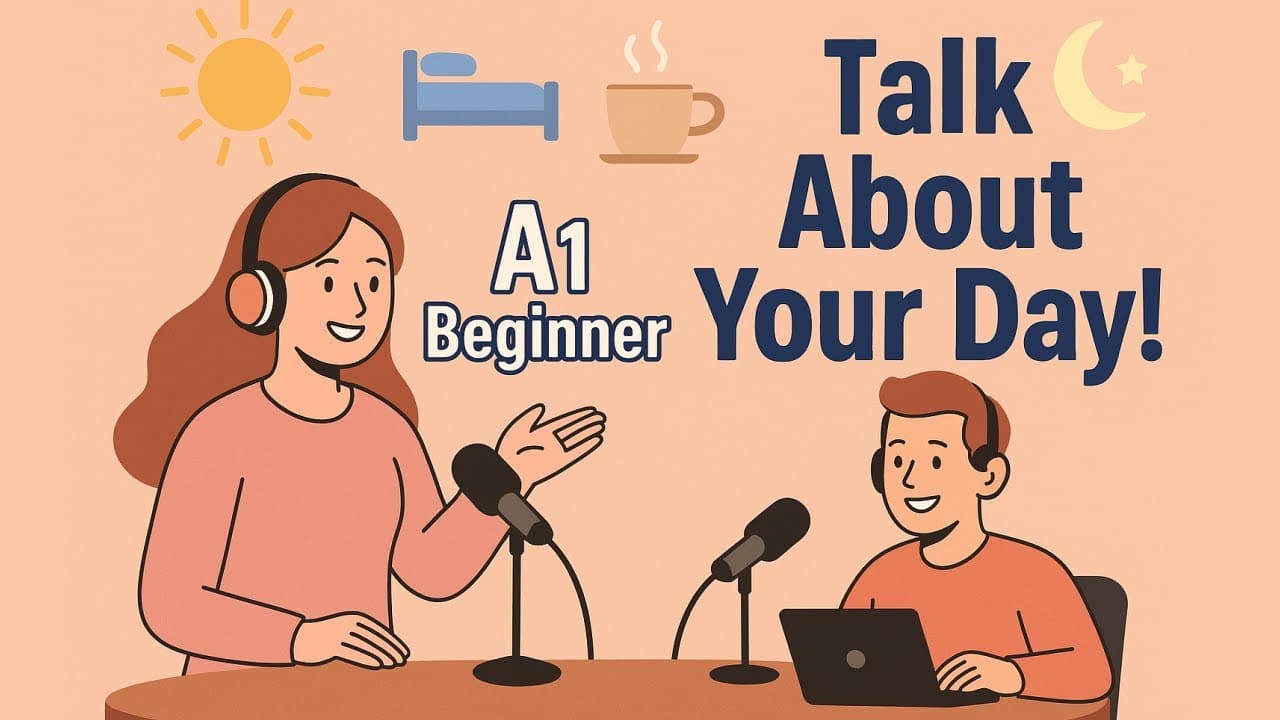
How to Talk About Your Daily Routine | A1 English Podcast
TL;DR
Describe your daily routine in English by using simple verbs in chronological order, from “wake up” and “get dressed” to “go to work” and “go to bed.” Paul’s example begins around 6:30, while Emily wakes around 7:00, and their routines cover meals, work, relaxation, and bedtime. Read on for practical A1 English phrases and complete examples for talking about your day.
Transcript
hello everyone and welcome back to Mr English Channel I'm Emily Hi Emily Hi everyone It's great to be here again It's wonderful to have you back Paul And to all our amazing listeners thank you for tuning in Today we have a super simple and useful topic for you beginners out there That's right Emily We're going to talk about our day You know the thi... Read More
Key Insights
- Waking up is the first step of the day, often around 6:30 or 7:00 AM.
- Basic morning activities include brushing teeth, washing face, and making breakfast.
- Getting dressed involves choosing and putting on clothes, shoes, and sometimes a coat.
- Work routines can include sitting at a desk, using a computer, answering emails, and having meetings.
- Lunchtime usually involves a light meal such as a sandwich or salad.
- After work, people often go home, relax, and sometimes cook dinner.
- Evening activities can include watching TV, reading, or talking to family and friends.
- Night routines often involve brushing teeth again and going to bed around 10:30 or 11:00 PM.
Install to Summarize YouTube Videos and Get Transcripts
Explore YouTube Video Summarizer or Get YouTube Transcript Extractor
Questions & Answers
Q: How do you describe your daily routine in English?
Describe your routine in chronological order, beginning with when you wake up and ending with when you go to bed. Use simple phrases such as “get out of bed,” “brush my teeth,” “make breakfast,” “go to work,” “have lunch,” “go home,” and “cook dinner.”
Q: How do you describe a morning routine in English?
You can say, “I wake up around 6:30, get out of bed, go to the bathroom, wash my face, and brush my teeth.” Then continue with breakfast, getting dressed, putting on your shoes or coat, leaving the house, and going to work.
Q: What A1 English verbs can you use to talk about getting ready?
Useful phrases include “wake up,” “get out of bed,” “brush my teeth,” “wash my face,” “make breakfast,” and “get dressed.” If you are going out, you can add “put on my shoes,” “put on my coat,” and “leave the house.”
Q: How can you talk about breakfast and lunch in English?
Use “make breakfast,” “have breakfast,” and “have lunch” to describe meals. Emily often has coffee and toast and sometimes fruit for breakfast, while Paul has tea and cereal; for lunch, he often has a sandwich or salad.
Q: How do you describe your workday in simple English?
You can say, “I sit at my desk, work on my computer, answer emails, write reports, and have meetings with my colleagues.” When working from home, Paul may write articles, prepare lessons, or attend online meetings.
Q: How do you describe what you do after work?
Start with “After work, I go home.” You can then say that you relax on the sofa, watch TV, cook pasta or soup for dinner, wash the dishes, read a book, or talk to family and friends.
Q: What English phrases describe evening activities?
Useful phrases include “go for a walk,” “listen to music,” “read a book,” “talk to my family,” and “talk to my friends.” Paul sometimes walks or listens to relaxing music, while Emily often reads or talks with family and friends.
Q: How do you describe a bedtime routine in English?
You can say, “Before going to bed, I brush my teeth again, and then I go to bed.” Paul tries to go to bed around 10:30 or 11:00, while Emily usually goes to bed around 11:30.
Summary & Key Takeaways
-
Describing your daily routine in English involves using basic verbs and vocabulary. Start with waking up, then move through morning activities like brushing teeth and making breakfast. Continue by describing work routines, lunchtime, and evening activities, concluding with nighttime habits.
-
Practice makes perfect. Regularly speaking or writing about your daily routine helps improve your English fluency. Use simple phrases to describe actions from morning until night, and don't worry about perfection. Celebrate small progress and keep learning.
-
Learning a new language requires patience and practice. Use daily routine phrases to talk about your day, and try writing them down to better remember the words and phrases. Engage with English content, like podcasts, to enhance your learning experience.
Read in Other Languages (beta)
Share This Summary 📚
Summarize YouTube Videos and Get Video Transcripts with 1-Click
Try YouTube Summary with ChatGPT & Claude or YouTube Transcript Generator
Explore More Summaries from Mr. English Channel 📚





Summarize YouTube Videos and Get Video Transcripts with 1-Click
Try YouTube Summary with ChatGPT & Claude or YouTube Transcript Generator