Ninja Nerd Metabolism: How Does the Krebs Cycle Produce Cellular Energy?
TL;DR
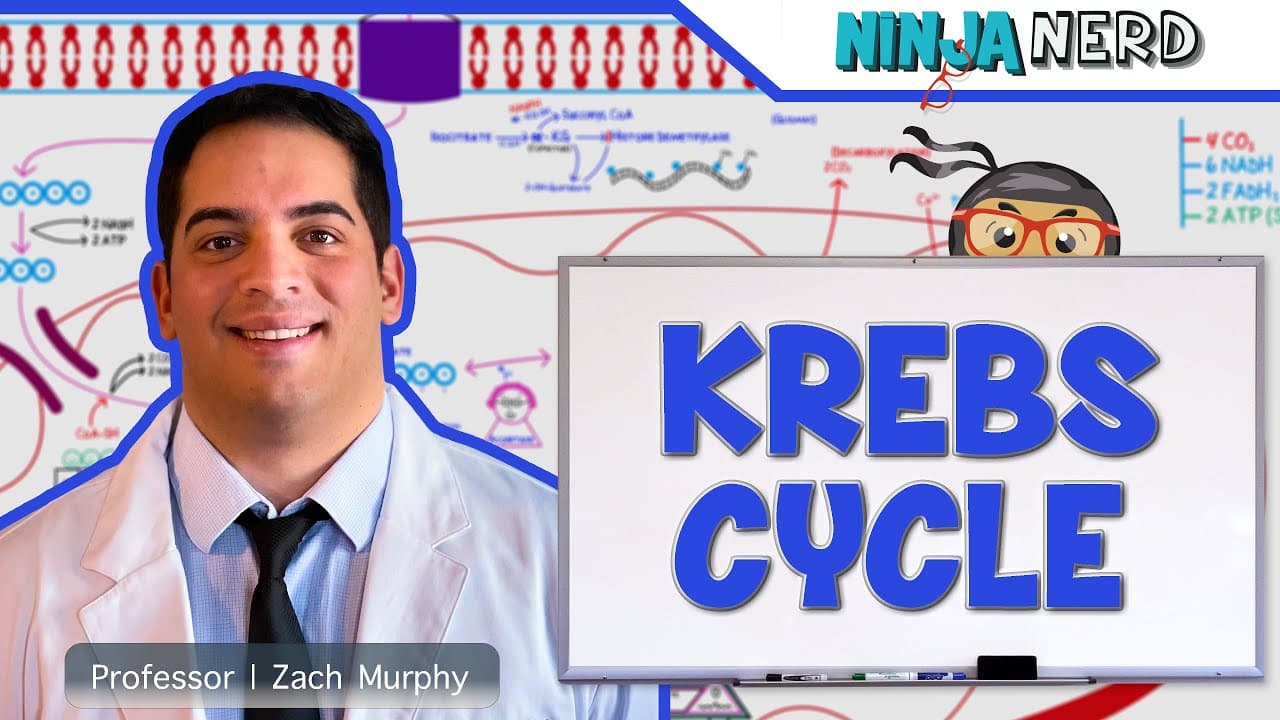
The Ninja Nerd Krebs cycle lesson explains how acetyl-CoA is oxidized to generate NADH, FADH₂, and GTP, which support ATP production. Acetyl-CoA combines with four-carbon oxaloacetate to form six-carbon citrate, then passes through eight enzymatic reactions that regenerate oxaloacetate. Read on for the intermediates, regulatory enzymes, energy signals, and mnemonic used to remember the pathway.
Transcript
All right, ninja nerds. In this video, we're going to talk about the KB cycle. So, you can also call it, you know, the triricaroxyic acid cycle. You can call it the citric acid cycle. So, there is other names for it. It was actually founded and developed by the guy named Hans Krebs. That's that's where it came from. Okay. So, now when we go through... Read More
Key Insights
- The Krebs cycle is the citric acid cycle or tricarboxylic acid cycle, and it functions as a central hub of aerobic metabolism by oxidizing acetyl-CoA and producing electron carriers that support ATP production.
- Acetyl-CoA enters the cycle by combining its two-carbon structure with four-carbon oxaloacetate, creating the six-carbon molecule citrate through a one-way reaction controlled by the highly regulated enzyme citrate synthase.
- Citrate synthase is inhibited by ATP, NADH, citrate, and succinyl-CoA because their accumulation indicates sufficient energy, abundant products, or excessive downstream intermediates that reduce the need for continued cycle activity.
- ADP is an allosteric stimulator of citrate synthase because its accumulation signals that ATP has been consumed and that the cell needs additional NADH and FADH₂ to support further ATP production.
- Aconitase converts citrate into isocitrate through a reversible isomerization reaction that rearranges the molecule without changing its six-carbon count, allowing excess isocitrate to be converted back into citrate.
- Fluoroacetate can be converted into fluorocitrate, which inhibits aconitase and prevents citrate from progressing to isocitrate, thereby disrupting the eventual generation of NADH, FADH₂, and ATP.
- Decarboxylation is the removal of a carbon in the form of carbon dioxide, and it occurs when six-carbon isocitrate becomes five-carbon alpha-ketoglutarate during the cycle.
- Krebs cycle intermediates have both catabolic and anabolic significance because alpha-ketoglutarate, succinyl-CoA, oxaloacetate, and citrate can contribute to amino acid, heme, and fatty acid synthesis.
Install to Summarize YouTube Videos and Get Transcripts
Explore YouTube Video Summarizer or Get YouTube Transcript Extractor
Questions & Answers
Q: What does the Ninja Nerd Krebs cycle lesson explain?
The lesson explains how acetyl-CoA enters the Krebs cycle and moves through a sequence of intermediates that regenerates oxaloacetate. The cycle produces NADH, FADH₂, and GTP, which support ATP production through the electron transport chain.
Q: What other names does Ninja Nerd give the Krebs cycle?
The Krebs cycle is also called the citric acid cycle and the tricarboxylic acid cycle. Its name comes from Hans Krebs, who is identified in the lesson as the person who founded and developed it.
Q: How does acetyl-CoA enter the Krebs cycle?
The two-carbon acetyl-CoA combines with four-carbon oxaloacetate. Citrate synthase catalyzes this fusion to produce the six-carbon molecule citrate in a one-way reaction.
Q: What are the main intermediates of the Krebs cycle?
The intermediates proceed through citrate, isocitrate, alpha-ketoglutarate, succinyl-CoA, succinate, fumarate, malate, and oxaloacetate. Regenerated oxaloacetate can then combine with another acetyl-CoA molecule to begin the cycle again.
Q: What mnemonic helps recall the Krebs cycle intermediates?
The lesson uses the mnemonic, “Citrate is Krebs’s starting substrate for making oxaloacetate.” Its major words correspond to citrate, isocitrate, alpha-ketoglutarate, succinyl-CoA, succinate, fumarate, malate, and oxaloacetate.
Q: How is citrate synthase regulated?
ATP, NADH, citrate, and succinyl-CoA inhibit citrate synthase. Their accumulation indicates abundant energy, excess product, or excessive downstream material, while ADP stimulates citrate synthase because it signals that ATP has been consumed.
Q: What does aconitase do in the Krebs cycle?
Aconitase converts citrate into isocitrate through a reversible isomerization reaction. Both molecules contain six carbons, so the reaction rearranges the molecule without changing its carbon count.
Q: Why is the Krebs cycle important beyond ATP production?
The cycle has both catabolic and anabolic functions. Its intermediates contribute to other pathways, with citrate supporting fatty acid synthesis and alpha-ketoglutarate, succinyl-CoA, and oxaloacetate contributing to amino acid and heme synthesis.
Summary & Key Takeaways
-
Acetyl-CoA enters the Krebs cycle by combining its two-carbon structure with four-carbon oxaloacetate, producing six-carbon citrate through citrate synthase. The pathway then progresses through citrate, isocitrate, alpha-ketoglutarate, succinyl-CoA, succinate, fumarate, malate, and regenerated oxaloacetate, allowing the cycle to begin again.
-
The cycle’s eight enzymatic reactions produce NADH, FADH₂, and GTP while oxidizing acetyl-CoA. These high-energy electron carriers supply the electron transport chain and contribute to ATP production. Carbon atoms are also removed as carbon dioxide during decarboxylation reactions, including the conversion of isocitrate into alpha-ketoglutarate.
-
Citrate synthase, isocitrate dehydrogenase, and alpha-ketoglutarate dehydrogenase are key regulatory enzymes. High ATP and NADH indicate abundant cellular energy and inhibit continued activity, while ADP indicates ATP depletion and stimulates the pathway. Krebs cycle intermediates also contribute to fatty acid, amino acid, and heme synthesis.
Read in Other Languages (beta)
Share This Summary 📚
Summarize YouTube Videos and Get Video Transcripts with 1-Click
Try YouTube Summary with ChatGPT & Claude or YouTube Transcript Generator
Explore More Summaries from Ninja Nerd 📚
Summarize YouTube Videos and Get Video Transcripts with 1-Click
Try YouTube Summary with ChatGPT & Claude or YouTube Transcript Generator