How Does Cortisol Regulate Stress and Metabolism?
TL;DR
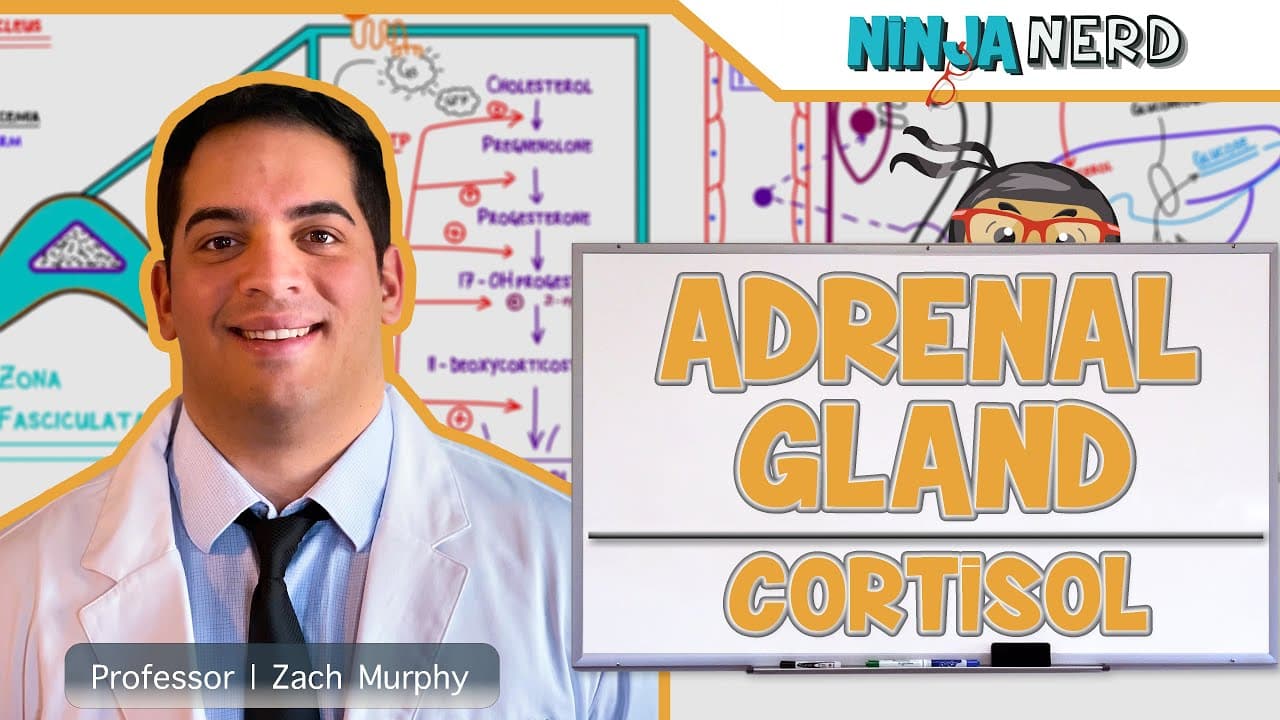
Cortisol is a steroid glucocorticoid produced by the adrenal cortex's zona fasciculata after the hypothalamic-pituitary-adrenal axis releases CRH and ACTH. It supports the stress response by promoting gluconeogenesis, protein catabolism, and lipolysis, while also suppressing inflammation and immune activity, maintaining vascular tone and catecholamine sensitivity, and influencing bone metabolism.
Transcript
All right, ninja nerds. In this video, we're going to continue our discussion about the adrenal gland. If you guys haven't already, go and watch the video on the adrenal gland where we talk about the zona glomemeillosa. Okay, in this video, we're going to focus on the zonaficulata. Okay, so zonapiculata is again this middle layer of the adrenal cor... Read More
Key Insights
- The zona fasciculata is the middle layer of the adrenal cortex and produces cortisol, the body's primary glucocorticoid hormone. Its position between the zona glomerulosa and zona reticularis corresponds to its distinct endocrine function in metabolism, immune modulation, and the physiological stress response.
- The hypothalamic-pituitary-adrenal axis is the regulatory pathway controlling cortisol secretion. Corticotropin-releasing hormone from the hypothalamus stimulates anterior pituitary corticotropes, which release adrenocorticotropic hormone into the blood to activate cortisol production in the zona fasciculata.
- ACTH signaling works through a G protein-coupled receptor and a stimulatory G protein. Receptor activation causes the G protein to bind GTP, activate adenylate cyclase, convert ATP into cyclic AMP, and stimulate protein kinase A inside the adrenal cortical cell.
- Cortisol synthesis begins with cholesterol rather than DNA, messenger RNA, or amino acids. Cholesterol is converted through pregnenolone, progesterone, 17-hydroxyprogesterone, and 11-deoxycortisol before becoming cortisol, demonstrating how steroid hormone production differs from protein hormone synthesis.
- The 21-hydroxylase enzyme catalyzes the conversion of 17-hydroxyprogesterone into 11-deoxycortisol. Protein kinase A promotes cortisol formation by phosphorylating enzymes throughout the steroid synthesis pathway, linking ACTH receptor activation directly to increased hormone production.
- Cortisol transport depends on carrier proteins because cortisol is lipid-soluble and cannot circulate primarily in free form. About 75% binds corticosteroid-binding globulin, also called transcortin, while about 25% binds albumin for transport through the bloodstream to multiple target organs.
- Cortisol stimulates protein catabolism in muscle, bone, and certain connective tissues. It enters target cells, binds intracellular receptors, changes gene expression, and promotes production of proteases that break proteins into amino acids, which enter the bloodstream and can subsequently be taken up by the liver.
- Cortisol coordinates metabolic, immune, cardiovascular, and skeletal responses to stress. It promotes gluconeogenesis, lipolysis, and protein catabolism, inhibits cytokine production and leukocyte migration, supports vascular tone and catecholamine sensitivity, and affects bone metabolism under physiological and clinical conditions.
Install to Summarize YouTube Videos and Get Transcripts
Explore YouTube Video Summarizer or Get YouTube Transcript Extractor
Questions & Answers
Q: How does the hypothalamic-pituitary-adrenal axis control cortisol?
The hypothalamic-pituitary-adrenal axis controls cortisol through a sequential hormonal pathway. The hypothalamic paraventricular nucleus releases corticotropin-releasing hormone into the hypophyseal portal system. CRH stimulates corticotropes in the anterior pituitary to secrete adrenocorticotropic hormone. ACTH enters the circulation and stimulates zona fasciculata cells in the adrenal cortex to synthesize and release cortisol. Cortisol then provides negative feedback to the hypothalamus and pituitary.
Q: Where is cortisol produced in the adrenal gland?
Cortisol is produced in the zona fasciculata, the middle of the adrenal cortex's three layers. The zona glomerulosa forms the outer cortical layer, the zona fasciculata lies beneath it, and the zona reticularis forms the deeper layer. Zona fasciculata cells respond to adrenocorticotropic hormone from the anterior pituitary and synthesize cortisol as their characteristic glucocorticoid hormone.
Q: How does ACTH stimulate cortisol synthesis?
ACTH binds a G protein-coupled receptor on the membrane of a zona fasciculata cell. This activates a stimulatory G protein by replacing GDP with GTP. The activated G protein stimulates adenylate cyclase, which converts ATP into cyclic AMP. Cyclic AMP activates protein kinase A, and this kinase phosphorylates enzymes that participate in the pathway converting cholesterol into cortisol.
Q: How is cortisol synthesized from cholesterol?
Cortisol synthesis starts with cholesterol, the basic precursor for steroid hormones. Cholesterol is converted into pregnenolone, which becomes progesterone. Progesterone is then converted into 17-hydroxyprogesterone, followed by 11-deoxycortisol and finally cortisol. Enzymes catalyze each reaction, while ACTH signaling through protein kinase A promotes the activity of enzymes involved throughout the synthesis pathway.
Q: What does 21-hydroxylase do during cortisol production?
The 21-hydroxylase enzyme catalyzes an important step in cortisol synthesis, converting 17-hydroxyprogesterone into 11-deoxycortisol. That product is subsequently converted into cortisol. The enzyme functions as part of a larger series of steroidogenic reactions beginning with cholesterol. Protein kinase A, activated downstream of ACTH, stimulates enzymes involved in these reactions and thereby promotes cortisol formation.
Q: How is cortisol transported through the bloodstream?
Cortisol requires transport proteins because it is a lipid-soluble steroid hormone and is not water-soluble. About 75% of circulating cortisol binds corticosteroid-binding globulin, which is also called transcortin. About 25% binds albumin. These proteins carry cortisol through the bloodstream, allowing it to reach multiple target organs where it can enter cells and activate intracellular receptors.
Q: What does cortisol do to proteins in muscle and bone?
Cortisol stimulates protein catabolism in muscle, bone, and certain connective tissues. As a steroid hormone, it crosses the cell membrane and binds an intracellular receptor, leading to gene transcription, messenger RNA formation, and protein production. Some newly produced proteins function as proteases, breaking peptide bonds and releasing amino acids into the bloodstream for uptake by the liver.
Q: What are cortisol's major effects during the stress response?
Cortisol supports the physiological stress response by coordinating actions across several organ systems. It promotes gluconeogenesis, lipolysis, and protein catabolism, making metabolic substrates available during stress. It also reduces inflammation and immune activity by inhibiting cytokine production and leukocyte migration. Additional effects include supporting vascular tone, increasing catecholamine sensitivity, and influencing bone metabolism during illness, infection, surgery, or other stress.
Summary & Key Takeaways
-
Cortisol production begins when the hypothalamic paraventricular nucleus releases corticotropin-releasing hormone into the hypophyseal portal system. CRH stimulates anterior pituitary corticotropes to release adrenocorticotropic hormone. ACTH then travels through the blood to the adrenal cortex, where it stimulates the zona fasciculata to synthesize and secrete cortisol.
-
ACTH activates a G protein-coupled receptor on zona fasciculata cells. The stimulatory G protein activates adenylate cyclase, which converts ATP into cyclic AMP and activates protein kinase A. Protein kinase A phosphorylates enzymes involved in converting cholesterol through several intermediates into cortisol, increasing steroid hormone synthesis.
-
Circulating cortisol binds mainly to corticosteroid-binding globulin, also called transcortin, while a smaller portion binds albumin. At target tissues, cortisol enters cells and activates intracellular receptors that regulate gene expression. Its systemic actions include gluconeogenesis, lipolysis, protein catabolism, immune suppression, reduced inflammation, vascular support, and altered bone metabolism.
Read in Other Languages (beta)
Share This Summary 📚
Summarize YouTube Videos and Get Video Transcripts with 1-Click
Try YouTube Summary with ChatGPT & Claude or YouTube Transcript Generator
Explore More Summaries from Ninja Nerd 📚





Summarize YouTube Videos and Get Video Transcripts with 1-Click
Try YouTube Summary with ChatGPT & Claude or YouTube Transcript Generator