Claude Fable 5 vs Opus 4.8 for One-Shot Apps
TL;DR
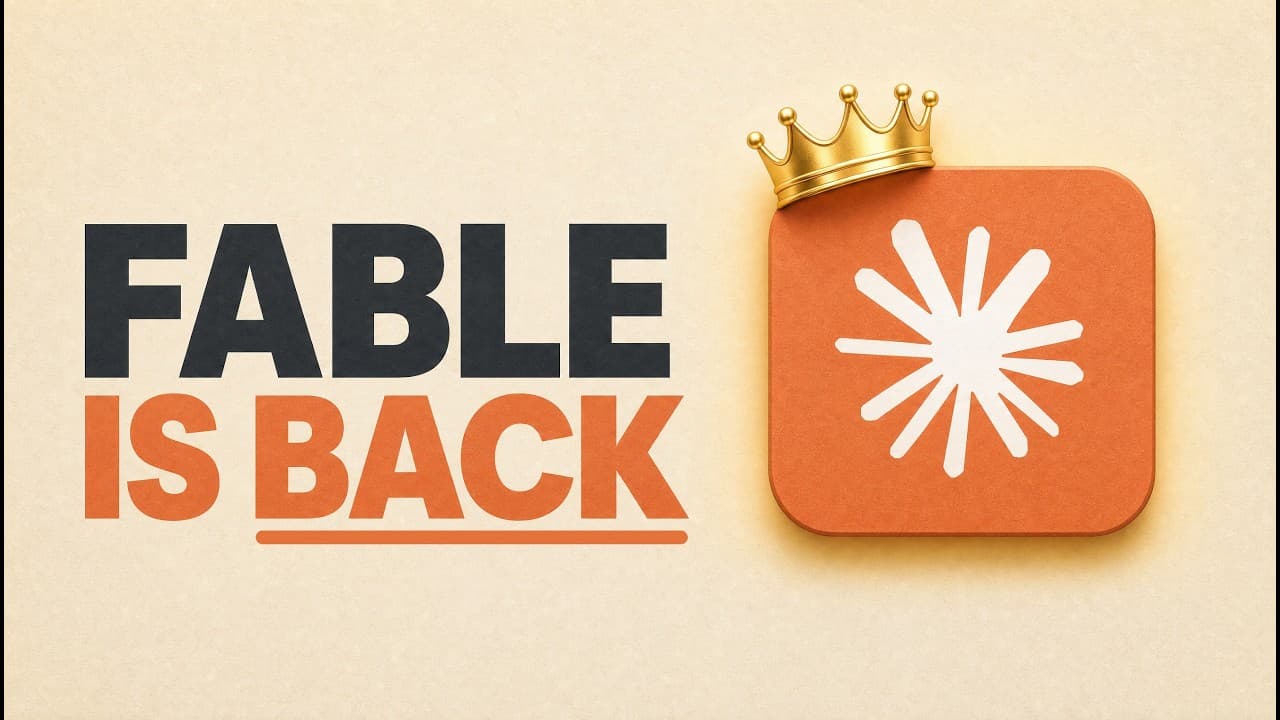
Claude Fable 5 completed the health dashboard build while Opus 4.8 encountered errors during the same-prompt comparison. The workflow combined a generated design system, a detailed project requirements document, explicit success criteria, and a repeating /goal process that checked the output and continued working when requirements were not satisfied.
Transcript
Ladies and gentlemen, Fable 5 is back online and in this video we are going to be building an application using Fable 5 and comparing it to Anthropic's other models. We're going to be using the same prompts up against each other, comparing the results, and by the end of this video, you'll have a good idea on the capabilities of Fable 5 across all t... Read More
Key Insights
- Fable 5 is evaluated through a complex application connected to real health and habit data, rather than a small demonstration. The planned dashboard includes sleep information from a ring API, goal tracking, editable documents, a calendar, habit controls, and a database-backed interface.
- A design system is created before application development so visual decisions can be separated from backend wiring and API work. The exported project archive contains the selected colors, images, interface inspiration, and animations needed to guide implementation in Claude Code.
- The Molten direction is selected from three generated styles called Mission Control, Molten, and Signal. Its resulting guide covers color, typography, liquid-glass styling, shapes, spacing, component treatments, status pills, and progress rings for the health dashboard.
- Domain-specific language improves the usefulness of the generated design because the prompt can name relevant interface elements and desired behavior. The example requests Aura Ring statistics, progress displays, a dark document editor, calendar views, goal tracking, and consistency indicators.
- The SPAR framework produces a detailed project requirements document by having Claude interview the user about concrete deliverables. The user answers extensive questions, and the resulting prompt includes the information and success criteria needed for Claude to code the application.
- The /goal process works as an iterative agent loop that attempts the assigned goal, evaluates whether the output matches defined success criteria, supplies feedback when requirements remain unmet, and restarts the work until the stated goal is completed.
- The model comparison uses separate directories and the same application prompt for Fable 5 and Opus 4.8. This setup is intended to make differences in implementation, testing, completion, errors, and final application quality easier to observe.
- Fable 5 completes and tests its application before receiving an additional editing pass, while Opus 4.8 encounters errors and struggles during its build. The chapter sequence then reviews both applications, including the updated Fable 5 result and the eventual Opus 4.8 result.
- More videos from this channel:
- More from this channel: AI Foundations
Install to Summarize YouTube Videos and Get Transcripts
Explore YouTube Video Summarizer or Get YouTube Transcript Extractor
Questions & Answers
Q: How did Fable 5 compare with Opus 4.8 for app building?
Fable 5 completed and tested the requested application, then handled a further editing pass that produced an updated version. Opus 4.8 received the same prompt in a separate directory but encountered errors and struggled during its build. The comparison concludes by reviewing both results, although the supplied transcript does not provide a detailed feature-by-feature scorecard.
Q: How was the health dashboard designed before coding began?
The creator first described a personal operating system called Drake OS in Claude Design. The request covered health statistics, habits, goals, documents, calendar functionality, liquid-glass styling, and distinctive typography. Fable 5 proposed Mission Control, Molten, and Signal directions. Molten was selected and expanded into a branding guide and layouts for the other requested pages.
Q: What features were planned for the Drake OS application?
Drake OS was planned as a personal dashboard for health, habits, and broader life management. Requested features included sleep and other Aura Ring statistics, stat cards, goal tracking, consistency displays, an editable dark document system resembling the creator's Google Docs workflow, a calendar, clickable controls, habit tracking, a database, and the possibility of later becoming an iOS application.
Q: Why create a design system before building the application?
Creating the design system first separates interface planning from backend implementation, database work, and API wiring. In the demonstrated workflow, Fable 5 defines colors, typography, glass effects, spacing, shapes, components, page layouts, images, and animations. That complete project archive can then be handed to Claude Code so the build starts with a consistent visual direction.
Q: What is the /goal workflow used with Fable 5?
The /goal workflow turns the build into a repeating process tied to explicit success criteria. Fable 5 attempts the goal and produces an output, while a secondary agent checks whether that output matches the defined goal. If the criteria are not satisfied, feedback explains what remains incomplete, and the process restarts until the stated requirements are completed.
Q: How was the project requirements document created?
The project requirements document was created with an interview-style template from the SPAR framework. Claude asked questions about the concrete things that should exist when the work was finished, and the creator supplied detailed answers about the application. Those responses became a large copy-and-paste /goal prompt containing the project scope and measurable success criteria for the coding task.
Q: How was the Fable 5 versus Opus 4.8 test structured?
The creator prepared the design system and a detailed shared prompt, then planned two separate directories in Claude Code. Fable 5 and Opus 4.8 were given the same application task at the same time. The comparison followed their build behavior, model differences, testing, completion, errors, editing, and final applications, providing a common task rather than unrelated demonstrations.
Q: What design deliverables did Fable 5 generate?
Fable 5 first generated three style concepts, then expanded the chosen Molten direction into a full branding guide. The deliverables covered color, typography, liquid-glass styling, shaping, spacing, status pills, progress rings, and other components. It also created layouts for the document editor, calendar, goals page, and consistency tracking, followed by an exportable project archive with assets and animations.
Summary & Key Takeaways
-
The comparison begins by using Fable 5 in Claude Design to plan Drake OS, a personal dashboard for health, habits, goals, documents, and calendar information. After an ideation exchange, the model produces three visual directions, Mission Control, Molten, and Signal, with Molten selected for the complete branding guide.
-
The resulting design system defines color, typography, glass styling, shapes, spacing, status pills, progress rings, page layouts, assets, and animations. It is exported as a project archive for use in Claude Code, allowing the later coding process to begin with an established interface direction instead of designing and implementing simultaneously.
-
A detailed project brief and success criteria are created through an interview-style prompt before Fable 5 and Opus 4.8 receive the same application task. The described outcome shows Fable 5 testing, completing, reviewing, and revising its application, while Opus 4.8 encounters errors and struggles before its result is reviewed.
Read in Other Languages (beta)
Share This Summary 📚
Summarize YouTube Videos and Get Video Transcripts with 1-Click
Try YouTube Summary with ChatGPT & Claude or YouTube Transcript Generator
Explore More Summaries from AI Foundations 📚

Summarize YouTube Videos and Get Video Transcripts with 1-Click
Try YouTube Summary with ChatGPT & Claude or YouTube Transcript Generator