How to Build AI Agents with n8n in 2025
TL;DR
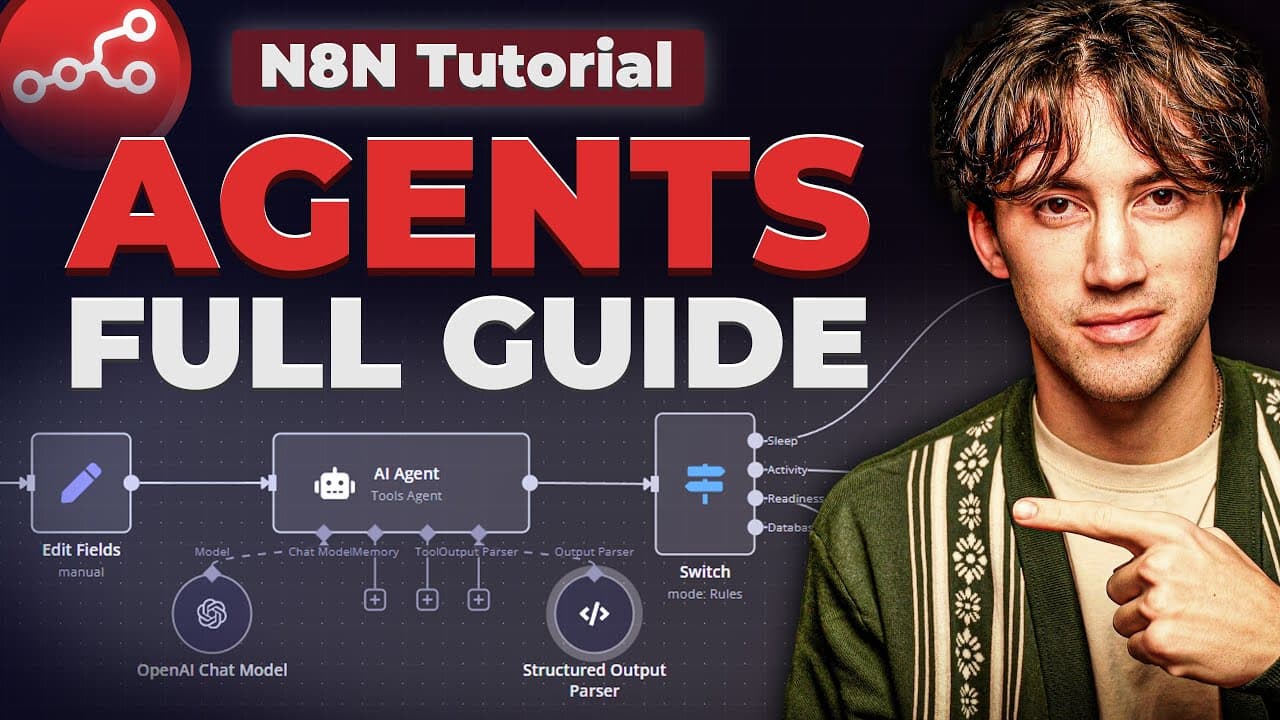
Create AI agents using n8n by combining workflows and dynamic decision-making capabilities. This tutorial covers key features like memory integration and tool usage, enabling your agents to interact with data more intelligently.
Transcript
today I'm going to teach you how to build AI Agents from start to finish in N we're going to start with the basics and then work our way up to some of the more Advanced Techniques before we start jumping in and learning how to build this we need to understand what it is and why it's important first so what are agentic system... Read More
Key Insights
- Agentic systems are comprised of agents and workflows, where workflows are predefined automations and agents dynamically decide the necessary tools and outputs.
- The n8n platform allows users to create workflows and agents using various node types, each serving different functions like triggering actions, performing tasks, or running code.
- Nodes in n8n are categorized into triggers, actions, utilities, code, and advanced AI agent nodes, each facilitating different aspects of workflow automation.
- AI agents in n8n can be enhanced with memory to maintain context across interactions, enabling more coherent and context-aware conversations.
- The integration of tools like Airtable allows AI agents to access and manipulate external data, expanding their functionality beyond simple chat interactions.
- Using the 'fromAI' expression, n8n can dynamically map data into workflow fields, allowing AI to autonomously determine and input necessary information.
- Sub-agents can be nested within main agents, allowing complex workflows to call other workflows and share data dynamically, enhancing the ecosystem's capabilities.
- Joining the AI Foundations community provides access to courses, live calls, and a network of like-minded individuals to further develop skills in building AI agents.
Install to Summarize YouTube Videos and Get Transcripts
Explore YouTube Video Summarizer or Get YouTube Transcript Extractor
Questions & Answers
Q: What are agentic systems in n8n?
Agentic systems in n8n are environments composed of agents and workflows. Workflows are automations with predefined outputs, while agents use large language models to dynamically decide which tools and outputs are necessary based on the input. This allows for more flexible and responsive automation processes.
Q: How does n8n categorize its nodes?
n8n categorizes its nodes into five main types: triggers, which start automations; actions, which perform tasks within apps or services; utilities, which transform data; code, which allows running scripts and making HTTP requests; and advanced AI agent nodes, which enable autonomous decision-making and complex interactions.
Q: What is the purpose of adding memory to AI agents in n8n?
Adding memory to AI agents in n8n allows them to maintain context across multiple interactions. This means the agent can remember previous conversations and use that information to provide more coherent and context-aware responses, enhancing the overall user experience and making the agent more effective in its tasks.
Q: How can AI agents in n8n interact with external data sources like Airtable?
AI agents in n8n can interact with external data sources like Airtable by integrating tools within the workflow. This integration allows the agent to access, search, and update records in the Airtable database, enabling it to provide information and perform actions based on real-time data stored externally.
Q: What is the 'fromAI' expression in n8n?
The 'fromAI' expression in n8n is a feature that allows users to dynamically map data into workflow fields by asking AI to fill in the necessary information based on the chat or input. This expression helps automate the process of determining and inputting data, making workflows more efficient and responsive.
Q: How do sub-agents enhance the functionality of AI agents in n8n?
Sub-agents enhance the functionality of AI agents in n8n by allowing complex workflows to call other workflows and share data dynamically. This nesting capability means that a main agent can delegate tasks to sub-agents, each equipped with specific tools and instructions, thereby creating a more powerful and flexible ecosystem.
Q: What benefits does the AI Foundations community offer?
The AI Foundations community offers numerous benefits, including access to comprehensive courses on building AI agents, live calls for real-time learning and interaction, and a network of like-minded individuals. This community provides a collaborative environment where members can share insights, learn from each other, and stay updated with the latest advancements in AI automation.
Q: How does n8n facilitate the creation of workflows and AI agents?
n8n facilitates the creation of workflows and AI agents by providing an intuitive interface with various node types that users can drag and drop to build complex automations. With features like memory addition, 'fromAI' expressions, and tool integrations, users can create sophisticated, context-aware agents capable of interacting with external data sources and performing dynamic tasks.
Summary & Key Takeaways
-
The tutorial introduces agentic systems, explaining the difference between workflows and agents, and how they function within n8n to automate tasks dynamically.
-
n8n's interface and node types are discussed, showing how to create workflows and integrate AI agents with tools like Airtable for enhanced data handling capabilities.
-
Advanced features such as memory addition, 'fromAI' expressions, and sub-agent creation are explored, demonstrating how to build complex, context-aware AI systems.
Read in Other Languages (beta)
Share This Summary 📚
Summarize YouTube Videos and Get Video Transcripts with 1-Click
Try YouTube Summary with ChatGPT & Claude or YouTube Transcript Generator
Explore More Summaries from AI Foundations 📚

Summarize YouTube Videos and Get Video Transcripts with 1-Click
Try YouTube Summary with ChatGPT & Claude or YouTube Transcript Generator